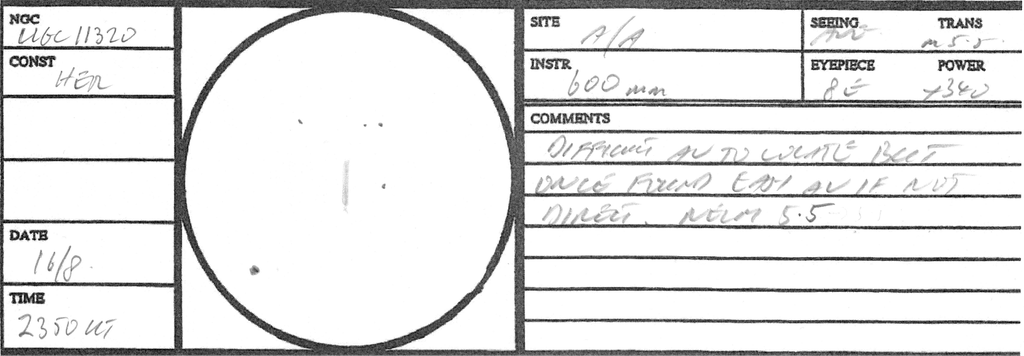
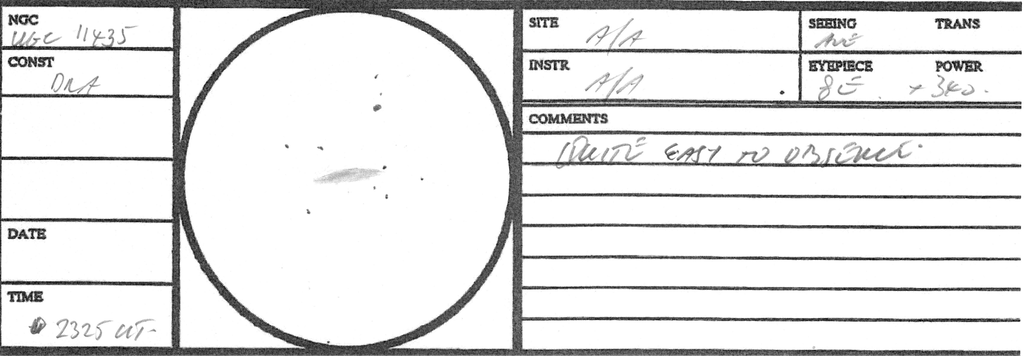
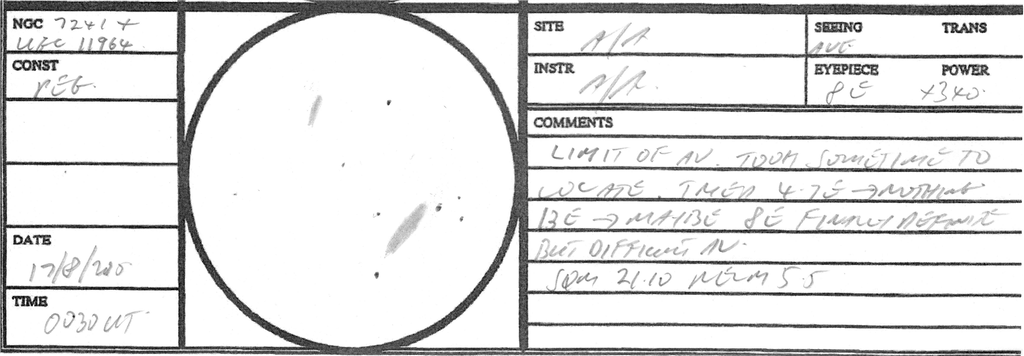
These are our observations in Draco
-
The Spindle Galaxy (M 102) in Draco
The Spindle Galaxy was discovered by Pierre Méchain on 27th March 1781. Méchain described the object as a
nebula between the stars Omicron Boötis & Iota Draconis,
adding thatit is very faint; near it is a star of the sixth magnitude.
Méchain probably meant Theta Boötis, not Omicron, which contributed to the subsequent confusion around the identity of M 102. Omicron Boötis is more than 40 degrees away from Iota Draconis, which makes the possibility of an error very likely. Méchain reported the discovery to Messier, who added the object to his catalogue.The confusion about the object started two years later, in May 1783, when Méchain wrote to Bernoulli in Berlin saying that the listing of M 102 was a mistake and that the object referred to was a duplicate observation of M 101. One can imagine that M 102 could not be found due to the error in the original observation notes.
It was the French astronomer Camille Flammarion who identified NGC 5866 as M 102 in his “List of the Messier Objects,” published in L’Astronomie in November 1917, arguing that the Greek letter Omicron (ο), written down by Messier, was in fact a lowercase Theta (θ). This was probably correct because the object found at this location corresponds to Messier’s description of M 102.
The Spindle Galaxy was independently discovered by William Herschel in 1788. Herschel determined the position of the object on May 5, 1788, describing it as
very bright. Considerably large. Extended. Following [east of] 2 stars.
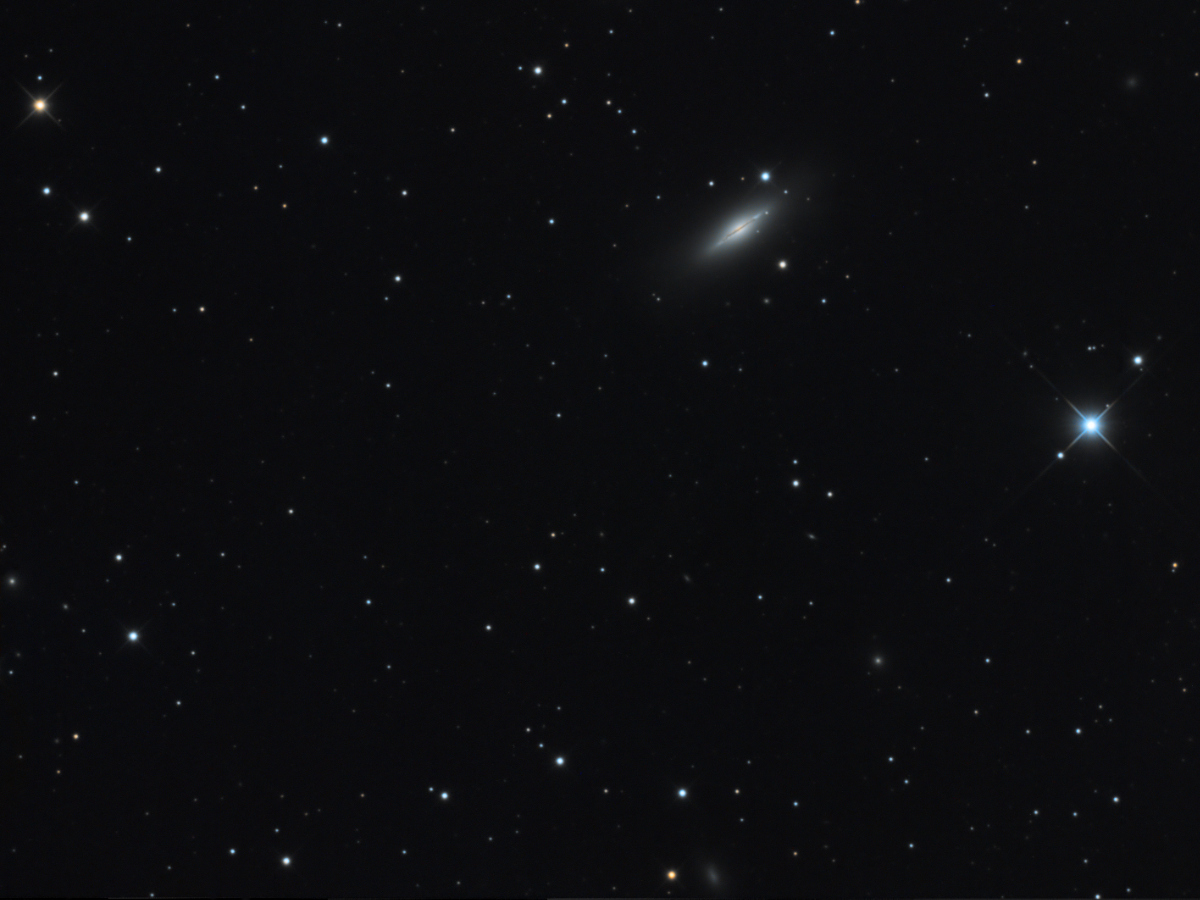
M 102 is a spindle-type galaxy, seen edge-on and around 41 million light years distant. It is magnitude 10.7 and 6 x 3 arc minutes in extent. There are many faint galaxies in this image including mag 14.9, NGC 5826, at bottom centre and mag 16.2, PGC166188 towards top-right.
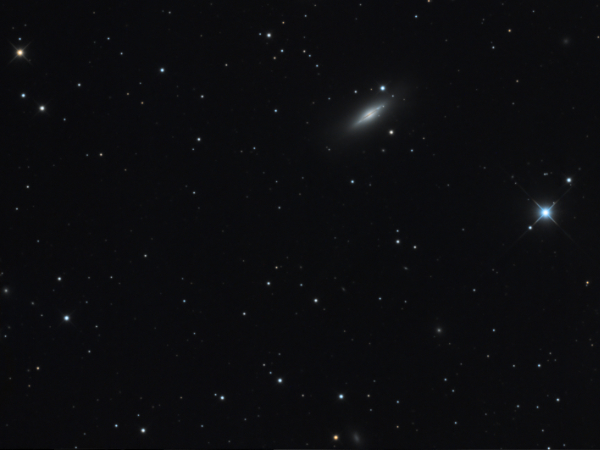
This image of M 102 (NGC 5866) was provided by David Davies and taken from Cambridge in the UK. To see more of David's work please visit his Flickr Photostream. Click on the image for the larger version. I find the image to be particularly pleasing as I seem to have captured the pearly white glow of the halo around the galaxy, the warp at the eastern (right) edge of the dust lane, something of the blue glow of star-forming regions at the western edge of the dust lane and the orange glow of old stars in the core. This cropped image shows more detail.
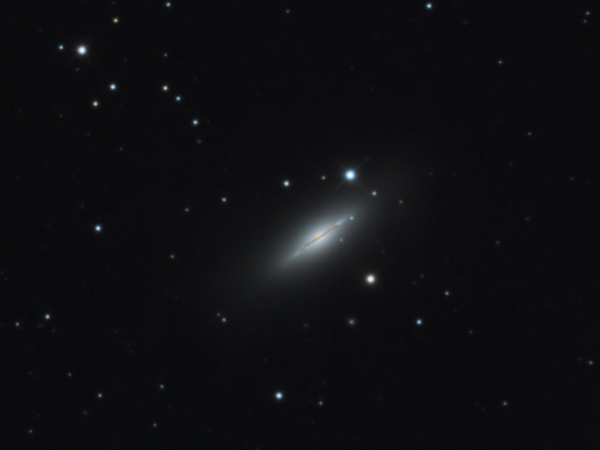
A close-up of M 102 (NGC 5866) provided by David Davies. Image Details
- Telescope: 8" Ritchey-Chretien at 1660mm focal length.
- Camera: QSI 583 with Astrodon filters.
- Mount: Skywatcher EQ8.
Data for this image were captured between 27th May and 17th June - yes on the shortest nights and with a waxing Moon. The data comprises 23 x five-minutes luminance and seven each of five-minutes RGB subs, all binned 1 x 1.The main image is 30 minutes each of RGB in two-minute subs.
David Davies - (21 June 2019).
-
Draco Doubles
I enjoy observing doubles in the summer months – sitting in the warmth, a gentle breeze and around midnight the Milky Way arching across the sky. Then before I know it this band of stars begins to fade as the sky lightens in the NE at 2 am.
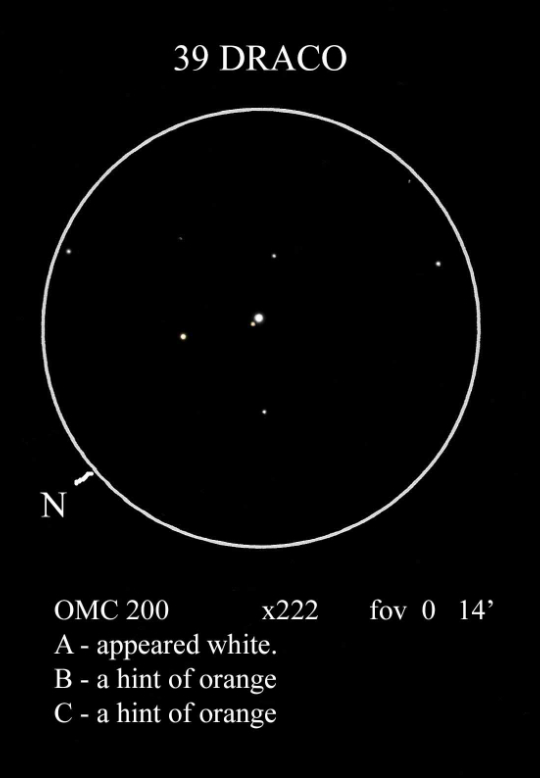
Double of the month led me on a delightful adventure in Draco for two hours on July 10th using my OMC 200 mounted on an Ioptron MiniTower. 39 Draco is a lovely sight with component A shining white and bright. Its companion contrasts in magnitude and on this occasion I felt it had a hint of orange. On a previous occasion I felt it had a hint of blue. Component C makes a lovely addition to the pair and for me it too had a hint of orange. Deciding on star colour for me is often a hit and miss affair.
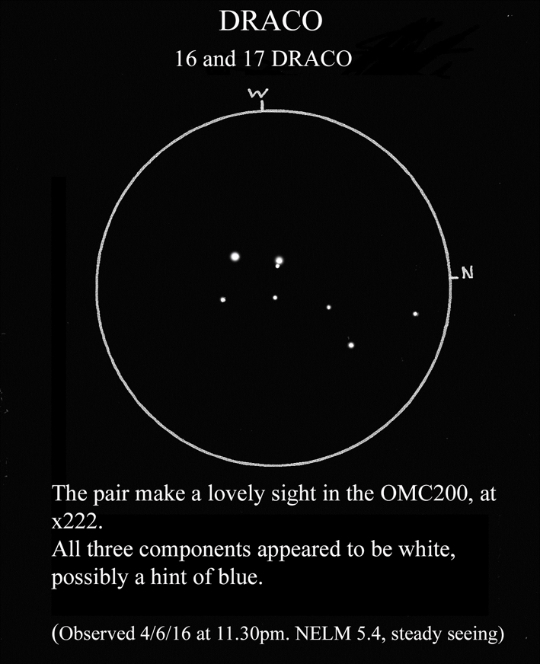
Back in June I enjoyed observing 16/17 Draco and after 39 Dra I revisited it – a delightful sight. For the first time ever I located Epsilon Draco – a real stunner of a double because of its contrast in magnitude and colour. Observing for two hours until just after 2 am was immensely rewarding. As the sky lightened it was hard to stop observing for conditions were so good and I was enjoying so many lovely doubles in Draco, including splitting doubles at 0.9” separation. I must revisit Draco in the near future.
Thanks once again to the Webb Society for sparking a great night out under the stars.
Mike Wood - 13 July 2016
-
Supernova SN2016coj in Draco
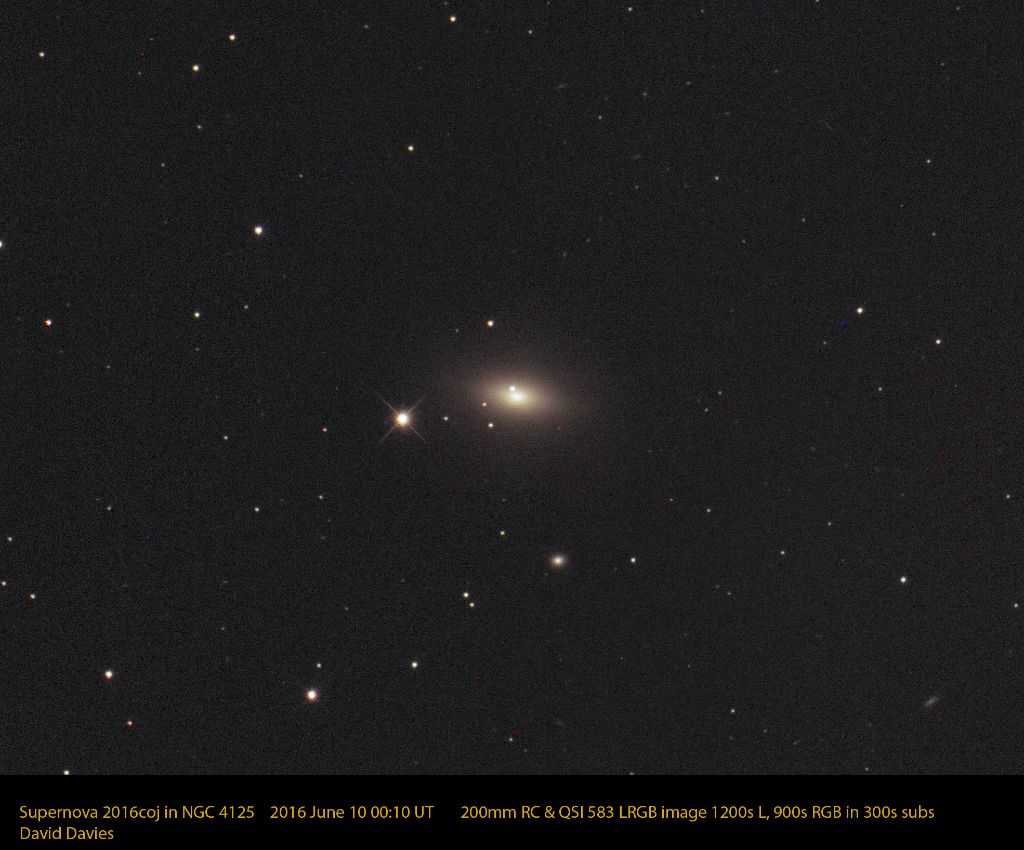
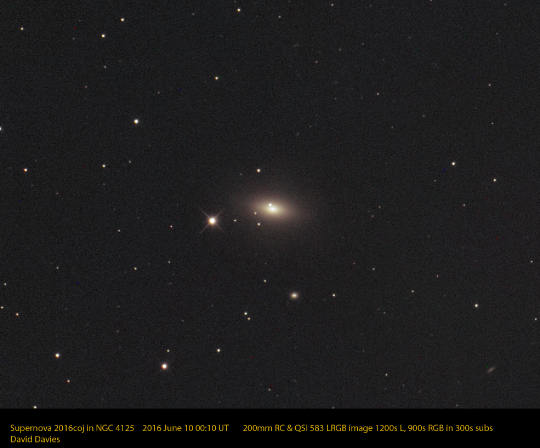 Image Courtesy of David Davies, Cambridge, UK.
I learned about this supernova from The Webb Deep-Sky Society and decided to have a look for it last night despite the high thin cloud.
I read that this supernova has taken place in NGC 4125, a very elongated elliptical galaxy of type E6, which is located about 70 million light years away and is approximately magnitude 10 in the constellation Draco, just above the ring of the Big Dipper. The supernova itself is a type 1a and is around magnitude 14. You can see it in this image just above the galactic centre.
Calculations show that this supernova currently has an absolute magnitude of -17.5, equivalent to a billion suns, which can give us an idea of the spectacular nature of this phenomenon. If this supernova occurred at the distance of Sirius, its apparent magnitude would be -24.5, and would be easily visible in broad daylight and approaching the brightness of our sun, which has a magnitude of -26.
The Image
20 minutes luminance and 15 minutes each of RGB data in 5-minute subs; The image is a crop at 22 x 17 arc minutes at .68 arcsec per pixel.
Equipment
- Telescope
- 8-inch Ritchey Chretien at f/8.
- Camera
- QSI 583 plus Astrodon RGB filters and Lodestar guider.
- Mount
- Modified Skywatcher NEQ6
- Software
- Scopefocus; PHD2: EQMOD; Carte du Ciel; Deep Sky Stacker, PixInsight; Photoshop CC2015
David Davies - (10 June 2016).
-
16 and 17 Draconis
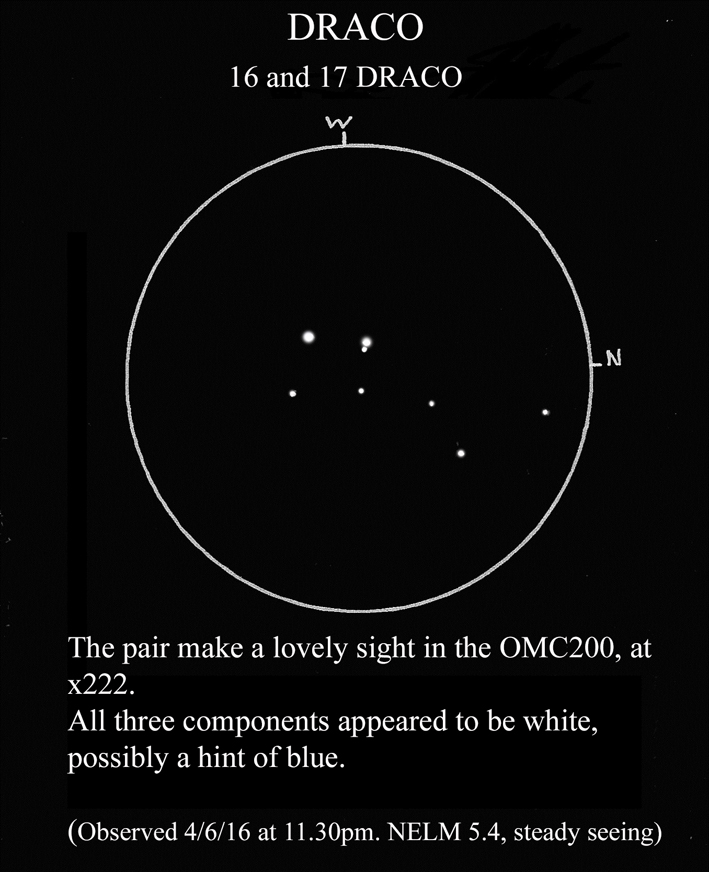
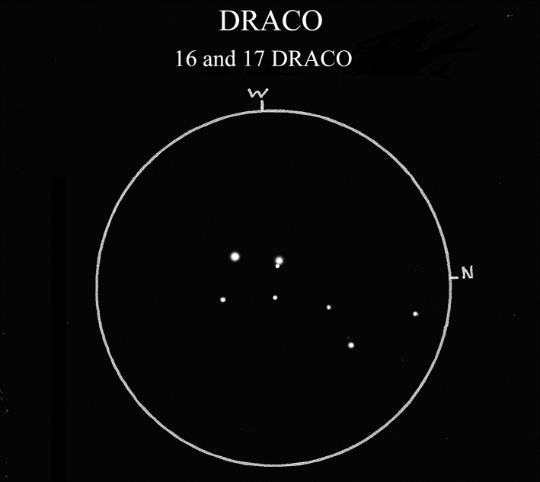
The double of the month for June 2016 – 16 and 17 Draconis observed on 4th June 2016 at 11:30pm BST under steady NELM 5.4 skies.
The pair make a lovely sight in the OMC200, at x222. All three components appear to be white, possibly a hint of blue.
Mike Wood - 4 June 2016
-
Flat Galaxies Hunt
Got out shortly after 10pm on Sunday night and went until 3am!
My skies were reasonable but not the best. I was getting SQM of 21.0 and NELM of 5.5 but they were very damp skies and I suspected them to be going ‘off’ later on in the observing session.
I had no lists planned so decided to go ‘Flat’ galaxy hunting using the Webb Society's latest Flat Galaxy publication, courtesy of Alvin Huey. I always find thin edge on galaxies more difficult than their quoted magnitude. For example UGC 3696, the integral sign galaxy is quoted at mag 13.5 but difficult enough in a 16” scope from a good sky. For tonight I was using my 600mm driven Dobsonian with Argo-Navis.
Anyway, started off with NGC 5777 in Draco. Quite easy with 8mm Ethos (x340); suspected UGC 9570 in same FOV but couldn’t be certain – need a better sky. Just left the 8mm (x340) in for the rest and the Argo-Navis and ServoCat ‘found’ them ☺.
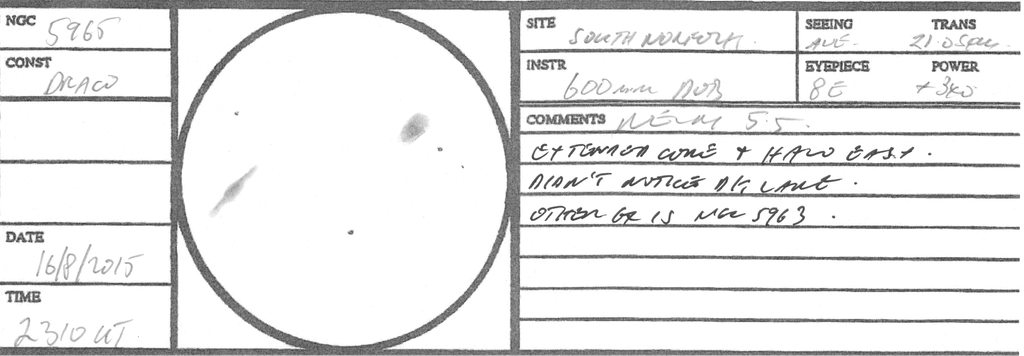
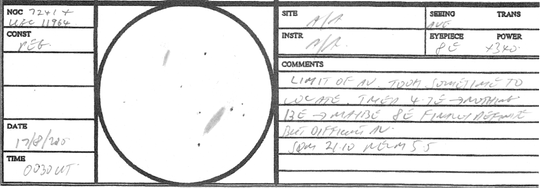
Then the rest as per the attached sketches (click on them for a better view.)
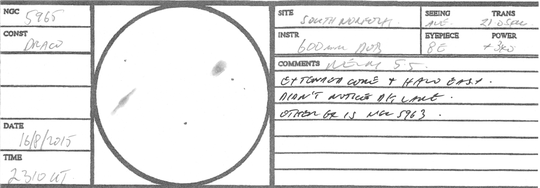
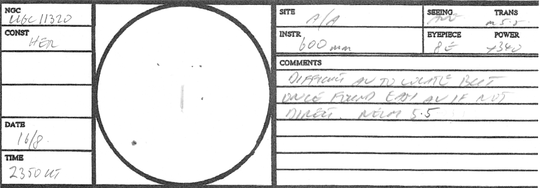
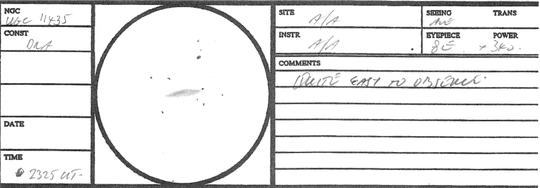
The only one I really struggled with was UGC 11964 near NGC 7241 in Pegasus. It was the only one where I had to hunt down the correct field stars, tried 13E, 8E and 4.7E. Nearly gave up but in the end confirmed it with the 8mm Ethos - but the sky was getting damper by now (0130 BST) although I was still getting 21.0 SQM but then I have had 21.35 from this location.
I then tried for a couple of exotic PN’s but failed – a better night maybe?
Very enjoyable session.
Andrew Robertson - 22 August 2015