Galaxy of the Month in Leo Minor
-
NGC 3158 in Leo Minor
April 2026 - Galaxy of the Month

This interactive image of the galaxies surrounding NGC 3158 in Leo Minor was provided by the Sloan Digital Sky Survey (SDSS) using Aladin Sky Atlas. We also have a finder chart should help you locate these galaxies, as will this link for NGC 3158 on the Stellarium Web planetarium. I have chosen the small group of galaxies around NGC 3158 in Leo Minor for this GOM.
NGC 3158 itself was discovered by William Herschel in 1787 along with NGC 3163. The rest of the galaxies in the group were discovered either by Bigourdan in 1886 (NGC 3150, NGC 3151, NGC 3159) using a 12” refractor or by Mitchell (NGC 3152, NGC 3160) using the 72” at Birr. The whole group containing about 8 galaxies included in the NGC is also known as WBL 258 or the NGC 3158 group.
NGC 3158 itself is a giant elliptical with a classification of E3. It is the brightest cluster galaxy (BCG) for the group. NGC 3158 appears to form a non interacting pair with NGC 3160. If the distance is correct then NGC 3158 has a diameter of about 183,000 light-years, so considerably larger than our Milky Way galaxy. However there are suggestions it could be as large as 230,000 light-years in diameter. It is also a radio galaxy, but interestingly for a radio galaxy, it does not appear to have an AGN.
The NASA/IPAC Extragalactic Database (NED) suggests that the total number of galaxies in the cluster is about 30, although many are faint dwarves. The distance to the group is about 84 Mpc.
UV images from GALEX suggest there is not much star forming activity in the group, although the centre of NGC 3158 does show up, possibly from a low level AGN. The majority of the galaxies in the group appear to be early type galaxies although NGC 3160 is an edge on spiral. NGC 3159 is a peculiar galaxy with a faint plume of stars, possibly from an interaction with NGC 3158. In 2018 a type Ia supernova (SN 2018aaz) was seen in NGC 3018.
There is more information on the group at Rick Johnson's Mantrap Skies Catalog website.
The whole of the WBL 258 group is pretty compact and all of them will fit in the field of view of a medium power (say 265x) hyperwide field eyepiece. There is a nice amateur image of the group by Dan Crowson on Flickr. Steve Gottlieb suggests that NGC 3158 will require a 13” to see well. The others in the group may require 45cm or so to find and even then they maybe faint.
For those doing EAA then there is also the group Shakhbazian 49 in the same area but the galaxies in this group are very faint, around 16th magnitude, so probably out of the visual range of all but the very largest telescopes, although Alvin Huey does include it in his Shakhbazian group guide available at www.faintfuzzies.com. You may see suggestions in the internet that the NGC 3158 group and Shak 49 are the same. They are not.
Owen Brazell - Galaxy Section Director
If you'd like to try out the Clear Skies Observing Guides (CSOG), you can download observing guide for the current Galaxy of the Month without the need to register. CSOG are not associated with the Webb Deep-Sky Society but the work of Victor van Wulfen.
A Postscript
When this article arrived in my email inbox with a brief note from Owen I never thought that it would be his last Galaxy of the Month. Yet three days later Owen Brazell died, on the 16th of March 2026, in a road traffic accident on his way to Kelling Health Star Party.
As our current President, Galaxies Director and DSO Editor he leaves a huge gap in the Webb Deep-Sky Society to which he's dedicated an enormous amount of time and effort over many years.
James Whinfrey - Website Administrator
-
NGC 3414 in Leo Minor
January 2024 - Galaxy of the Month

This interactive image of the NGC 3414 and was provided by the Sloan Digital Sky Survey (SDSS) using Aladin Sky Atlas. We also have a finder chart should help you locate these galaxies, as will this link for NGC 3414 on the Stellarium Web planetarium. Our galaxy this month is the lenticular galaxy NGC 3414 in Leo Minor. First discovered by William Herschel in 1785 it is the central galaxy of the rich galaxy group known as the NGC 3504 group, which in turn is also part of the Leo II group, a series of clusters on the edge of the Virgo cluster. The group is also catalogued as LGG 227, a cluster of 9 galaxies. For more information on the Leo II group see An Atlas of the Universe.
NGC 3414 is also known as Arp 162 and has a weak AGN of the LINER type. The Arp listing also includes NGC 3418, another nearby lenticular galaxy, although recent classifications suggest that this is a spiral galaxy. Interestingly the gas flows in NGC 3414 appear to follow a spiral pattern, however the gas in the inner part rotates in a different direction for the outer part. Deeper images also show signs of shells so all of this could be due to a recent merger. NGC 3414 also has a very strong bar in images.
NGC 3414 lies at a distance of perhaps 23 Mpc and NGC 3418 lies perhaps 800,000 lyrs from NGC 3414. If NGC 3414 is at this distance, then it is perhaps 40,000 light-years across, perhaps half the size of our Milky Way Galaxy. NGC 3414 is classified as S0pec.
It is probable that UGC 5958, a nearby edge on galaxy, is also associated with NGC 3414. Observations in the UV part of the spectrum with the GALEX satellite shows the bright core of NGC 3414 but also shows active regions in both NGC 3418 and UGC 5958 suggesting the galaxies are interacting. There also appear to be a number of dwarf spheroidal galaxies associated with NGC 3414, although these are far beyond amateur visual observations.
NGC 3414 is bright enough to make it into the Herschel 400 list of the Astronomical League. Observations from the UK suggest that NGC 3414 can be seen in 20cm but NGC 3418 is tough in a 40cm., however other observations suggest that NGC 3418 is visible in 30cm under very dark skies, although the quality of the site here was not defined. The The Night Sky Observer's Guide (NSOG) Vol. 2 suggests that 20-25cm telescopes will show NGC 3418 as a bright core but that 30-35cm is needed to show NGC 3818. Luginbuhl and Skiff (L&S) suggest that 25cm is needed to show NGC 3414 clearly and again it shows a bright core.
Owen Brazell - Galaxy Section Director
-
NGC 3432 in Leo Minor
April 2023 - Galaxy of the Month
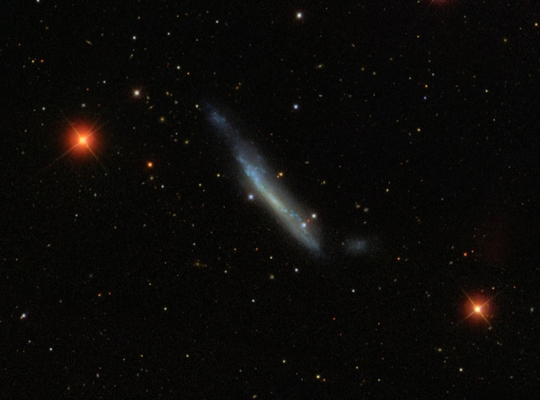
This interactive image of the NGC 3432 and was provided by the Sloan Digital Sky Survey (SDSS) using Aladin Sky Atlas. We also have a finder chart should help you locate these galaxies, as will this link for NGC 3432 on the Stellarium Web planetarium. As we move into the brighter spring skies, I have stayed in the constellation of Leo Minor for this month’s GOM.
NGC 3432 was first discovered by William Herschel in 1785 and was included by Halton Arp in his atlas of peculiar galaxies as Arp 206. It was also added as VV11 in Vorontsov-Velyaminov’s catalogue.
NGC 3432 appears to be a barred spiral galaxy seen edge-on and is interacting with its neighbour the dwarf galaxy UGC 5983. This interaction appears to be causing intense star formation in NGC 3432 as well as filaments between them. The GALEX satellite image in the UV shows that star formation is occurring throughout the galaxy. Due to the amount of dust the core of the galaxy is not well seen.
Interestingly despite all the star formation going on NGC 3242 is not classified as a starburst galaxy. This maybe because the number of really massive stars being formed is not that high yet. It is suggested that the interaction with UGC 5983 took place very recently, say less than 400 million years ago and that is not enough for a full starburst to get going, in fact the star formation rate is unusually low at the moment. It appears that both ends of NGC 3432 are strongly warped from the gravitational attraction.
The pair is thought to lie about 30 million light-years from us. NGC 3432 was home to an unusual transient event catalogued as SN 2000ch, initially catalogued as a type II supernova it was later shown to be an LBV like Eta Car as it underwent numerous brightening events.
There is a Hubble image on NASA's website, although a more normal coloured image by the HST can be seen on NGC 3432’s Wikipedia page.
Interestingly the interaction does not appear to have sparked that much star formation in UGC 5983. There is an odd condensation though in NGC 3432 off to its northern end. At about 55,000 light-years across NGC 3432 is a relatively small galaxy. UGC 5983 is only 12-15 thousand light-years across and as such is a dwarf galaxy, about the size of the LMC. Observations suggest that NGC 3432 may hide an AGN of the LINER type at its core.
The galaxy makes it into a number of popular observing lists including the Astronomical Leagues H400 list and Stephen O’Meara’s The Secret Deep.
The visibility of the galaxy seems to depend on the observer’s location and the companion galaxy UGC 5983 appears to be very difficult to spot so that is the challenge for larger telescope observers.
The Night Sky Observer's Guide (NSOG) suggests that in 20-25cm telescopes the galaxy is visible as a long spindle, which is backed up by observations from the UK. In 40-45cm telescopes the suggestion is that it will show some of the mottling in the spindle. Unfortunately, there are no large telescope observations in NSOG. There are also observations of the galaxy with a wide range of telescopes on the Webb Deep-Sky Society Observer's Handbook (WSDSOH) Volume 4.
I suspect that using a medium power may be best to see this galaxy, although if the seeing and transparency conditions are good then high power may tease out UGC 5983.
Owen Brazell - Galaxy Section Director
-
NGC 3395 in Leo Minor
March 2023 - Galaxy of the Month

This interactive image of the NGC 3395 and was provided by the Sloan Digital Sky Survey (SDSS) using Aladin Sky Atlas. We also have a finder chart should help you locate these galaxies, as will this link for NGC 3395 on the Stellarium Web planetarium. This month’s challenge is the galaxy pair in Leo Minor, NGC 3395 and NGC 3396, also known as Arp 270 and VV 246. The pair were discovered by William Herschel in December 1785. They are part of the NGC 3430 group, also known as LGG 218, which lists about 15 members lying at about 30 Mpc.
There are a number of other fainter galaxies in the field that were discovered by Stephan Javelle using a 76cm refractor, these being IC 2604, IC 2605, IC 2608 and IC 2612, although IC 2605 is just a bright spot in NGC 3395. IC 2612 is not associated with the group being a background galaxy.
UV observations of the group with the GALEX satellite show that large amounts of star formation appear to be going on in both NGC 3395 and 3396 along with the nearby galaxy NGC 3430, in fact NGC 3395 is classified as having a starburst nucleus.
The galaxies appear to be in the early stages of an interaction and are still separate, although at the calculated distance they would only be about 12 kpc apart, about a third of the distance between our Milky Way and the LMC. The galaxies appear to be overlapping and a bridge and tidal tails have been detected in the pair. The suggestion is that they have already had one close pass and the second will be due in 10 million years or so.
NGC 3395 has been classified as a distorted spiral and NGC 3396 as Im (a Magellanic style irregular), although with its bright line spectrum it has also been classified as a Wolf-Rayet galaxy because of all the massive star formation going on. NGC 3395 was one of the galaxies that the Rosse team at thought to be spirals after observations using the 72” at Birr.
Perhaps surprisingly I can’t find an HST image of the pair. One assumes because they have strong infra-red emission, probably caused by the strong star formation, that at some point the JWST will have a look.
The NGC 3395/3396 pair is one of the best and brightest of the galaxies in the Arp atlas. NGC 3395 makes the Astronomical League’s H400 list, although the brighter of the pair, NGC 3396 does not.
The galaxies are a close pair so using high power to separate them will work well. A medium power field judiciously placed will also include the low surface brightness galaxy NGC 3430 in the same field of view as the others. This pair should be considerably easier to see than the last two GOM’s.
There are many reports of people seeing them with a 25cm (10”) scope which suggest both galaxies are easy to see. The Night Sky Observer's Guide Vol. 2 suggests that at a medium power in 40-45cm (16-18”) scopes the pair is well seen and looks like a butterfly. The nucleus of NGC 3395 is almost stellar. The pair have an entry in OOTW in the DSF forum.
Owen Brazell - Galaxy Section Director
-
NGC 3245 in Leo Minor
February 2018 - Galaxy of the Month
This interactive image of the NGC 3245 group was provided by the Sloan Digital Sky Survey using Aladin Sky Atlas. We also have a finder chart should help you locate these galaxies. NGC 3245 in Leo Minor is part of a small group of galaxies catalogued as LGG 197. The group also includes the galaxies NGC 3245A, NGC 3254, NGC 3277 and NGC 3265.
NGC 3245 itself was first discovered by William Herschel in 1784 and is a mildly active galaxy of a type known as a LINER/HII transition object. NGC 3245 is classified as a lenticular galaxy and observations with the Hubble Space Telescope suggests that it contains a supermassive black hole at the centre. The mass of the black hole is probably going to be of the order of 2 x 10⁸ solar masses.
NGC 3245 appears to form a physical pair with the superthin edge on galaxy NGC 3245A. It should be noted that the use of a letter on NGC designations normally comes from much later cataloguers, often from those using the POSS plates. In this case I believe the A designation comes from the RNGC catalogue of Sulentic and Tifft. The letter designations were also sometimes assigned in the RC2 catalogue which was published slightly later.
NGC 3245 itself may not be much of a visual challenge as it is quite bright however its companion NGC3245A I think will be and is probably going to be one for observers with larger scopes of 40cm+ aperture in a good transparent sky. NGC 3245A is also classified as a low surface brightness galaxy. Steve Gottlieb in his NGC notes suggests that with his 17.5” telescope from altitude it was an averted vison object at best.
It is not clear if the pair are tidally interacting, although GALEX images in the UV suggest there is a lot of star formation going on in NGC 3245A. NGC 3245A is also catalogued as RFGC 1796 in the revised flat galaxy catalogue. It is also listed in Alvin Huey’s Observing Flat Galaxies guide. The distance to the NGC 3245/3245A pair is of the order of 21 Mpc.
Hubble observations, particularly with the NIC (Near Infrared Camera) seem to show dust features near the nucleus of NGC 3245, which is a little unusual for a S0 galaxy. Chandra also showed that there were X-Rays coming from a small jet from the nucleus.
The other galaxies in the group are substantial distances away on the sky from NGC 3245, of the order of a degree or more so this is not a tight group of galaxies. The other galaxies in the group, with the exception of NGC 3245A, were also discovered by William Herschel, although not on the same sweeps. NGC 3254 was discovered almost a month earlier than the others.
As such they should be relatively easy targets for medium aperture telescopes, say 30cm aperture. NGC 3265 may however be a bit more challenging as it is much fainter than the others. NGC 3254 is a nice edge on spiral the others are much less interesting.
Owen Brazell - Galaxy Section Director
-
NGC 3430 in Leo Minor
January 2018 - Galaxy of the Month
This interactive image of the NGC 3430 group was provided by the Sloan Digital Sky Survey using Aladin Sky Atlas. We also have a finder chart should help you locate these galaxies. For the first time in the GOM column we head into the constellation of Leo Minor and the nice group of galaxies around NGC 3430. All of the NGC galaxies in the group (NGC 3430, NGC 3425, NGC 3413, NGC 3395 and NGC 3396) were discovered by William Herschel in 1785.
The area is also littered with IC objects that were discovered by Bigourdan, although almost none of them are real, he was obviously having a bad night!
The group is listed as LGG 218 which apparently contains 10 galaxies including the main core around NGC 3430. However, it appears from its radial velocity that NGC 3413 is not part of the physical group, just a line of sight addition.
NGC 3395/6 are also known as Arp 270 and it maybe that Bigourdan saw a knot in the spiral arm of NGC 3395 part of this galaxy pair when he reported the object that became IC 2605. This pair were also noted in the VV catalogue of interacting systems that preceded Arp’s work. Arp 270 has also featured in the DSF OOTW column.
NGC 3430 itself is classified as a Wolf-Rayet (WR) galaxy, a relatively rare type of galaxy undergoing a strong burst of star formation and showing emission lines in its spectra. The WR phenomena in galaxies are normally triggered by interactions between galaxies and it is thought that NGC 3430 is interacting with NGC 3424 and indeed deep images and radio observations suggest that both NGC 3430 and NGC 3424 do show signs of tidal interaction.
NGC 3430 was also one of the galaxies that the Rosse team at Birr thought were spiral in nature, and it appears that they were correct in that call in this case. With the exception of NGC 3413 which is a lenticular galaxy all of the others in the field are spiral in nature.
The group is probably of the order of 90 million light years away, although I have seen distances as close as 76 million light years quoted.
Arp 270 is a merging galaxy system, probably in the early stages of the merger and there is a lot of star formation going on. There is a sixth NGC galaxy which is also part of the LGG 218 group in NGC 3442 but this is almost a degree north of the main core around NGC 3430.
The main galaxies are bright enough to be seen in medium aperture telescopes, of the order of 30cm, and the group around NGC 3430 is a nice triple system when using high power. All five galaxies may appear on the same field when using a modern hyperwide eyepiece with a medium power of say 180x.
Also in the same area is IC 2604, a 14th magnitude galaxy that was discovered by Javelle in 1896. It is also thought to be part of the group and will be a challenge for owners of larger telescopes. So overall an interesting group which appears to have two independent interaction events going on in it.
Owen Brazell - Galaxy Section Director

