Galaxy of the Month in Cygnus
-
NGC 7013 in Cygnus
August 2023 - Galaxy of the Month
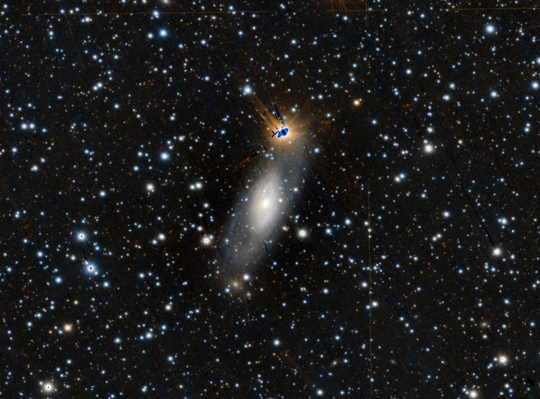
This interactive image of the NGC 7013 was provided by the Pan-STARRS1 Surveys using Aladin Sky Atlas. We also have a finder chart that should help you locate these galaxies, as will this link for NGC 7013 on the Stellarium Web planetarium. Moving into August we are now in the Milky Way season and galaxies are becoming harder to find. For this month I have chosen the little observed galaxy NGC 7013 in Cygnus (near the border with Pegasus) as the galaxy of the month. First discovered by William Herschel in 1784 it was also observed by John Herschel.
It is variously classified as a spiral or lenticular galaxy with NASA/IPAC Extragalactic Database (NED) suggesting a classification of SA(r)0/a which suggests an odd lenticular. The nucleus contains a mild AGN of the LINER type. The galaxy does show the remains of a bar as well as copious amounts of dust.
NGC 7013 is thought to lie at a distance of between 37 and 41 million light-years from us. At this distance it would be perhaps 42000 light-years across.
The GALEX image in the UV suggests there may be a ring of star formation going on around the nuclear region. Radio observations suggest there are two rings of HI gas in the galaxy with little gas in between them. The small bulge-to-disk ratio and the slow rotation velocity suggest that NGC 7013 is a low-mass, low-density galaxy unlike the more luminous, typical lenticular galaxies. The galaxy may thus be a former late-type spiral galaxy which has exhausted most of its interstellar gas, either by star formation or by internal sweeping.
Hubble has observed this galaxy but there appears to be no colour image available only this black and white one. As the galaxy is only two degrees from the Veil nebula it suffers quite a bit of interstellar extinction. I have not been able to find any decent amateur colour images of the galaxy but there is a nice black and white one by Martin Germano. Deep amateur images such as this one by Jim Thommes show some of the dust present in the area.
Although NGC 7013 itself is quite bright for owners of large telescopes there is a faint galaxy just of the southern edge catalogued at about 16th magnitude. It seems to be catalogued as PGC 1881063, although NED only has designations for it from the infra-red WISE and 2MASS surveys. The two galaxies are probably not associated as PGC 1881063 would appear to lie a long way in the background with distances suggested at 285 Mpc.
NGC 7013 does not make it into any of the standard observing guides such as the The Night Sky Observer's Guide (NSOG) and Luginbuhl and Skiff (L&S). It should however be visible at a stretch in 25cm and I suspect easily visible in 35cm from the UK. It does make the Herschel 3 list, although this is mostly faint unremarkable galaxies. It does lie in a rich starfield so this may distract from the galaxy. I would suggest using a medium power when trying to find it.
Owen Brazell - Galaxy Section Director
And as an addition to this month's article, this is a very nice image of NGC 7013 by Denis Janky that I found on Astrobin.
-
June 2017 - Galaxy of the Month
NGC 6764 in Cygnus
This interactive image of NGC 6764 was provided by the Digitized Sky Survey using Aladin Sky Atlas. We also have a finder chart should help you locate this galaxy. From the UK, June and July are practically dead months for deep sky observing as it never gets astronomically dark so choosing a Galaxy of the Month target is pretty hard and, some may say, pointless.
For this month, I have chosen the galaxy NGC 6764 in Cygnus. Cygnus is perhaps not an obvious constellation to look for galaxies in but it does share a border with Draco and it is close to here that NGC 6764 lies.
First discovered in 1885 by Lewis Swift using a 16” refractor NGC 6764 is a barred spiral, not dissimilar to NGC 7479 in that we can see a strong bar but weak spiral structure.
The galaxy itself is a hybrid active galaxy and its spectrum shows it as a LINER, although it has also been classified as a type 2 Seyfert. By hybrid it means that the optical emission spectra cannot be explained by a single ionizing agent so in this case as well as a central black hole there must be other sources of radiation. It is suggested in this case that it is a circumnuclear ring ionized by hot young stars from a recent star formation pulse.
The galaxy spectra has also been classified as a Wolf-Rayet type so it is perhaps a composite starburst/AGN galaxy. NGC 6764 does also have radio jets from the central black hole. There are also signs of radio lobes associated with the galaxy.
Interestingly WISE images in the infrared show very strong signal in the centre of the galaxy which could be dust, indeed the PANSTARRS image below does show dust in the central region along with the expected blue star formation regions in the bar.
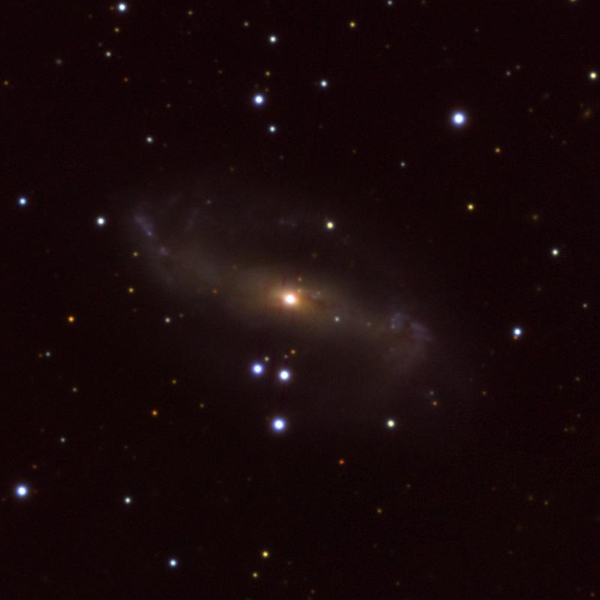
Image of NGC 6764 provided by the Pan-STARRS1 Surveys (PS1) via their PS1 Image Cutout Service. In terms of distance NGC 6764 is of the order of 111 million light years from the earth. There is some suggestion it may be physically associated with NGC 6759 given that the redshifts are similar.
Visually I would expect that at magnitude 11.9 the nucleus should be easy to find and larger telescopes should show the bar as well. The spiral arms may be visible under dark skies with the larger telescopes in amateur hands. There is also a small galaxy LEDA 214715 which, at mag 15, should be visible in large amateur telescopes very close to NGC 6764.
Perhaps unsurprisingly the galaxy does not appear in any of the standard references, although it does appear in the Webb Society Deep-Sky Observer's Handbook (WSDSOH) Volume 4 with an observation with the 82” at McDonald Observatory.
One of the few observations I have seen from the UK suggests that it was an averted vision object with a 35cm telescope. Steve Gottlieb reports that he can see the bar and a halo along with detail in the bar in a 24”, along with the companion.
Owen Brazell - Galaxy Section Director

