Galaxy of the Month in Boötes
-
NGC 5614 in Boötes
June 2024 - Galaxy of the Month

This interactive image of the NGC 5614 in Boötes was provided by the Pan-STARRS1 Surveys using Aladin Sky Atlas. We also have a finder chart should help you locate these galaxies, as will this link for NGC 5614 on the Stellarium Web planetarium. Now into June only the brightest galaxies can be seen from the latitude of the UK and I have chosen NGC 5614 in Boötes, also known as part of the Arp 178 triplet, for this GOM.
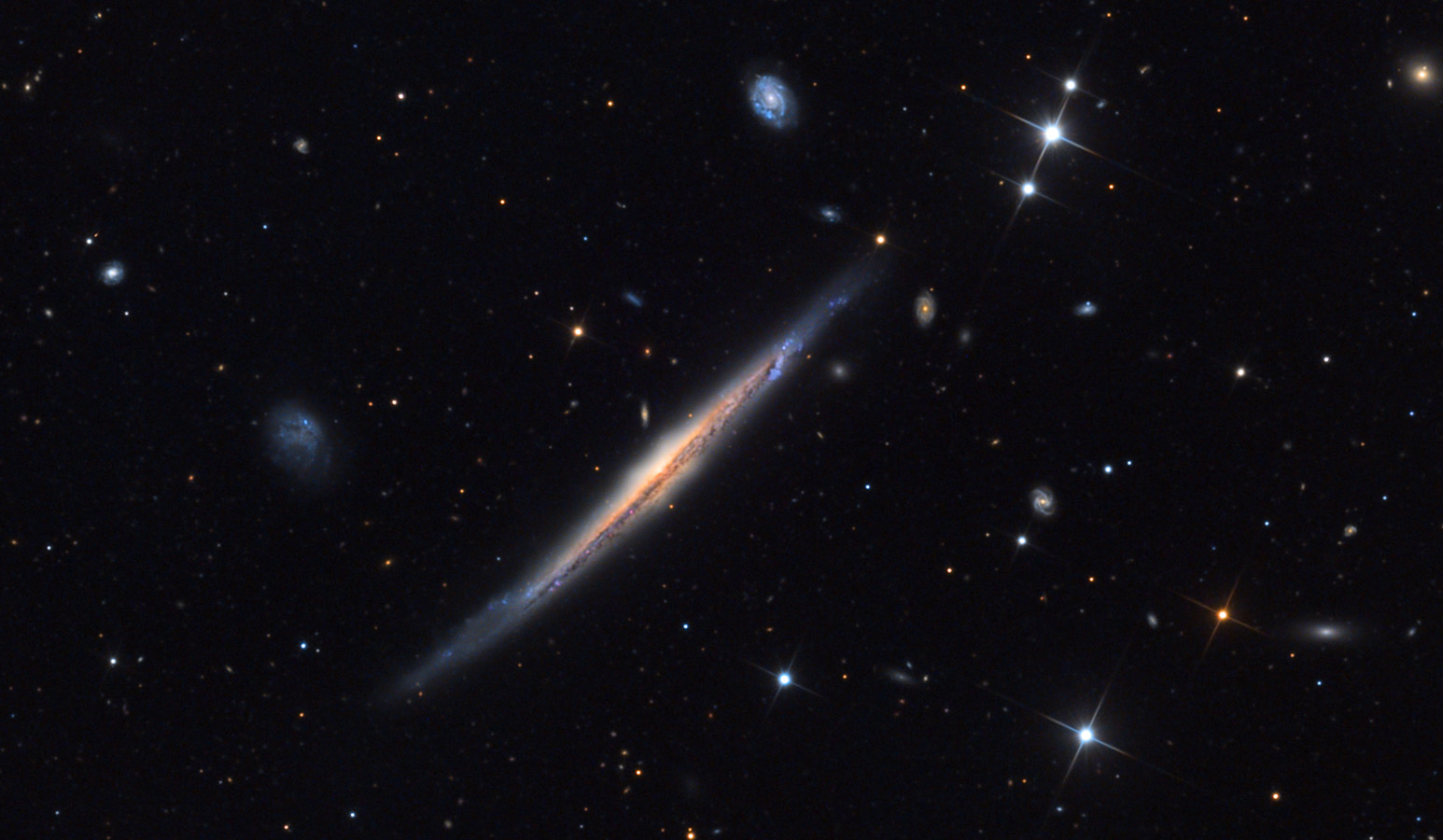
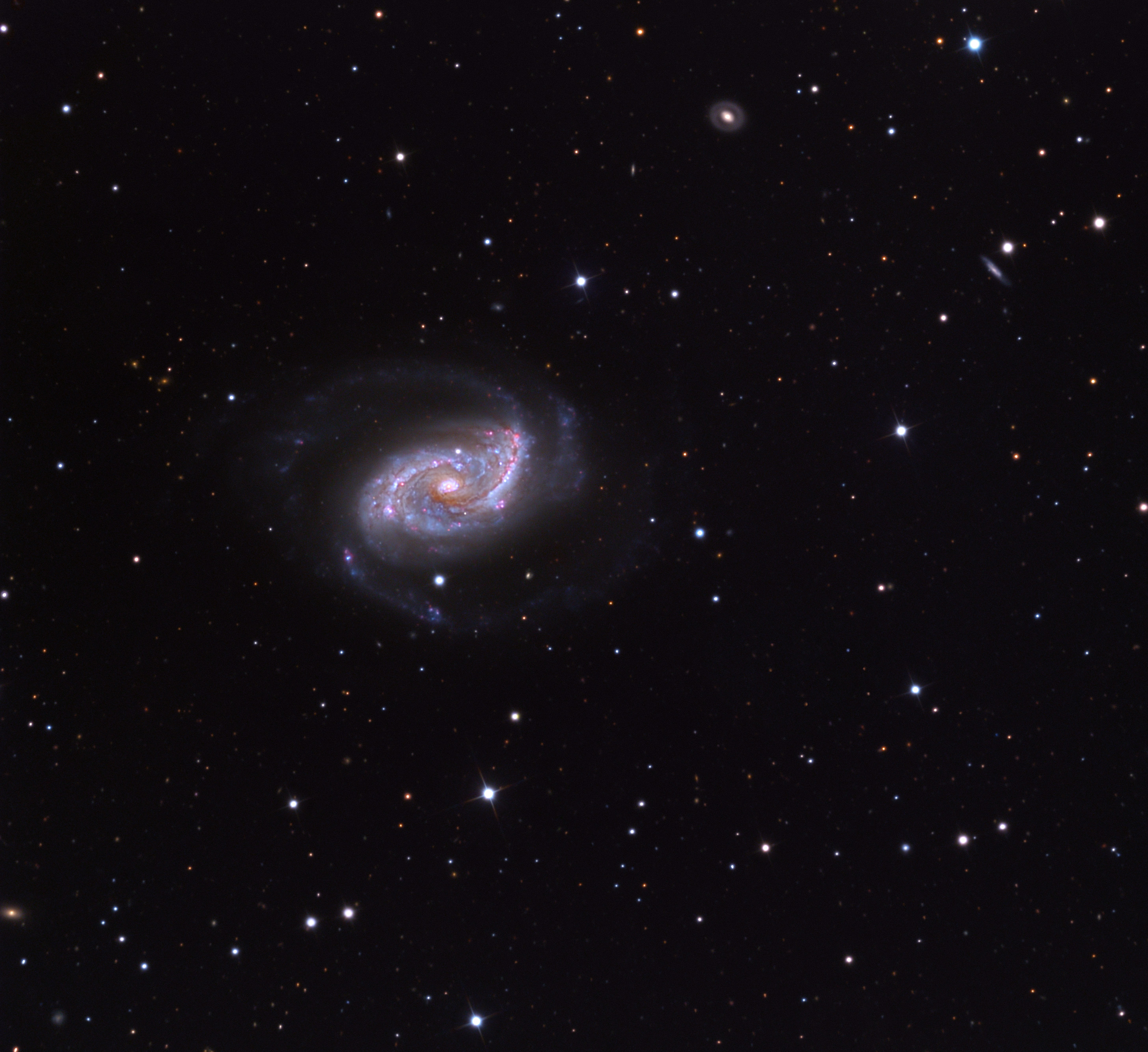
First discovered by William Herschel in 1785, NGC 5614 is a barred spiral galaxy lying at about 60 Mpc from the earth. The other members of the Arp 178 triplet are NGC 5613 and NGC 5615. NGC 5613 is however an unrelated galaxy lying almost twice as far away as the other two.
NGC 5614 sports a large tidal plume that has come from a gravitational interaction with another galaxy in the past. It is perhaps logical to assume this has come from NGC 5615 which is buried in the arms of NGC 5614. It is interesting to note that it took Bindon Stoney using the 72” at Birr to discover NGC 5615 in 1851. It is likely that NGC 5615 is the remains of a galaxy being torn apart by NGC 5614. Currently however it seems to lie about 3 million light-years from NGC 5614 (further than the Milky Way M31 distance) if so it must be in a long looping orbit.
Given their distances, NGC 5614 maybe about 130,000 light-years across and NGC 5615 only 10,000 light-years across.
One arm of NGC 5614 shows up very prominently in the UV image from GALEX which suggests a lot of star formation going on, and indeed the PanSTARRS image shows a number of clumps in that arm which could be new large young star clusters.
Observationally NGC 5614 should be relatively easy to find. The others given their discovery history will be much more challenging. NGC 5615 lies in the halo of NGC 5614 and will appear almost stellar and is probably going to be a challenge for large telescopes. NGC 5613 should be easier and in the range of 37cm or so. The group is very compact so a high magnification eyepiece will be required to split the group, perhaps of the order of 350x if the seeing conditions and telescope can take it.
The The Night Sky Observer's Guide (NSOG) Vol. 2 suggests that using a 30-35cm scope NGC 5614 is a faint circular patch, but using a 40-45cm scope will show all the galaxies in the group, although here again NGC 5615 is a tough call in the halo of NGC 5614. Steve Gottlieb suggest that NGC 5615 is an averted vision object with 45cm and a faint spot with 55cm, so this is going to be a challenge to find. He also suggests that NGC 5613 is similar in difficulty. There is a fine image of the group by Adam Block and the Mount Lemmon SkyCenter on Wikipedia.
Owen Brazell - Galaxy Section Director
-
NGC 5899 in Boötes
June 2021 - Galaxy of the Month
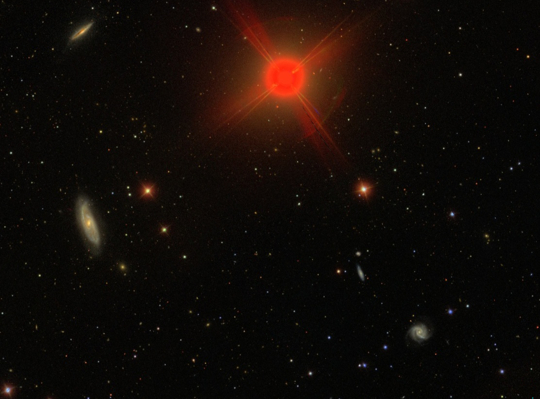
This interactive image of the NGC 5899 and was provided by the Sloan Digital Sky Survey using Aladin Sky Atlas. We also have a finder chart should help you locate these galaxies, as will this link for NGC 5899 on the Stellarium Web planetarium. It seems in some ways pointless to do a galaxy of the month for June and July from here in the UK as it never really gets dark enough to chase galaxies down, unless they are really bright. However, for the sake of completeness I have chosen the bright spiral galaxy NGC 5899 in Boötes for this month’s challenge.
NGC 5899 appears to be in a non-interacting pair with the much fainter NGC 5900 according to the RC2, however recent deep images of the pair suggest there are tidal tails coming off NGC 5900 and the dust lane in NGC 5900 also appears warped which suggests that a gravitational interaction is taking place between the pair.
Both of these galaxies were discovered by William Herschel in 1787, although not in the same sweep. Mitchell observing with Lord Rosse’s 72” at Birr believed he found another two nebulae near NGC 5900 although the one catalogued as NGC 5901 turned out to be just a star. The field also contains the much fainter and unrelated galaxies NGC 5893, NGC 5895 and NGC 5896.
If the distance measurements are correct NGC 5899 is about 46Mpc away. NGC 5899 appears to be a spiral galaxy seen at a highly inclined angle and has been given the rather complex morphological classification of SAB(rs)c which suggests it has a ring from which the spiral arms start. NGC 5900 is also a spiral but in this case seen almost edge on with a strong dust lane. NGC 5899 has also been classified as a Type 2 Seyfert galaxy which suggests it has an AGN. The UV images from GALEX show bright star forming regions in its spiral arms. The tidal tail in NGC 5900 also seems to show some UV emission.
Visually observing the field is complicated by the existence of the 6th magnitude star SAO 45445 close to the galaxies and a high-power eyepiece maybe needed to keep it out of the field when observing the galaxies. UK observations suggest that NGC 5899 can be seen faintly with a 25cm scope, although the same observer did not record an observation of NGC 5900 which suggests it is fainter. If you find NGC 5899 and NGC 5900 too easy then try for the fainter trio around NGC 5893 the other side of the star. Although NGC 5899 does not make the Herschel 400 list it does make the H400 II list. Steve Gottlieb’s observations of the field (along with all other NGC objects) can be found on his website.
Owen Brazell - Galaxy Section Director
-
NGC 5557 and Arp 199 in Boötes
June 2020 - Galaxy of the Month

This interactive image of NGC 5557 and Arp 199 was provided by the Sloan Digital Sky Survey (SDSS) using Aladin Sky Atlas. We also have a finder chart should help you locate these galaxies. Writing the galaxy of the month piece for June and July is often tricky as, certainly from the latitude of the UK, we never get any astronomical darkness during these months, and this won’t return until August. As such the choice has to be bright galaxies. For this month’s object I have chosen the elliptical galaxy NGC 5557 in Boötes.
Discovered by William Herschel in May 1785, NGC 5557 is part of a group of galaxies catalogued as LGG 378 which includes the edge on spiral NGC 5529, covered in an earlier GOM piece. William on the same night also found the nearby galaxy NGC 5544 but did not spot it was a double nebula, this was left to his son John to find in 1827 when he saw it split in two and the second galaxy was catalogued as NGC 5545, The pair was also independently split by Bindon Stoney, one of Lord Rosse’s assistants in 1852 using the 72” at Birr. The pair is now known as Arp 199, although it was earlier noted to be an interacting pair and was catalogued as VV 210.
Although looking fairly uninteresting to visual observers’ deep images show that in fact NGC 5557 is a shell galaxy with shells of gas and stars showing that in the last few (3-5) billion years or so NGC 5557 has undergone a number of interactions with other galaxies, and indeed merged with them. This is well illustrated in this image by Mark Hanson. Very deep images with the CFHT also show the presence of tidal tails and a number of dwarf galaxies accompanying NGC 5557. It has been suggested that some of these dwarf galaxies may have formed in the tidal tails. It has also been suggested that NGC 5557 may well have been formed from the merger of two spiral galaxies in the recent, astronomical, past.
NGC 5557 is classified either as an E1 or E2 galaxy, so pretty much round as seen from our perspective. Distance estimates vary widely but it would seem to be at about 33 Mpc from us. Interestingly Lord Rosse thought that NGC 5557 was a spiral galaxy, one of his few misjudgements in that area.
Although NGC 5557 is bright enough to show faintly in a 15cm telescope it will probably require something in the 25-30cm size to show its brighter core and surrounding haze, certainly from UK skies. Arp 199 lies perhaps 16’ away from it. I found that with a 37cm telescope under twilight skies that it was fairly easy, although admittedly the galaxy was overhead and not in the best position to view with a Dobsonian telescope. Both NGC 5557 and Arp 199 will appear in the same medium power field, say around 200x.
NGC 5557 is bright enough to have made the Astronomical League’s Herschel 400 list. There is a bright star involved in the halo of NGC 5557 which could be confused with a SN so beware before reporting it. Arp 199 is a very tight pair and much fainter than NGC 5557 so will require larger telescopes and high power to split. The pair consists of two spirals. Arp 199 was covered in the DSF OOTW in 2014.
Owen Brazell - Galaxy Section Director
-
May 2014 - Galaxy of the Month
NGC 5529 in Boötes

Image Courtesy of Adam Block/Mount Lemmon SkyCenter/University of Arizona. Please click on image for a high resolution version.
Although as we move into May chasing faint galaxies becomes more problematic with the shortness of the observing window there are still some possibilities early in the month. Although NGC 5529 was first discovered by William Herschel in 1785 this edge on spiral galaxy in Boötes has remained off the radar for many observers, perhaps because of its faintness. Thought to be at a distance of about 140 million light years its size would be about 250000 light years, about twice the size of our galaxy. The nucleus of the galaxy shows a box like shape, often taken as an indication of an interaction and the spiral arms also show a warp. The galaxy itself is classified as an Sc galaxy a few degrees from edge on (86 degrees) it is likely that it is a barred spiral. In this way it is very similar to the better known NGC 4565. In the same field of the galaxy are two other NGC objects in NGC 5524 and NGC 5527. These are both much fainter and were discovered in 1855 by Mitchell using the 72” at Birr. NGC 5527 may be a companion of 5529 but 5524 is likely to be further away. The galaxy that distorted NGC 5529 no longer appears to be in the field with it. Observations using the Infrared satellite ISO showed that NGC 5529 appears to have the largest known halo of PAH molecules yet seen (Polyaromatic Hydrocarbons). This must be symptomatic of some large scale outflow from the galaxy. Herschel observations of NGC 5529 also suggest some oddities with the dusk disk as it does not fit a simple pattern. NGC 5529 appears to be the dominant member of a group of about 17 small galaxies and this may also be the cause of the halo gas. Of these thirteen would appear to be NGC galaxies NGC’s 5529, 5533, 5544, 5545, 5577, 5589, 5590, 5596, 5614, 5656, 5675, 5684 and 5695. Observationally NGC 5529 is going to be a challenge and although observations have been reported with instruments as small as 15cm to see any detail, in particular the dust lane are going to require much larger instruments in the 40cm+ class, certainly from typical UK skies. A nice drawing through a 45cm telescope can be seen at the Astronomy Sketch of the Day website. As can be seen there are many other bright galaxies in the field including NGC 5557. These will fit in the medium power field of many telescopes. However to see the fainter members of the 5529 system you will need to use higher powers.
A Megastar© identification chart for the galaxies near to NGC 5529.
Owen Brazell - Galaxy Section Director
-
June 2013 - Galaxy of the Month
NGC 5248 in the Constellation of Boötes
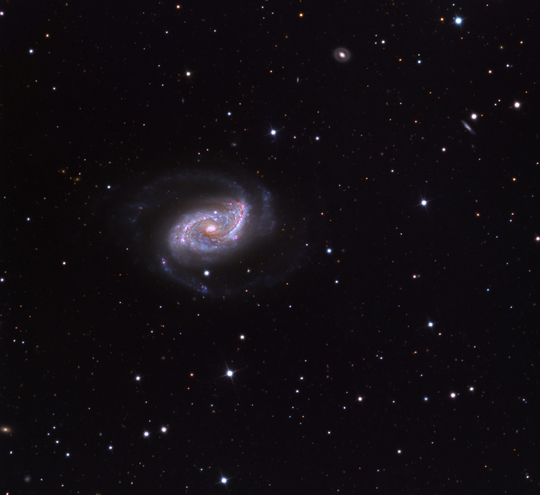
Image Courtesy of Adam Block, Mount Lemmon SkyCenter, University of Arizona. For more images from Adam please visit the University of Arizona SkyCenter website. You can click on image for a high resolution version
Hunting galaxies in mid northern climes in June is a challenging affair as the skies never really get astronomically dark. For this month’s object then I have chosen the bright galaxy NGC 5248.
NGC 5248 is in the constellation of Boötes but is actually part of the Virgo cluster of galaxies. NGC 5248 has its own small group which contains two other faint UGC galaxies and the group itself is part of the Virgo III group. The Virgo III chain consists of at least 8 groups of galaxies stretched into a chain at least 40 million light years long by the intense gravitational pull of the main Virgo cluster.
NGC 5248 itself is a spiral galaxy seen at an angle of about 45 degrees. It is classified as a grand design SAB spiral with a short bar. However recent observations in the near infra-red have shown that in fact there may be a much longer bar with intense star formation which may be driving the spiral arms outside it. These spiral arms also appear to have a large amount of star formation going on as can be seen from the numerous HII regions in its spiral arms and the strong blue colour. Interestingly there maybe two spiral patterns, one in the nuclear regions and one in the outer reaches of the galaxy.
As perhaps expected NGC 5248 was discovered by the indefatigable William Herschel in 1784. The distance to NGC 5248 is not as well defined as it might be but is at about 55 million light years. At this distance the galaxy itself is perhaps 120,000 light years across, so a bit larger than our Milky Way.
Shining at 10th magnitude NGC 5248 is visible in small telescopes although it may require a dark sky free from light pollution. A 10-20cm telescope will show the bright core but larger apertures will be needed to show any of the spiral structure. This is due to the fact that although the total brightness is quite high of NGC 5248 its large size means that its surface brightness is quite low. Large telescopes may also be able to pick up the other two much fainter members of its group, UGC 8575 and UGC 8829 which are half a degree east and half a degree south respectively from the NGC 5248.
Owen Brazell - Galaxy Section Director