Observations of NGC2146
These are the observations available for NGC2146. If you have any of your own that you'd like to submit we'd love to put them on the website.
-
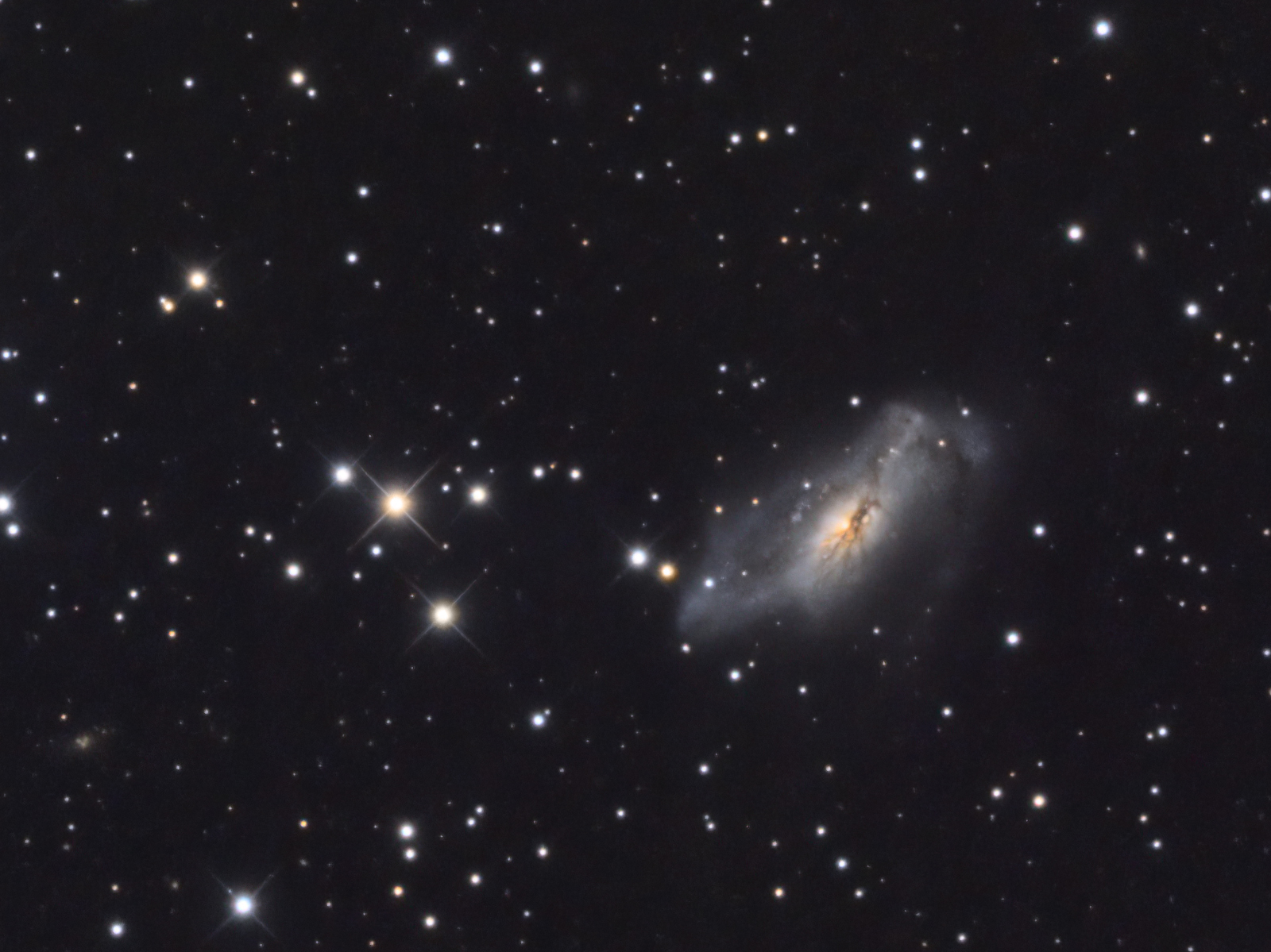
Barred spiral galaxy NGC 2146 in Camelopardalis
I was doing some electronically assisted observing some four weeks ago and was intrigued by the sight of NGC 2146. I had not investigated this galaxy previously and returned to it some nights later for a closer look.

An image of NGC 2146 and neighbouring NGC 2146A in Camelopardalis provided by David Davies and taken from Cambridge in the UK. To see more of David's work please visit his Flickr Photostream. Please click on the image for the larger version. This galaxy was discovered by Friedrich Winnecke, a German astronomer, in 1876. Despite its distorted presentation, it is not listed in the Arp Atlas of peculiar galaxies. It seems that the cause of the twisted presentation of this galaxy is not fully understood. Some have proposed that a close encounter with a nearby galaxy, such as NGC 2146A, which is to the top left of the uncropped image, is the cause of the disturbances. However, the significant difference in their radial velocities doesn't support this hypothesis.
Moreover, radio-based observations show little evidence of the disturbances we see in the optical wavelengths. Perhaps we are looking at a post-merger state of two galaxies, now merging into one. It is a starburst galaxy with significant star formation ongoing, and two supernovae have been observed in recent years. Some of the star-forming regions are just visible at the resolution limit in this image.
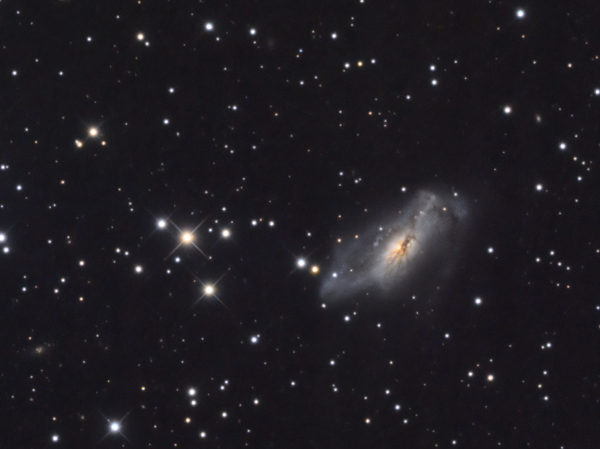
A cropped image to show the detail of barred spiral galaxy NGC 2146 in Camelopardalis provided by David Davies and taken from Cambridge in the UK. To see more of David's work please visit his Flickr Photostream. Click on the image for the larger version and a closer look at those stars. NGC 2146 is listed as being between 50 and 70 million light-years away. I find it interesting to reflect that all of the higher mammals on earth have evolved during the time the photons captured by my camera have traversed the void after emission from this galaxy.
Image Details
- Telescope: 200mm Ritchey-Chretien.
- Camera: QSI 683 camera.
- Mount: Skywatcher EQ8.
The image comprises 38 x five minutes of luminance plus 15 x five minutes each of RGB.
David Davies - (16 December 2021).