These are our observations of Globular
-
Three in one: NGC 6712, IC 1295 and PK 25-4.1
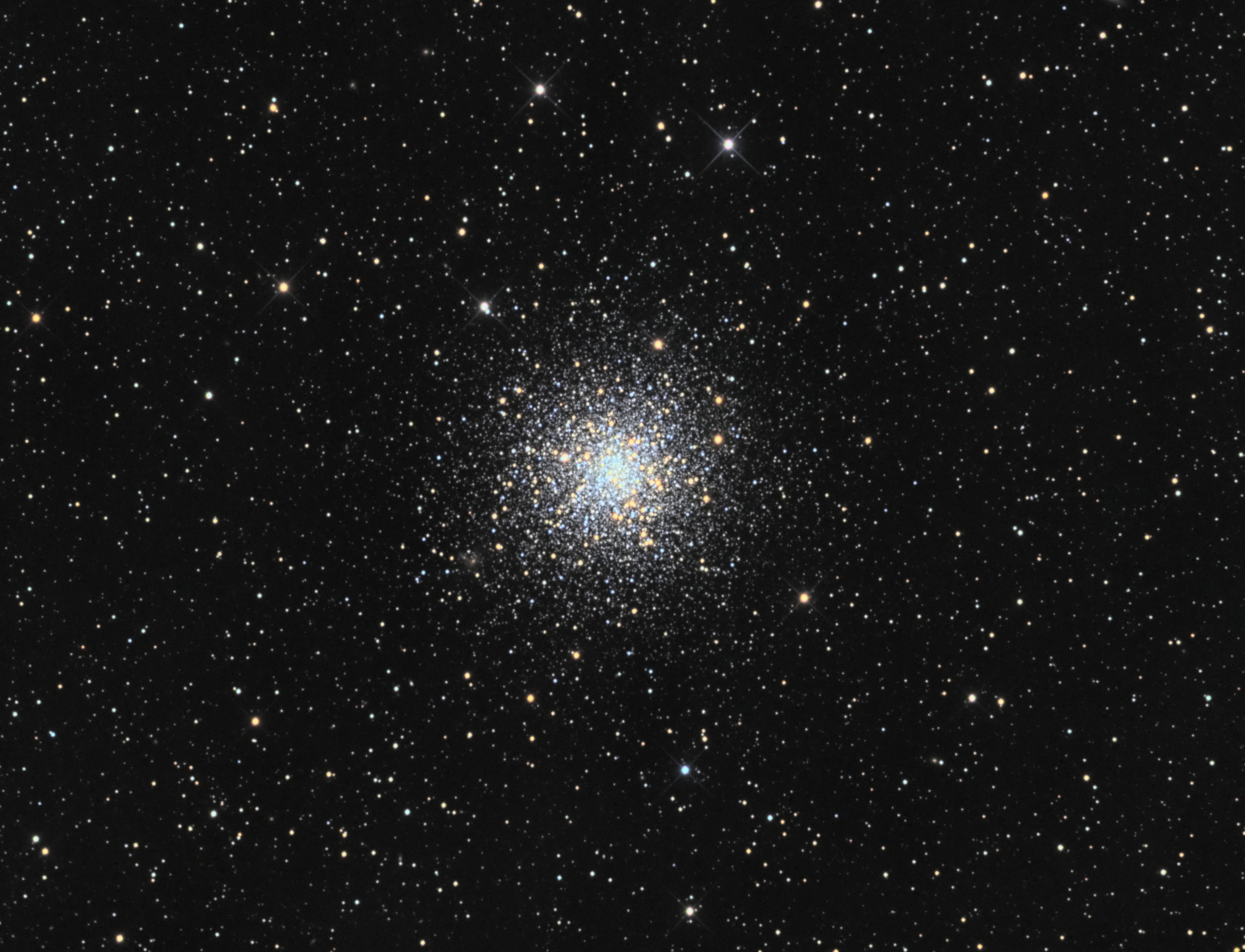
The attached image resulted from something of an experiment to explore what quality of image I might get from using the ASI 294MC Pro one-shot-colour camera to try and capture two low-down, planetary nebulae.
My attention was initially drawn to the globular cluster NGC 6712, but an exploration of that region of the sky with a Cartes du Ciel revealed the planetary nebula IC 1295 close by with the Perek-Kohoutek object, PK 25-4.1 close by. I, therefore, elected to try my RC10 telescope with a 0.7x reducer (finally at its correct spacing) and with the telescope recollimated following some incorrect assumptions concerning the pointing accuracy of my TS_Optics focuser.

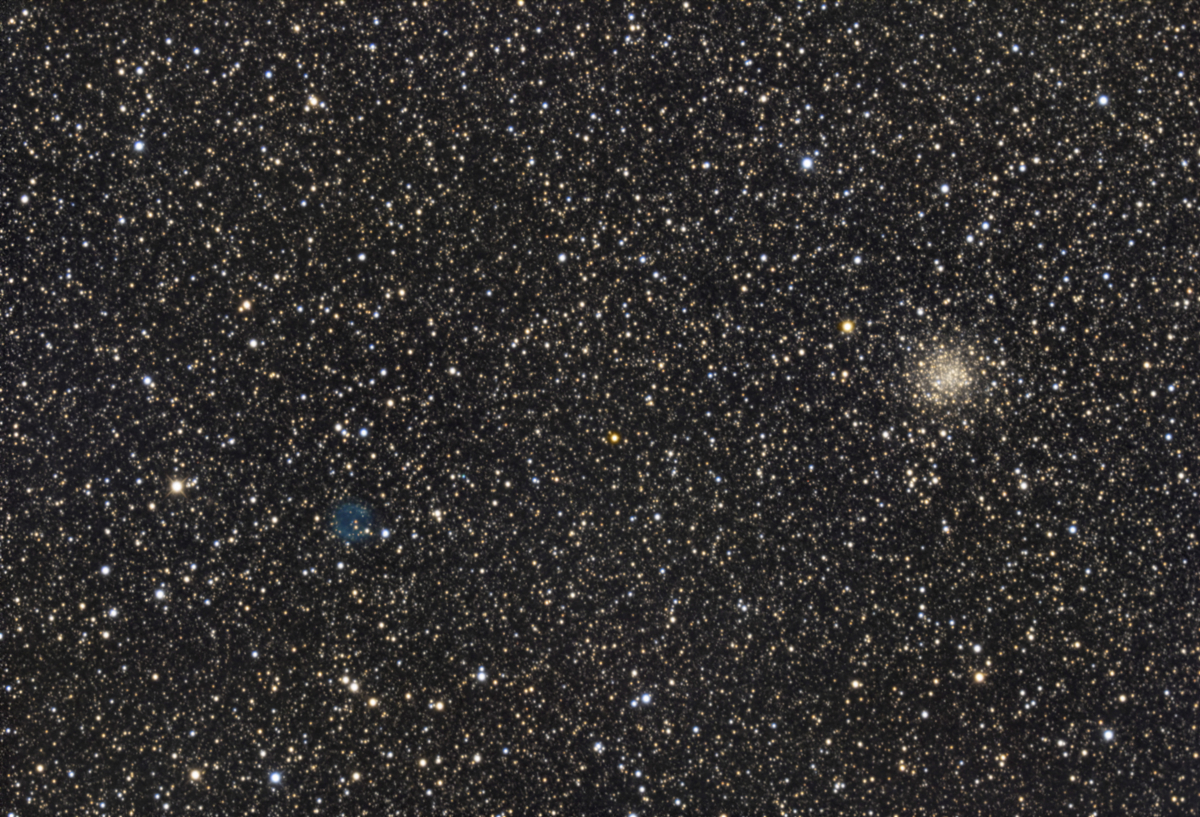
A 2x2 binned image of the globular cluster (NGC 6712) in a rich field of stars to the right of the image and IC 1295 to the lower left of the centre by David Davies. Taken from Cambridge in the UK. To see more of David's work please visit his Flickr Photostream. Click on the image for the larger version. NGC 6712 was discovered by William Herschel on June 16th, 1784. It is a relatively small (64 light-years across) and sparse (~1 million stars) globular cluster, which lies 22,500 light-years away.
A study by the European Southern Observatory concludes that NGC 6712 is only a pale remnant of a once much more massive cluster. It notes that none of NGC 6712’s stars is less massive than our Sun, making it totally unlike any globular cluster. Most likely, NGC 6712 is unique only because no other globular cluster comes as close to the Milky Way’s centre as NGC 6712; it penetrates very deeply into the galactic bulge, venturing to within 1,000 light-years of the galactic centre. The tidal force of the galaxy not only strips low-mass stars from the cluster but also stretches out the cluster like a comet’s tail. The ESO study labels NGC 6712 as a peculiar globular cluster. The Interstellarum Deep Sky Atlas labels 6712 as The Weird Globular.
Above is my 2x2 binned image of the full field which shows the globular cluster in a rich field of stars to the right of the image and IC 1295 to the lower left of the centre. I think I can see streams of stars running east of north and west of south from the globular cluster, as described in the literature.
Below is a full-resolution image of the region around IC 1295. IC 1295 is slightly left of the centre, and I believe that PK 25-4.1 is the small bright blue object in an arc of four stars to the upper right of the centre.
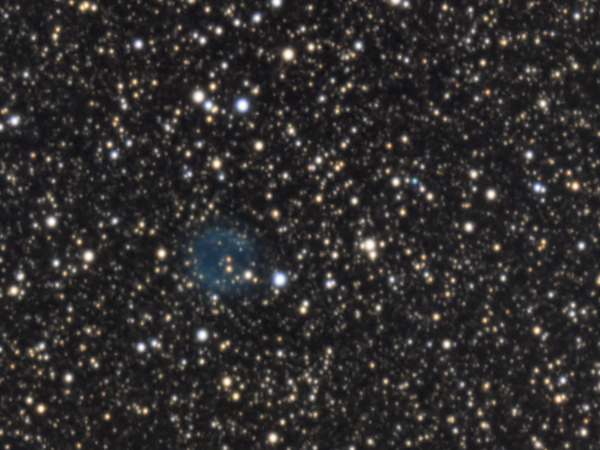
A full-resolution image of the region around IC 1295 by David Davies taken from Cambridge in the UK. Image Details
Data: 60 x 2-minutes exposures from 2nd to 6th October 2022.
- Telescope: 10-inch Ritchey Chretien with a x0.7 reducer at 1400mm focal length
- Camera: ASI 294MC Pro (-15C, gain 120, off 13)
- Mount: Skywatcher EQ8
- Software: NINA, Pixinsight, Photoshop
David Davies - (10 October 2022).
-
Messier 68 in Hydra
I keep a list of the Messier objects that I image and M68 is listed as being too low to observe. It reaches around 10.4 degrees of altitude at my location at which point it is skimming just above the branches of the trees at the end of the field behind my observatory. It is visible above the trees for barely an hour. Last night presented an opportunity to try to observe it, but the sky had become very dark with haze and only a few of the brighter stars were visible by eye. Nevertheless, I had a go.
I've recently rediscovered the power of binned exposures with my QSI camera, giving an effective pixel size of 10.8um and an ideal image scale of 1.3"/pixel on my 8" RC telescope. My previous experiments with binned exposures were mixed and I stopped using the technique.
Messier 68 is a globular cluster discovered by Charles Messier in 1780. Messier found it to be unresolvable, but William Herschel first resolved it into stars in 1786. M68 is a rich cluster of around 100,000 stars; it lies at a distance of 33,000 light-years and is around 106 light-years across.

This image of the globular cluster Messier 68 in Hydra is by David Davies and taken from Cambridge in the UK. To see more of David's work please visit his Flickr Photostream. This image is the result of just 10 minutes of exposures each of RGB, 5 x two minutes each, binned 2 x2, as M68 cleared the tops of the trees briefly. Despite atmospheric dispersion, poor sky transparency, horrible seeing and a severely attenuated blue component, I am happy to share the image. I suspect that it is rarely observed in the UK.
Image Details
- Telescope: 8" Ritchey-Chretien
- Camera: QSI 683 with Astrodon RGB filters
- Mount: Skywatcher EQ8.
David Davies - (24 March 2022).
-
Messier 15 in Pegasus
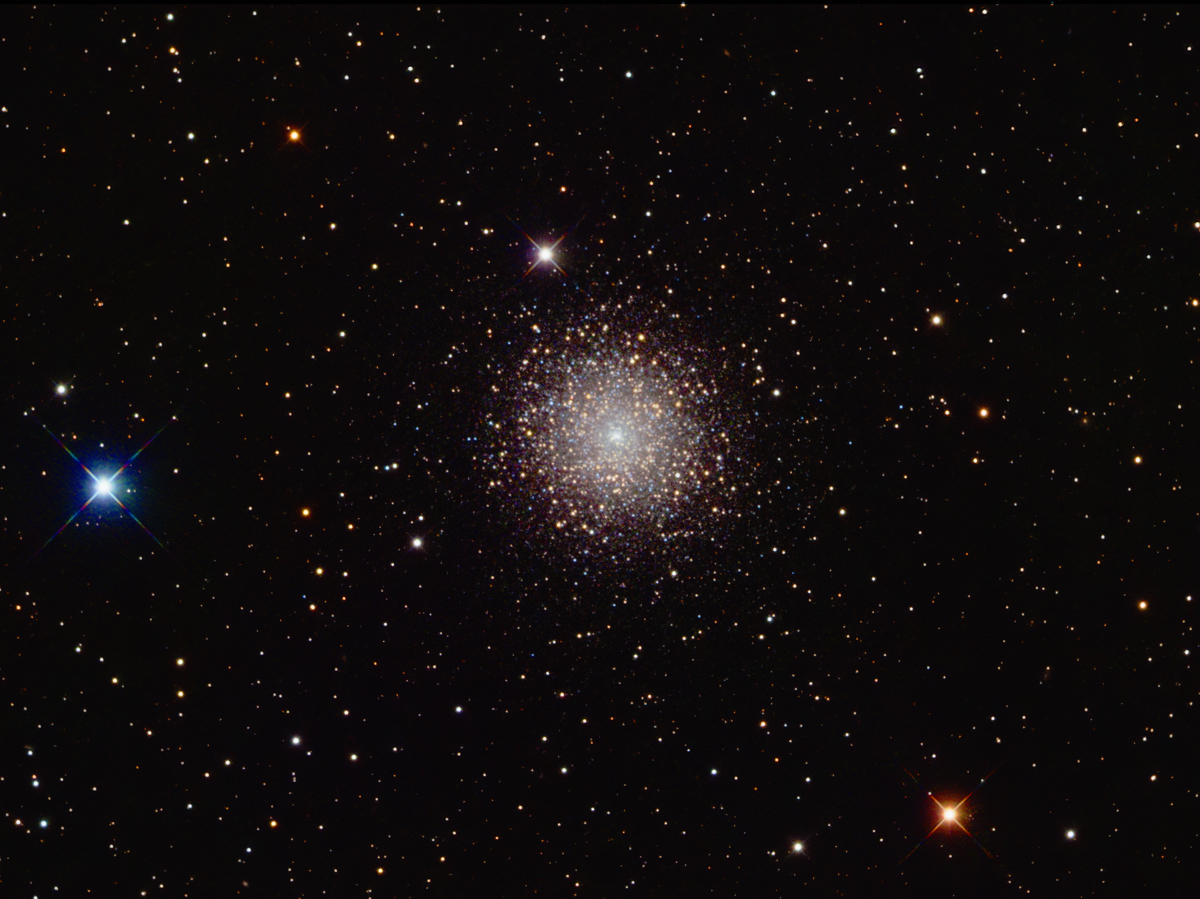
Messier 15 is a bright and beautiful globular cluster in the constellation of Pegasus. It was discovered by the French astronomer Jean-Dominique Maraldi on 7th September 1746 and he reported it as a bright nebulous star composed of many stars. Messier observed it on 3rd June 1764 and added it to his list of 'not a comet' objects with the remark that it appeared as a round nebula, without a star. Other early observers included William and John Herschel and they commented on its brightness and unusual beauty.
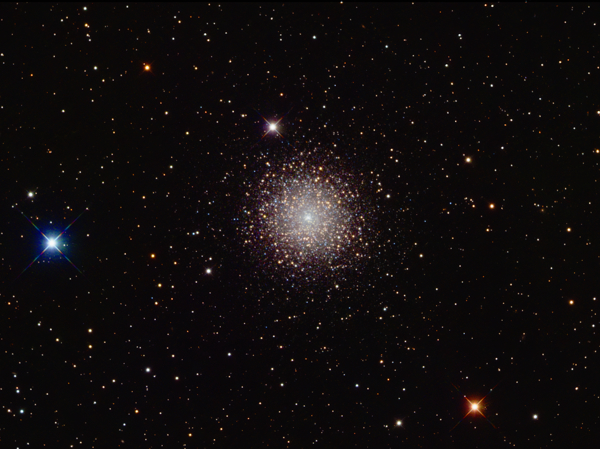
This image of the globular cluster Messier 15 was provided by David Davies and taken from Cambridge in the UK. To see more of David's work please visit his Flickr Photostream. Click on the image for the larger version. Image Details
I captured this image during the short darkness of 28th July as part of testing the imaging software N.I.N.A. It comprises just 10 x two-minute subs of red, green and blue sub-frames. The short exposures have ensured that the core is not over-exposed and the planetary nebula Pease1 can be discerned just north of the centre.
- Telescope: 8" Ritchey-Chretien with x0.7 reducer.
- Camera: QSI 683.
- Mount: Skywatcher EQ8.
David Davies - (20 August 2020).
-
Two faint globular clusters in Delphinus
NGC 6934
The first is NGC 6934, imaged on 16th August 2018 but processed only earlier this year.
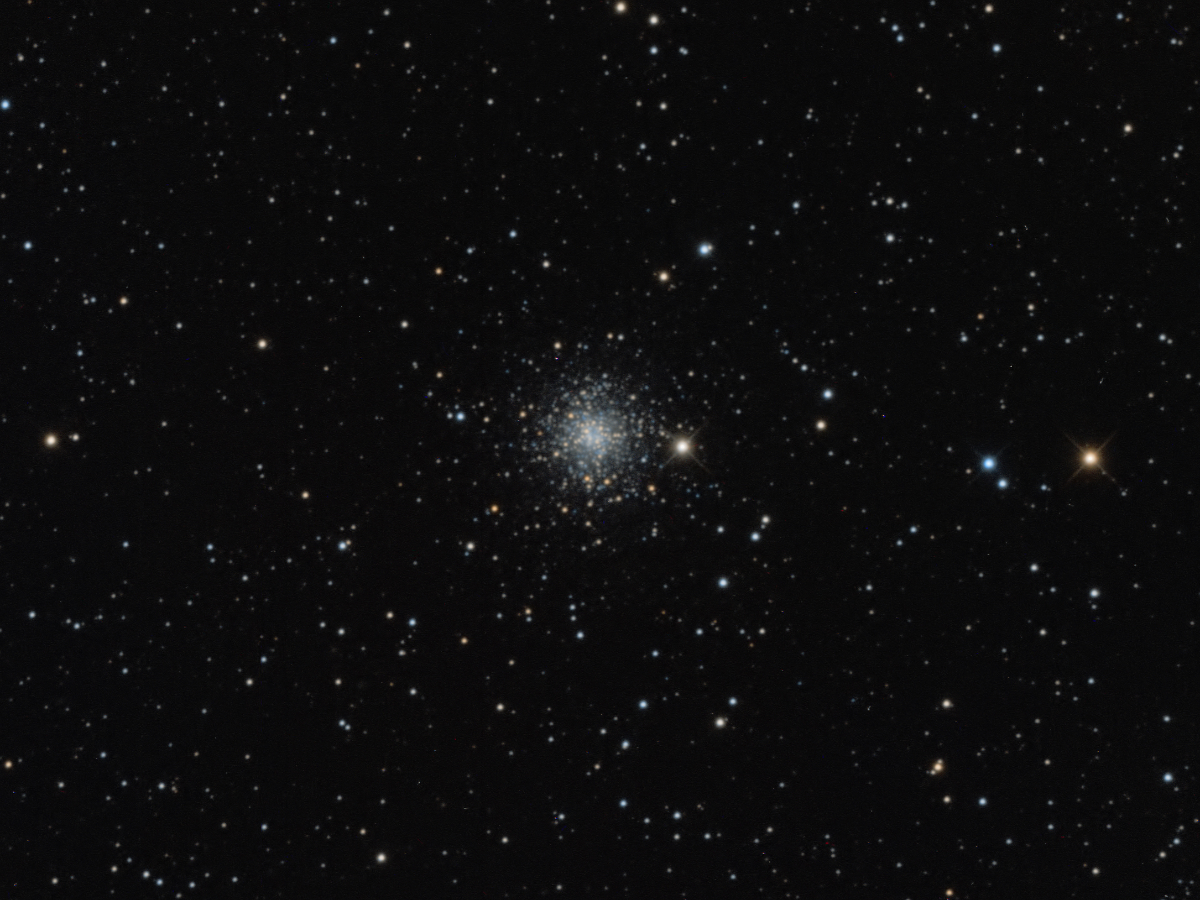
NGC 6934 is a faint globular cluster of magnitude 8.8 and containing 16th magnitude stars and fainter. It is 51,000 light years away.
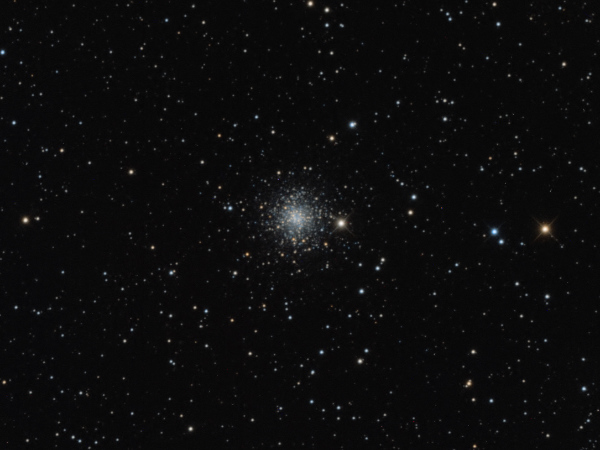
This image of NGC 6924 was provided by David Davies and taken from Cambridge in the UK. The image comprises 10 each of RGB subs of five minutes exposure. To see more of David's work please visit his Flickr Photostream. Click on the image for the larger version. NGC 7006
The second is NGC 7006 captured in September 2018.
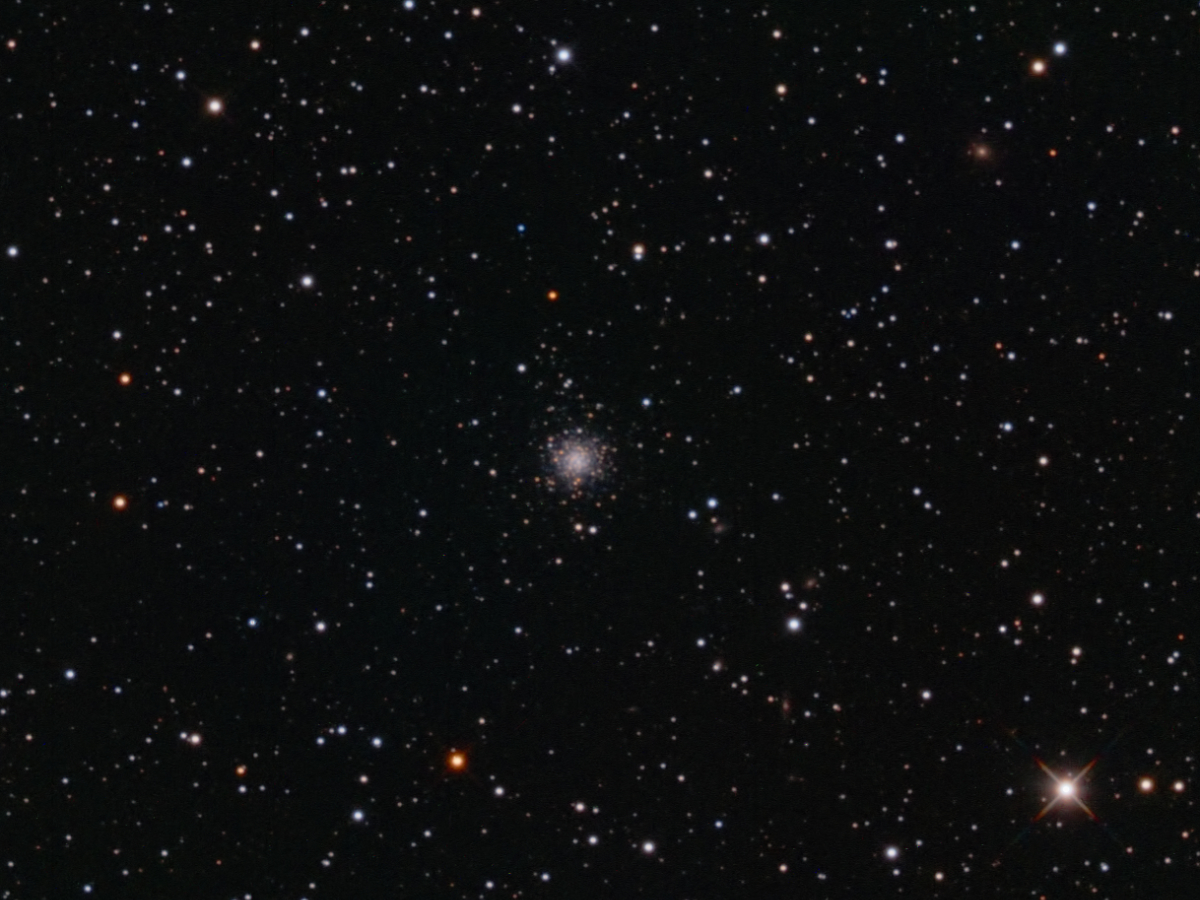
NGC 7006 lies on the fringe of the Milky Way's halo at a distance of 135,000 light years. In the 1910s and 20s, studies by Shapley of the stars in NGC 7006 and other globular clusters were used to measure the size of the Milky Way galaxy.
This cluster lies at a low galactic latitude and its brightness is dimmed by the intervening dust. It has a visual magnitude of 10.6 and stars near the core are around mag 15.6.
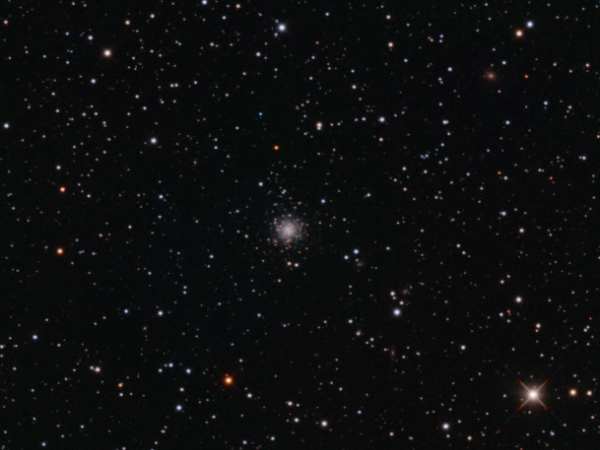
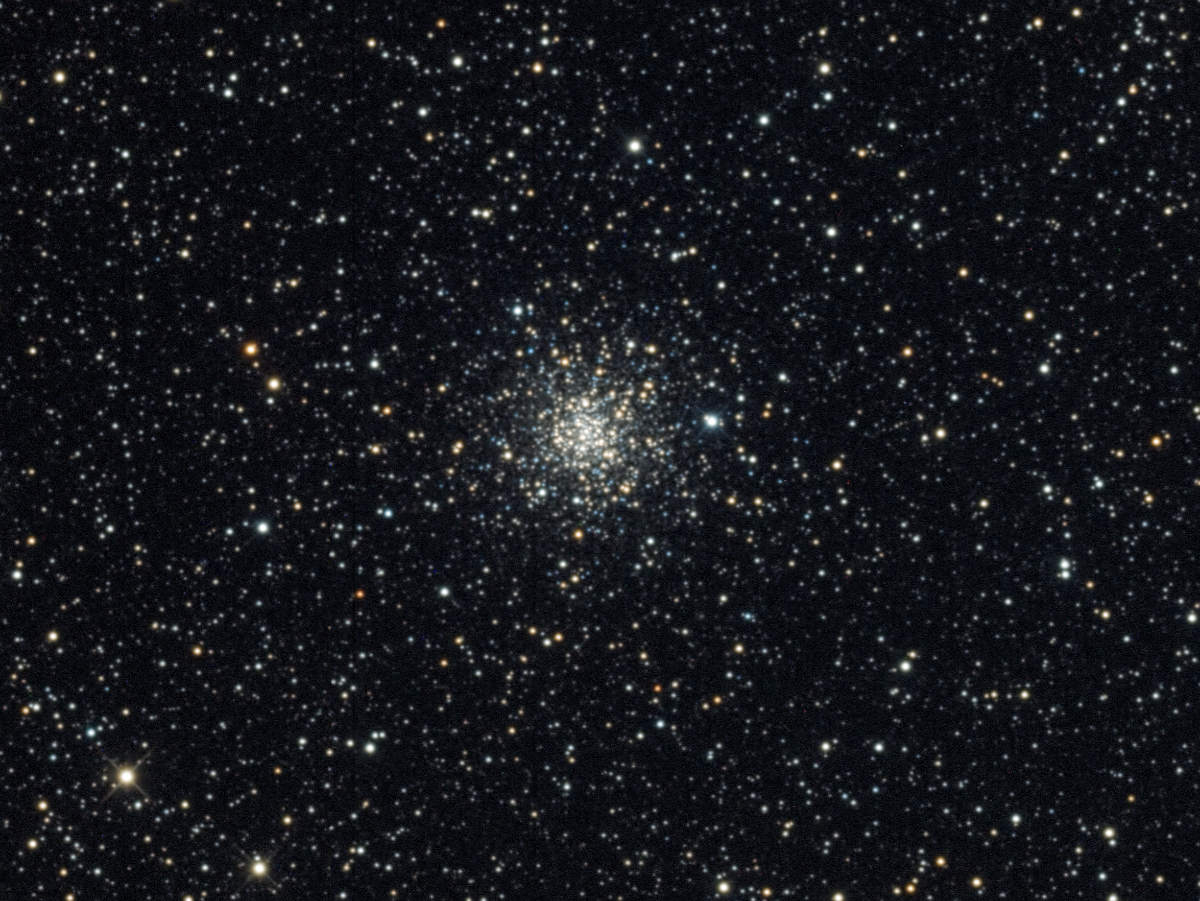
This image of NGC 7006 was provided by David Davies and taken from Cambridge in the UK. It comprises 10 x seven-minute subs of RGB. To see more of David's work please visit his Flickr Photostream. Click on the image for the larger version. Image Details
- Telescope: 8" Ritchey-Chretien at F/8.2
- Camera: QSI 583 with a Lodestar as off-axis guider
- Mount: Skywatcher EQ6
David Davies - (20 March 2019).
-
M56 in Lyra
I'm continuing my observations of globular clusters so this is Messier 56 in Lyra.
Charles Messier found M56 on the 19th March 1779, on the same night he also discovered a comet. He reobserved M56 on the 23rd March and noted that it was a
nebula without a star and little light close to a 10th magnitude star
. Five years later, John Herschel succeeded in resolving this globular cluster into individual stars. He described M56 as afine compressed cluster, inclining to a triangular form, brighter towards the middle, with stars of 12th to 14th magnitude
.
This image of M56 was provided by David Davies and taken from Cambridge in the UK. To see more of David's work please visit his Flickr Photostream. Click on the image for the larger version. M56 has a very eccentric orbit around the galactic centre taking it from a few thousand light-years of the galactic centre out to 40,000 light years from the centre. M56 is currently 27,000 light-years from us as it traverses the outer half of its orbit. It has around 200,000 solar masses and is just one third the size of M13. The 25 brightest stars have an average magnitude of 15.3. Notable is the 10th magnitude blue-white star to the west (right side) which was noted by Messier.
Image Details
- Telescope: 8" Ritchey-Chretien at F/8.2
- Camera: QSI 583 wsg and Lodestar guide camera
- Mount: Skywatcher EQ6
This is an RGB image with five 5-minute exposures per colour captured on 5-6 August 2018.
David Davies - (17 September 2018).
-
Globular Clusters in Coma Berenices
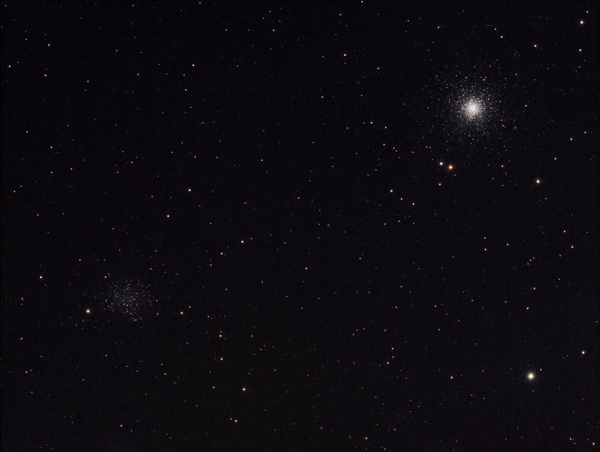
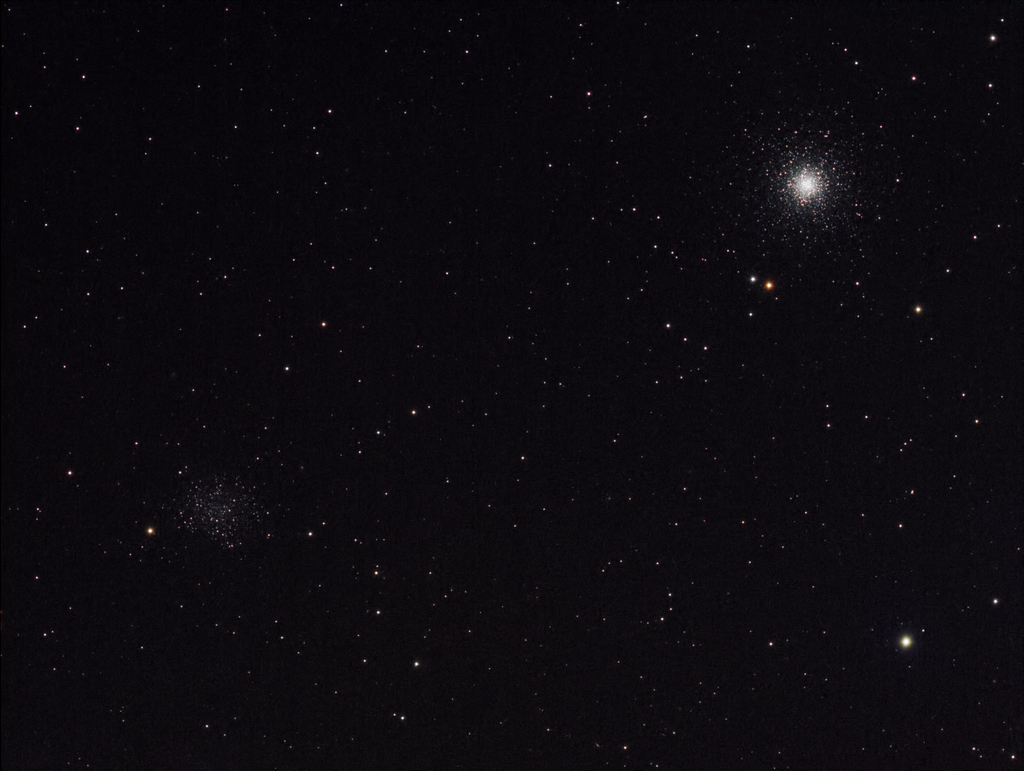
This image was provided courtesy of David Davies from Cambridge in the UK. To see more of David's work please visit his Flickr Photostream. Here is the product of my last successful imaging session before the autumnal rains started.
M53, NGC 5024, in Coma Berenices is at top right of this image. It is around 60,000 light years from us and in absolute terms is larger than M13, but appears smaller and fainter due to its greater distance; the 25 brightest stars have an average magnitude of 15.
To the east of M53, at bottom left, is NGC 5053. This is classified as globular cluster but it has a low star density and low metallicity stars; it is around 53,000 light years from us.
This image was captured in early May under brightening night skies with a 107mm APM refractor and QSI 583 camera. It is a simple RGB image of 30 minutes each colour in 2-minute subs.
David Davies - (6 June 2017).
-
A Morning with Galaxies and a Cluster
Here are a few observations from the morning of April 27th 2017. My primary aim was to follow up on an observation that I made with Andrew Robertson, Owen Brazell and Callum Potter at Kelling using Andrew's driven 24" Dobsonian of the NGC 5222 group in Virgo.
My effort was reasonably successful, however the field of view using the Watec camera is small and I couldn't match the field of the eyepiece view.
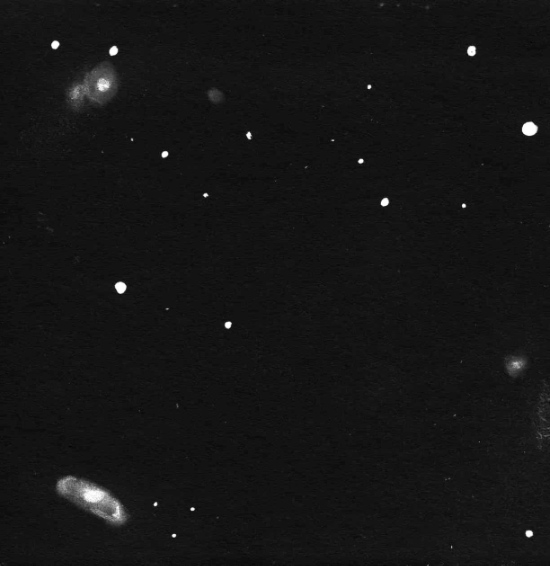
Sketch of NGC5222 by Dale Holt from his Chippingdale observatory in Hertfordshire. After this I took the chance of going low into Ophiuchus and getting a sketch of M12 which was missing from my Messier sketch archives. I used the 6" triplet refractor and older uncooled Watec video camera as globulars being very bright tend to saturate the camera using the big mirror.
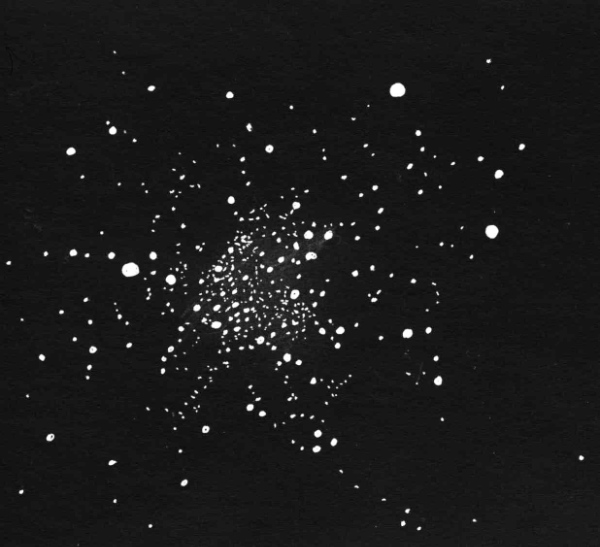
Sketch of M12 by Dale Holt from his Chippingdale observatory in Hertfordshire. After I had sketched M12 I moved back to the 20" and searched the cluster finding 3 tiny faint galaxies in the outer fringe, fascinating. Unfortunately I haven't been able to id them. (Ed. This image shows these galaxies nicely on the lower left edge of M12.)
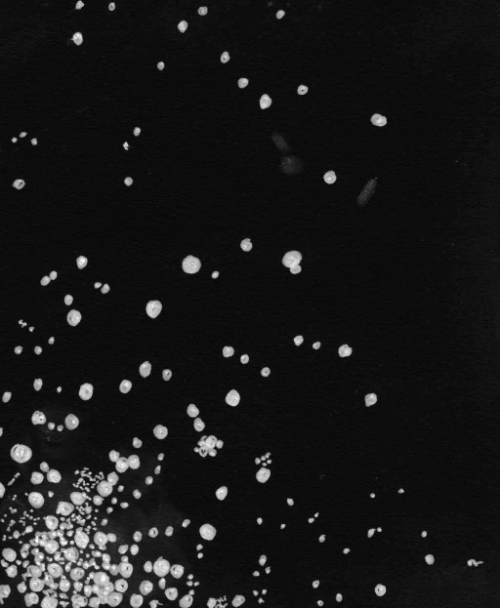
Close up sketch of a group of faint galaxies on the edge of M12 by Dale Holt from his Chippingdale observatory in Hertfordshire. Dale Holt - (2 May 2017).
-
An observation of M92 in Hercules
Here is a sketch of M92 from last night (6th August 2016, 21:39 UT) under a clear sky with no moon during Nautical twilight. Observing with a 12" f/5 Dobsonian with 15 mm lens from Moonfish. Pencil on cartridge paper. North is to the left in the sketch.
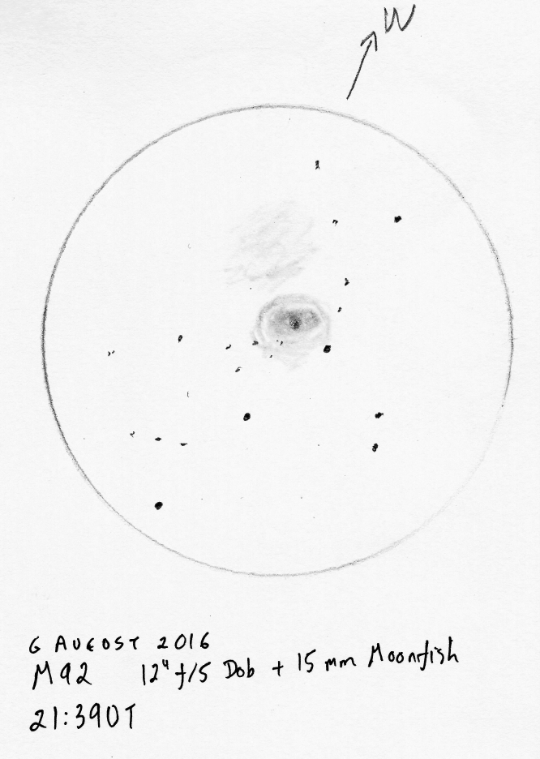
Visually M92 seems somewhat elliptical with the major axis roughly north-south. There is a distinct and unresolved core and a visual impression of concentric rings. There seemed to be an extended light source to the west only. I suspect this was some sort of optical illusion rather than anything to do with M92.
Rob Peeling - (7 August 2016).
-
NGC 7006 and the surrounding galaxies
Another of my compilation observations taken from the conversations on our Yahoo! Forum about the Globular Cluster, NGC 7006, and the faint galaxies that share the field of view.
Dale Holt's observation
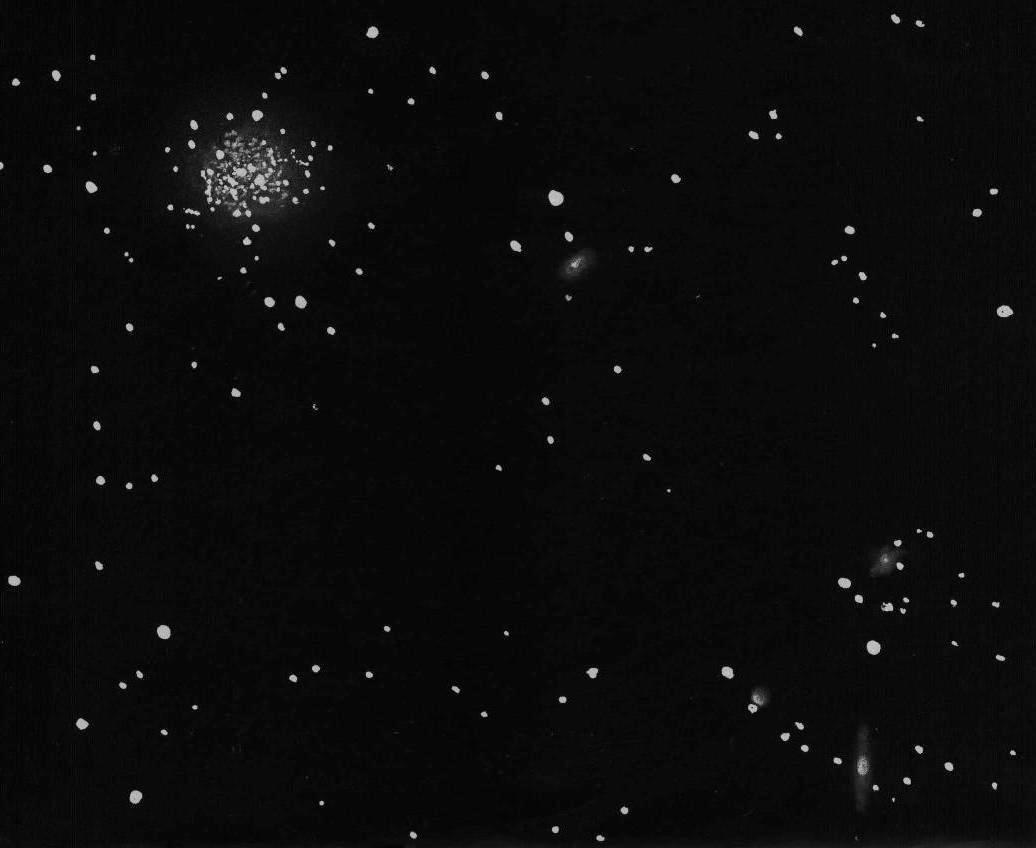
Sketches of faint galaxies, some of them I haven't identified around the small GC NGC 7006 in Delphinus. These video assisted observations were made following inspiration of Ken Hewitt-Whites, going deep in the latest addition of S&T magazine.
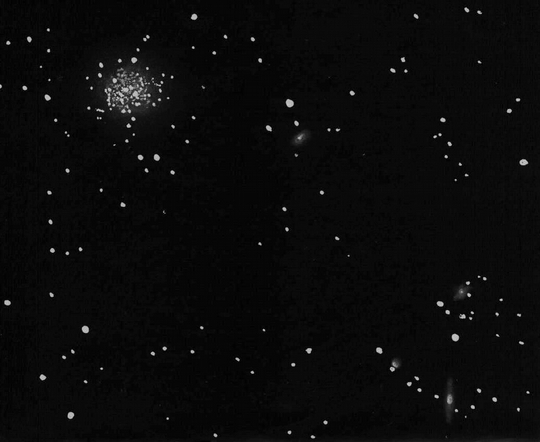
Sketch by Dale Holt with video assisted observing.
John Vickers' observation
- N7006 GC Del
- RA-Dec 21 01 29.2, +16 11 15
- Designation NGC 7006, Cald 42, GCL 119, IAU 2059+160.
- Brightest star visual magnitude: 16.-m.
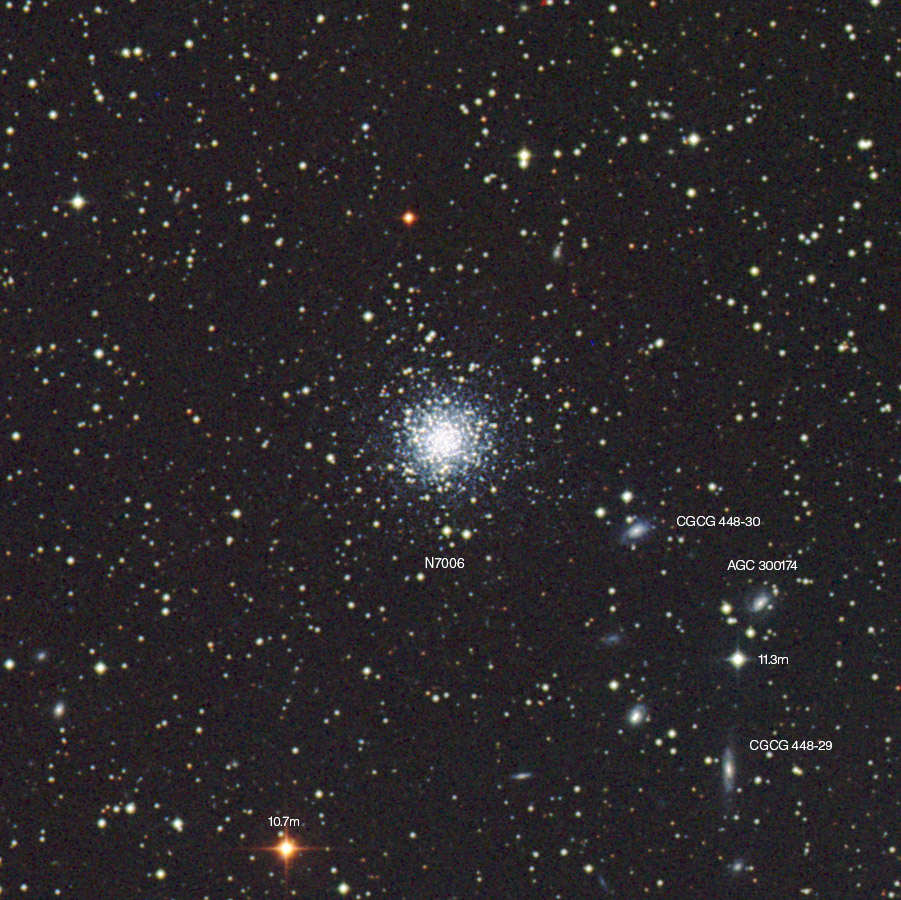
10.6m 2.8' 12.1SB. Extremely faint stars. A very remote loose group of 7 small, extremely faint galaxies is ~5.7' SW. 10.7m reddish star 7.4' SSE.
Dreyer Bright, pretty large, round, gradually brighter middle.
Other Globular cluster, mottled. Very difficult to resolve. Contains 71 observed variable stars.
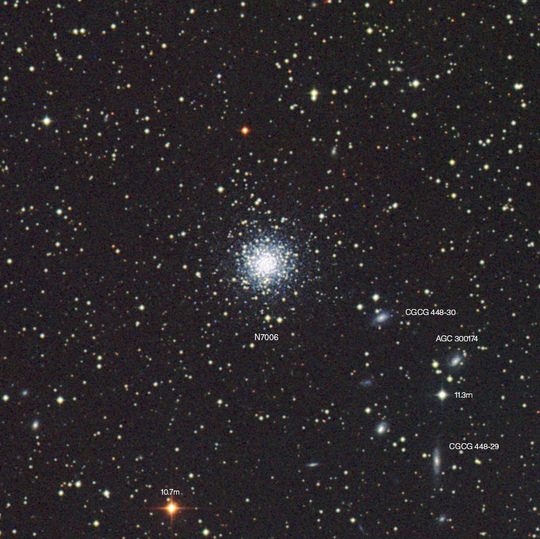
This is a POSSII combined IR-Red-Blue labeled image of N7006 from the BRO database. With those faint galaxies labelled.