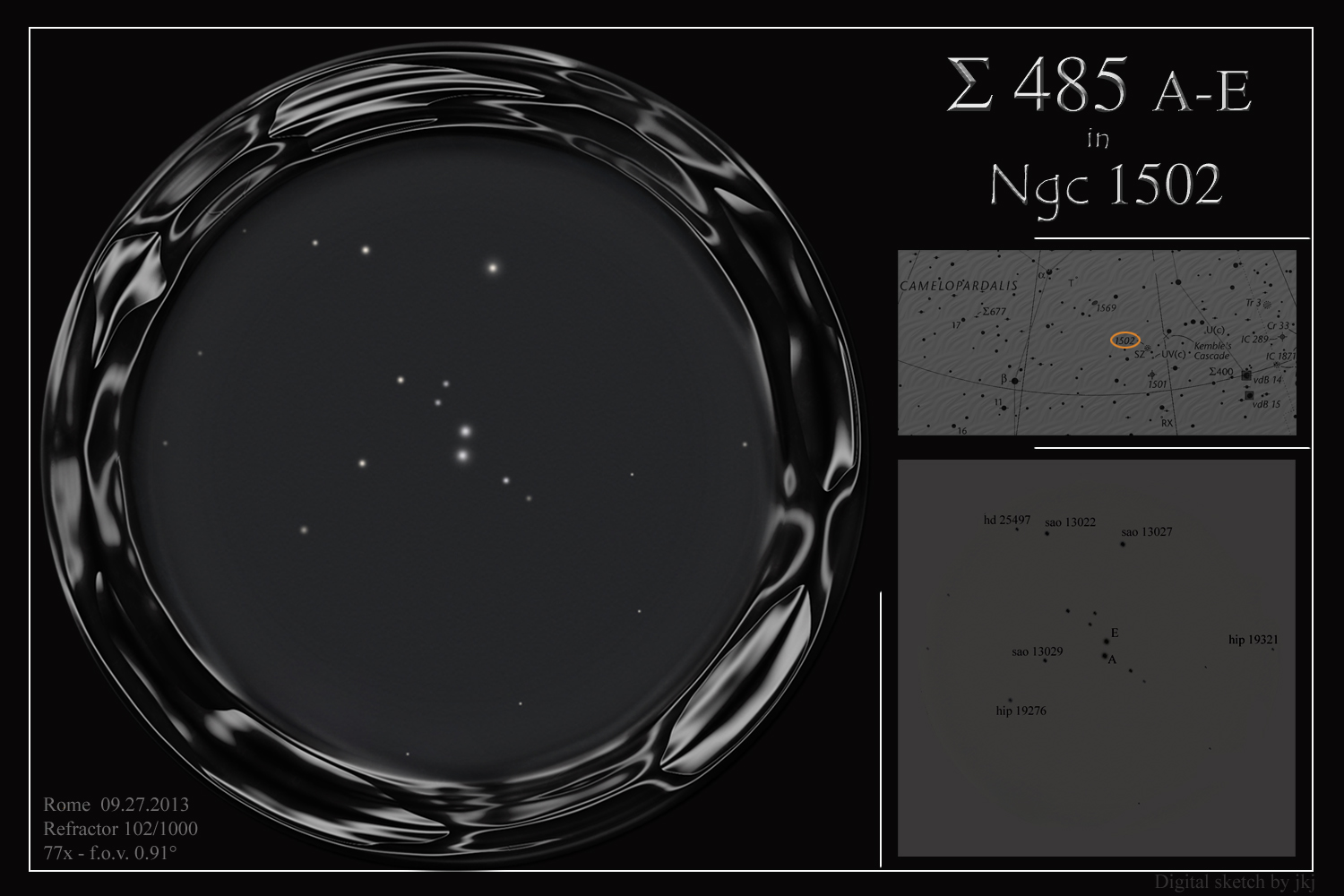
These are our observations of Double star
-
STF 485 and NGC1502 in Camelopardalis
Observed from Rome with a 102mm refractor at 77x magnification by Roberto Chiericoni - (27 September 2013).
-
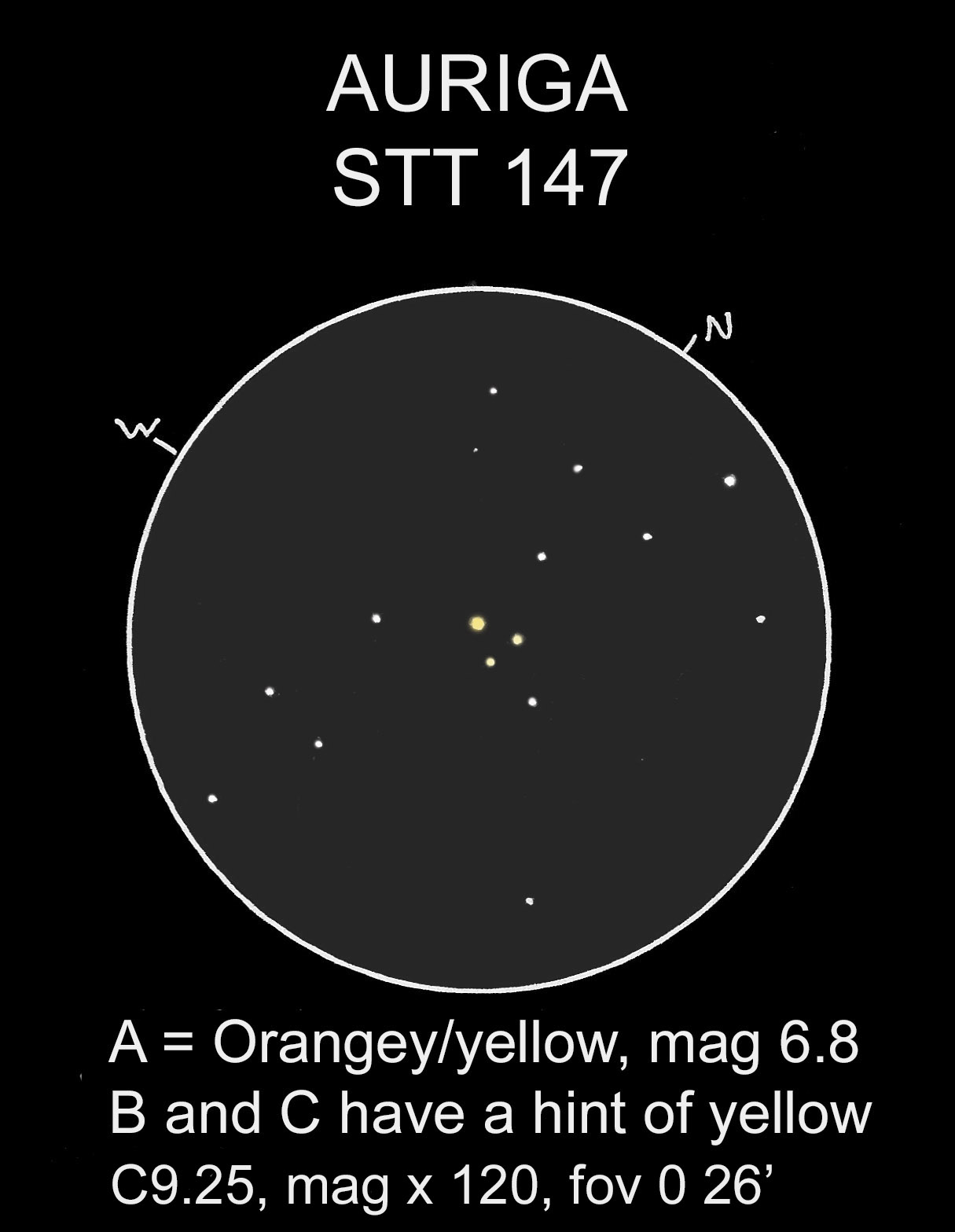
A tour around STT 147 in Auriga
I always look forward to the double of the month. STT 147 is one I have viewed before. The tight triangle of this multiple with the main star having a strong orangey/yellow colour is a lovely sight. Components B and C have a hint of colour; yellow?
When looking the double up on my planetarium I spotted the potential for a challenging tour of STT 147 and seven other nearby doubles.
I began by enjoying STT 147 at different magnifications and then star hopped to STF 929. A delightful pairing and both stars appearing to be yellow/orange in colour.
Next up was BU 194 in the same field of view. A trickier pair to separate at 1.5” and both showed a yellow tinge.
Moving this double to the edge of the eyepiece brought AG 116 into view; easier to split at 2.3” but fainter at mag 9.81/10.6.
STF 940 was now in the field of view. Interestingly so component B appeared distinctly orange despite being faint at a magnitude of 10.3.
In the same field of view was the star UU Aur (Bll 17), bright and a reddy orange with its faint companion 10.7 mag, 117” away.
The triple STF 928 required a nudge or two of the scope and there it was, a slender triangle. A and B easily split and component C (10.9) lying 128” away.
Normally I would be content at having found doubles with magnitudes around 10.0 but the chart showed Ali 822 (mag 12.8 and 13.2) and so with another slight nudge, combined with intense scrutiny I spotted the pair – delighted to have located them.
This left the final tweak of the scope’s position to bring me back to STT 147 and to muse on this very rewarding anticlockwise tour beginning and ending on the double of the month.
A C9.25 scope was used on the Ioptron Mini tower mount under NELM 5.0 skies.

Mike Wood - 8 January 2016
-
Taking opportunities when they present themselves
Ok, the weather has been pretty poor this Autumn around most of the UK. Lots of clouds and much warmer than normal. So you have to take your chances when they come up. Double stars are part of our remit and they don't need pristine skies as Andrew Robertson demonstrated in this observation.
Andrew's Observation Notes
I actually got a couple of hours in last night between about 8pm and 10pm. There was a small hole in the SE that just stayed there with cloud in the West up to about 70 degrees altitude and cloud in the East up to about 40 degrees altitude. Thin stuff kept moving across that window but even that was only patchy and not obscuring completely – strange. Did a few doubles around Auriga, Perseus, Taurus and the top of Orion.
Just for the record, doubles observed (mainly in the 4” Vixen FLS):
- Theta Auriga
- Omega Auriga
- 14 Auriga
- Triple and interesting one. I was using the Webb Soc Double star cards and it was given as 5.0, 7.3, 9.1 @ 14” & 10”, the fainter one being closer. The brighter companion was easy enough in the 4” but no way could I see the 3rd. I checked in the 12” Mewlon and it was direct vision but only just (poor seeing) so I decided the 3rd was fainter than mag 9.1 – maybe variable? Checked the books just now and it’s actually mag 11.1. Haven’t looked up WDS yet.
- 47 Tau
- Another difficult one. Given as 5.1, 7.3 @ 1.3”. Nothing in the 4”, just detected in the 12” but conditions not good for 12” - poor seeing in the 12”, not the best in the 4”.
- Phi Tau
- Chi Tau
- 20 Per
- Rho Ori
- 23 Ori
- Psi Ori
- 32 Ori
I found my recently acquired 13mm T6 nagler (for travel – light) was my favourite doubles eyepiece in the 4”.
Not a bad unforeseen session.
Andrew Robertson - 17 December 2015
-
Observation of STF2816 from Haw Wood
Double of the month (STF 2816), located in the Cepheus cluster Trumpler 37. It is a wonderful sight to see the three components sparkling away surrounded by a rich star field. I just could not resist a sketch.
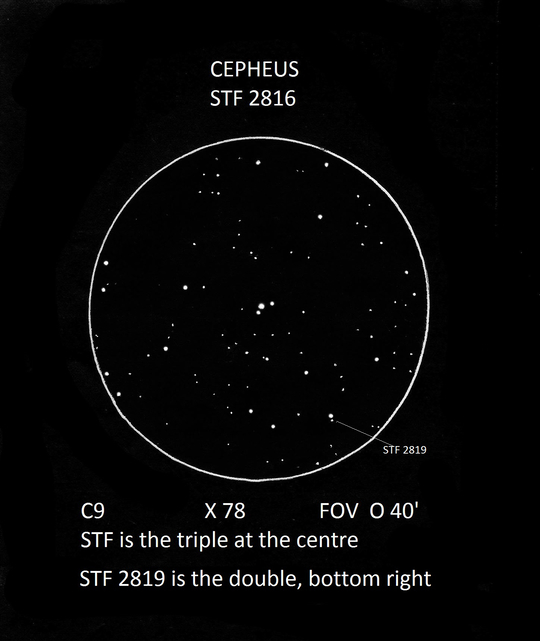
Mike Wood - 14 October 2015
-
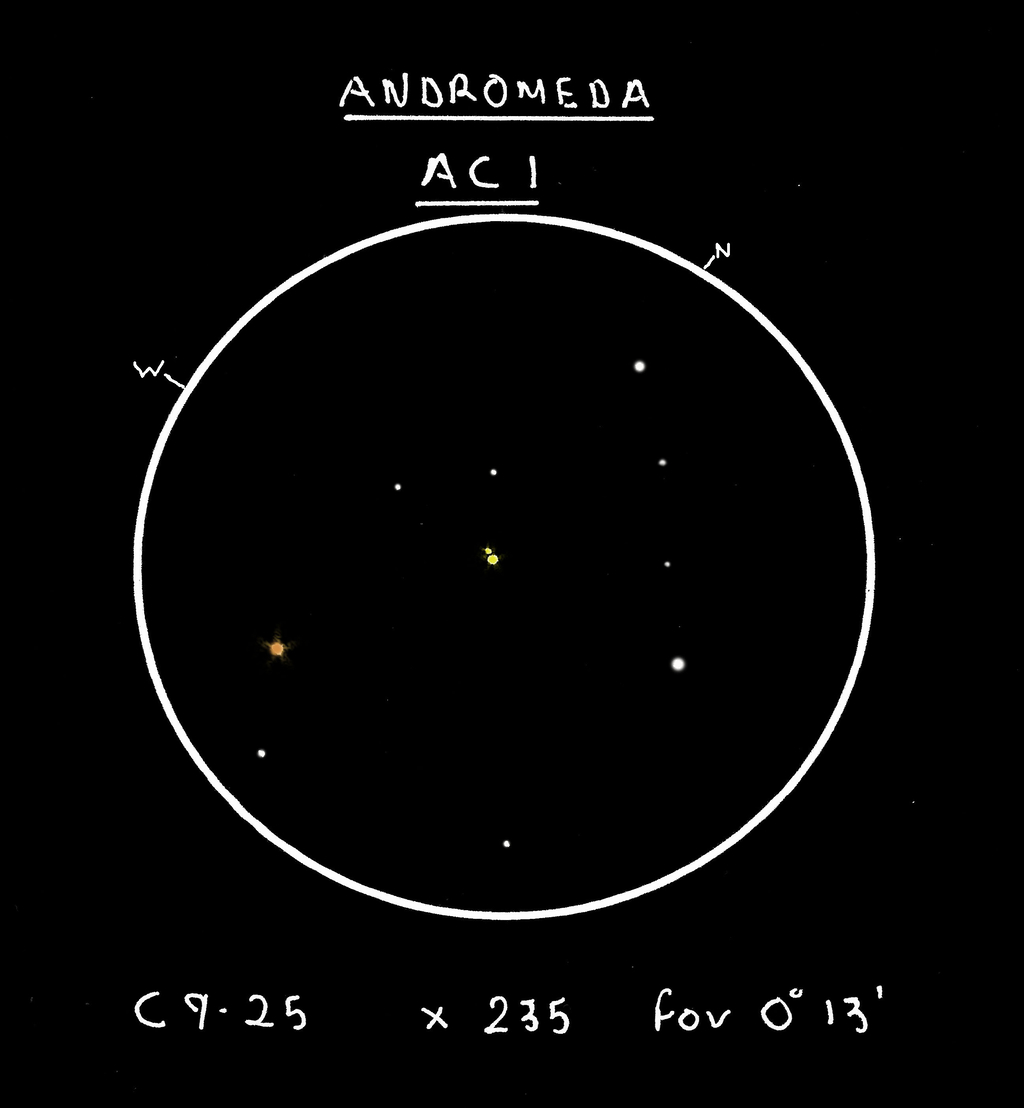
Double Star AC1 in Pegasus
Next up was the double of the month – AC1. I know a SCT C9 is hardly the scope for doubles but splitting the pair 1.9" was managed at x131 and became clearer at x235. Obviously not tight stars but still very pleasing.
The stars show a yellow tinge. AC1 sits in the middle of three bright stars which includes a lovely orangey/red star to the SW. See the attached sketch that was coloured in Photoshop.
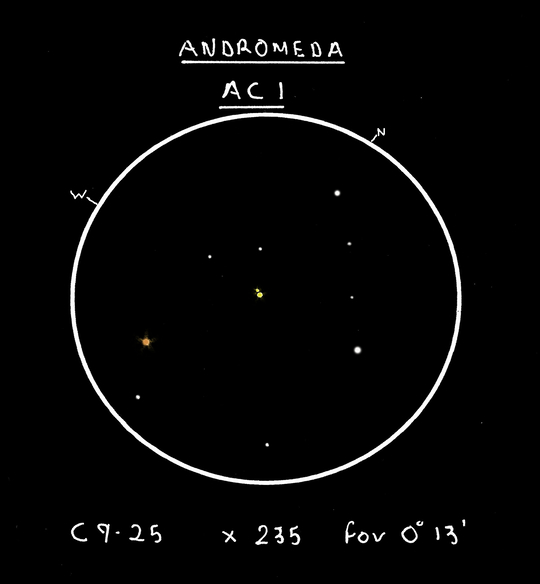
Mike Wood - 19 September 2015
-
20 Gem (STF924): a comparative observation
I look forward to double of the month not only because it will be worth observing but it provides a focal point for observing other nearby doubles.
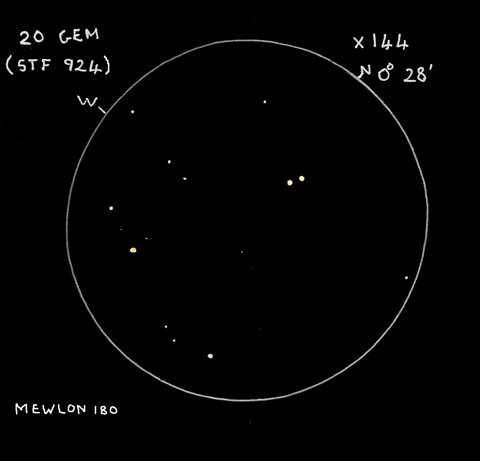
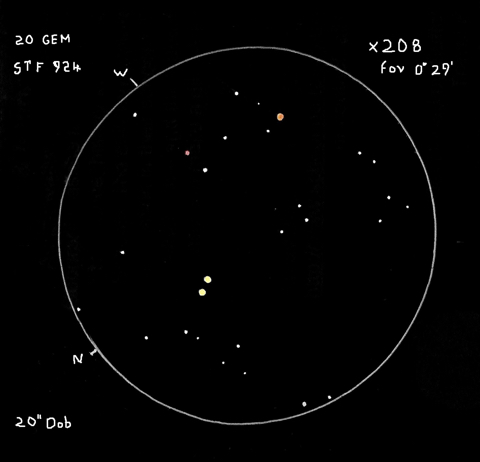
Notes
20 Gem (STF 924) is a real gem (pun intended) and although they are half a magnitude difference at first glance they appear equally bright. In the 180 Mewlon they are definitely white but not a clear sparkling white. The view in the Mewlon was nice with mag 11 stars just visible, and fainter ones noted using AV but as 20 Gem is so easy to locate, I quickly found it with the 20" Dob - the view went from nice to being "alive". The dob view just sparkled as mag 13 stars popped out all over the place. Both of the pair now looked a definite off white and a nearby star was clearly orange, another star had a hint of red. Going back to the Mewlon the view was disappointing after the Dob sparkle. I have attached two drawings, one with the Mewlon and the other with the Dob.
Mike Wood - (7 February 2015)
-
Another look at STF 644 and a new Atlas
I was convinced the sky would not be good last night so I just set up the grab&go 4" achro. 7 to 9.45 pm very cold with NELM 4.6.
As I was in manual mode I decided open clusters and doubles in Auriga using my new Interstellarum deep sky atlas. It shows doubles with a tail indicating PA and it's length and thickness an indication of separation and mag difference. This again proved very handy.
…Then by chance STF 644 (double star of the month), and to my surprise I was able to split this pair at 143x 7mm Nagler plus 2x barlow. Waiting for a brief moment of steady seeing two tiny points with a hair of a gap. Both looked off white.
As I was just travelling across the map somewhat randomly I was observing with no knowledge of separation just the notation shown on the maps. The PA indication on the map compared well with this tight pair in the eyepiece. Well chuffed.
Paul Webb - (19 January 2015) - 500mm fl Skywatcher Startravel 102
-
Observations of STF 644 and environs
I diverted to the double of the month, STF 644, which I first observed a week or so back, not knowing it would appear on the Webb Society page.
So it was great to go back to it and spend time on it. I gave it my best shot at colour detection and concluded white primary and red secondary - at x220.
But ever up for spotting more doubles in the same fov (lower magnification) there was BLL 13 (nice pair 8.8/9.5, sep 135") and just a little skip away lies SEI 105 (failed to see its mag 11 companion - bit silly trying in bright moonlight).
Another skip from STF 644 in the opposite direction and you land in cluster NGC 1778 with a triple (HJ3265) - using AV, x143 I got the two mag 10 stars but not the third mag 11 star.
Mike Wood - Takahashi Mewlon 180 (6/7 January 2015)
Just checked my records and I too had a go at STF 644 on 8 December 2014 with 7" mak. I was unable to split the pair but did note that I saw a figure 8. I didn't note magnification used, but I suspect it was 7 mm Nagler 254x.
Paul Webb - (8 December 2014)