These are our observations in Vulpecula
-
In the Region of the Summer Stars: The Coathanger Asterism
At last, I've had a few clear nights and managed to get out and enjoy the sky again. I decided to forego the forensic probings of my Ritchey-Chretien scope and take in more of the context around some of our summer objects. So, for the first time, I installed the ASI 071MC camera on my APM 107 refractor and included the 0.75x Riccardi reducer. This combination gives a focal length of 530mm and an image scale of 1.8 arcsec per pixel, which is a bit on the big side and gives around two pixels per star. Thus, the expectation was to see some blocky star images, which I have.
I have observed the Coathanger asterism previously but on this occasion, I deliberately shifted the "Coathanger" to the bottom of the frame so that I could explore the region to its north. The second night was plagued by high, thin clouds, which I did not see while imaging, but they became apparent during processing and produced a blue haze over the image. Rather than lose all the data, I used several tools and processing techniques to reduce the haze, and this image is the result of this work. There are over 19,000 stars in this image, says Pixinsight.

This image of the Coathanger asterism (Cr399) in Vulpecula is by David Davies and taken from Cambridge in the UK. To see more of David's work please visit his Flickr Photostream. Just for a bit of fun, I've been exploring the image and have identified the following objects of interest.
NGC6802: a 10th magnitude open cluster forming an extension of the coathanger bar to the east.

This image of open cluster NGC 6802 in Vulpecula is by David Davies and taken from Cambridge in the UK. IC1299: a very 14th magnitude open cluster to the northwest.

This image of open cluster IC 1299 in Vulpecula is by David Davies and taken from Cambridge in the UK. Sharpless 2-83, a 15th magnitude 2x2 arc-minutes HII region.
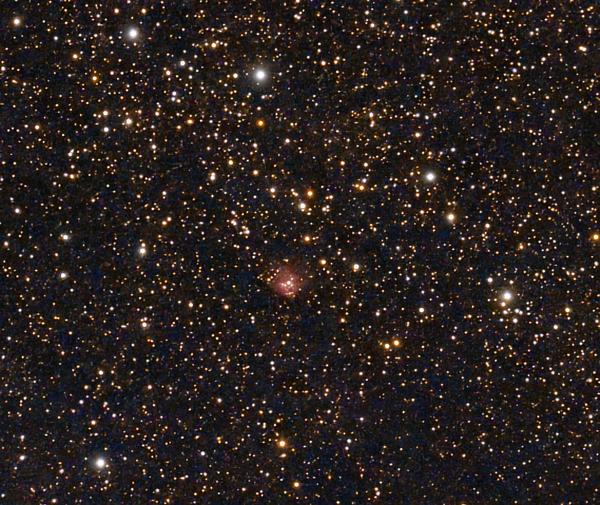
This image of the H-II region Sh2-83 in Vulpecula is by David Davies and taken from Cambridge in the UK. And three planetary nebulae from the Strasbourg-ESO catalogue of planetary nebulae that were discovered by Henize during the 1960s. These are small, faint objects on this image and took a bit of finding, but I think I have them. You might, of course, disagree, but that is fine.
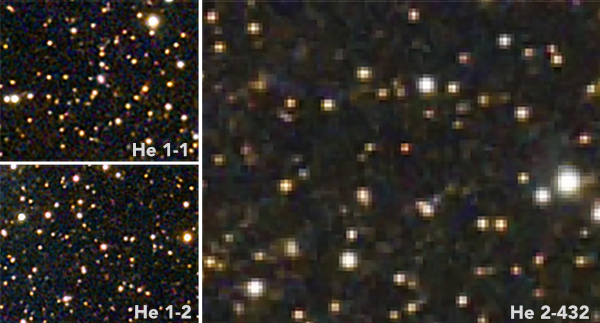
These images of the Henize planetary nebulae around the Coathanger asterism (Cr399) in Vulpecula are by David Davies and taken from Cambridge in the UK. - He 1-1: an 18.5 magnitude planetary nebula, 5 x 5 arcseconds
- He 1-2: a 17.2 magnitude planetary nebula, 5 x 5 arcseconds
- He 2-432: an 18.5 magnitude planetary nebula, 5 x 5 arc seconds
The images of these planetary nebulae have been copied from the original image and magnified. The nebulae are the pinkish star-like objects in the centre of the frame.
I'm astonished at the wealth of detail captured by my somewhat neglected refractor. The objects' brightness range is from 5th magnitude in the coathanger to 18th magnitude from the tiny planetary nebulae - that's around 140,000 times. It's time for a rethink on telescopes going forward, perhaps. I should go back to the objects using my RC telescope and see what it delivers.
Image Details
Data: 80 x 30s RGB sub-images collected on 27th and 28th July 2024.
- Telescope: APM 107 refractor with 0.75x Riccardi reducer flattener
- Camera: ZWO ASI 071 MC Pro
- Mount: Skywatcher EQ8
David Davies - (31 July 2024).
-
STF 2525 in Vulpecula
I look forward to the Double Star of the Month and this month was no exception.
On the evening of 10th August I geared up (OMC 200) just as the moon was rising behind cloud (and it stayed covered for my delightful 2 hour doubles session).
Using the Tak LE 30mm I sent the scope to STF 2525 and when I glanced into the eyepiece there was no sign of the double, although the view was a delightful show of pinprick stars.
Then as my eyes adjusted (such a pain getting old) there it was, just split at x133 and in the centre of the field of view – wonderful, to see this tight pair surrounded by many points of light. I marvelled for a few minutes before increasing the magnification to x267.
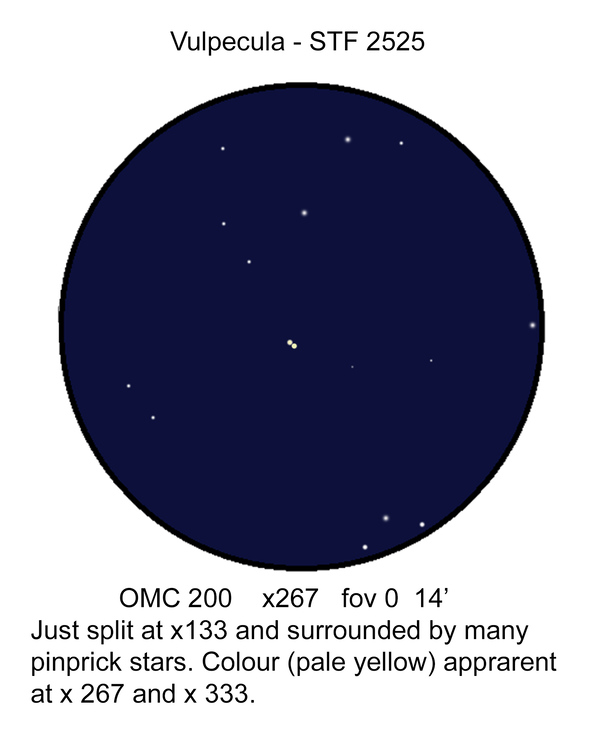
Double star STF 2525 in Vulpecula sketched by Mike Wood through his OMC 200. Both stars had a hint of colour. I plumped for orange/pale yellow. The colour remained at x333 and broken diffraction rings were in evidence.
Mike Wood - 11 August 2017


