These are our observations in Lyra
-
M56 in Lyra
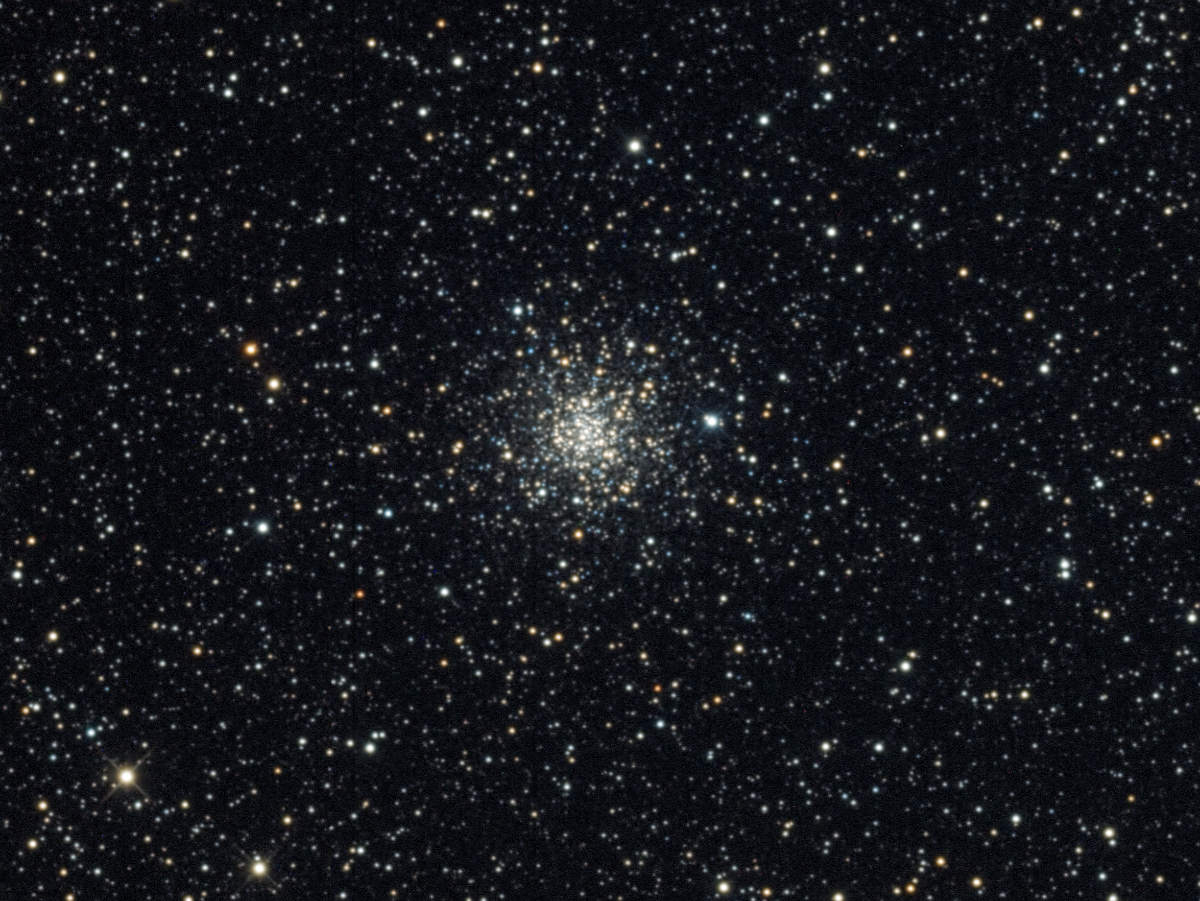
I'm continuing my observations of globular clusters so this is Messier 56 in Lyra.
Charles Messier found M56 on the 19th March 1779, on the same night he also discovered a comet. He reobserved M56 on the 23rd March and noted that it was a
nebula without a star and little light close to a 10th magnitude star
. Five years later, John Herschel succeeded in resolving this globular cluster into individual stars. He described M56 as afine compressed cluster, inclining to a triangular form, brighter towards the middle, with stars of 12th to 14th magnitude
.
This image of M56 was provided by David Davies and taken from Cambridge in the UK. To see more of David's work please visit his Flickr Photostream. Click on the image for the larger version. M56 has a very eccentric orbit around the galactic centre taking it from a few thousand light-years of the galactic centre out to 40,000 light years from the centre. M56 is currently 27,000 light-years from us as it traverses the outer half of its orbit. It has around 200,000 solar masses and is just one third the size of M13. The 25 brightest stars have an average magnitude of 15.3. Notable is the 10th magnitude blue-white star to the west (right side) which was noted by Messier.
Image Details
- Telescope: 8" Ritchey-Chretien at F/8.2
- Camera: QSI 583 wsg and Lodestar guide camera
- Mount: Skywatcher EQ6
This is an RGB image with five 5-minute exposures per colour captured on 5-6 August 2018.
David Davies - (17 September 2018).
-
Observations the June and July Galaxies of the Month
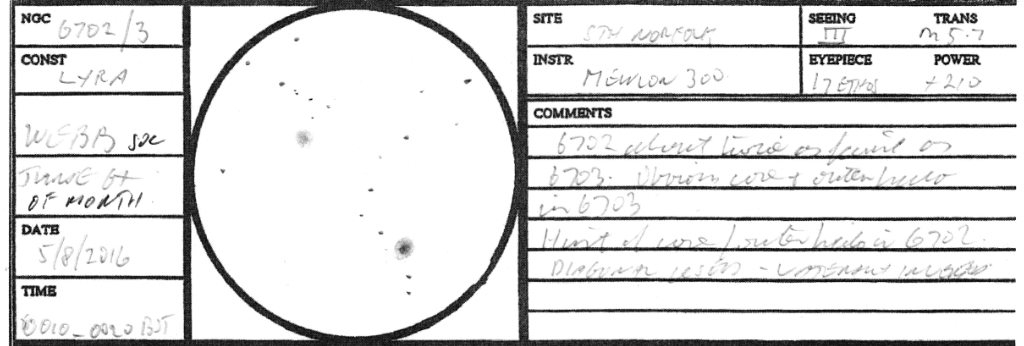
The skies were pretty good – about mag 5.7. I used the Mewlon 300 and 17mm Ethos (x210) for the sketches.
First off was June’s Galaxy of the Month; NGC 6702/3 in Lyra.
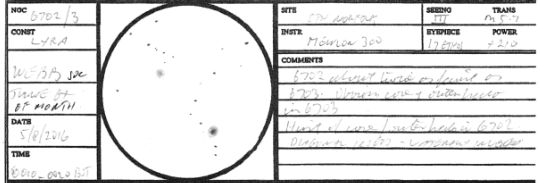
NGC 6702 was about twice as faint as NGC 6703 which had an obvious core and outer halo. Hint of core/outer halo in NGC 6702.
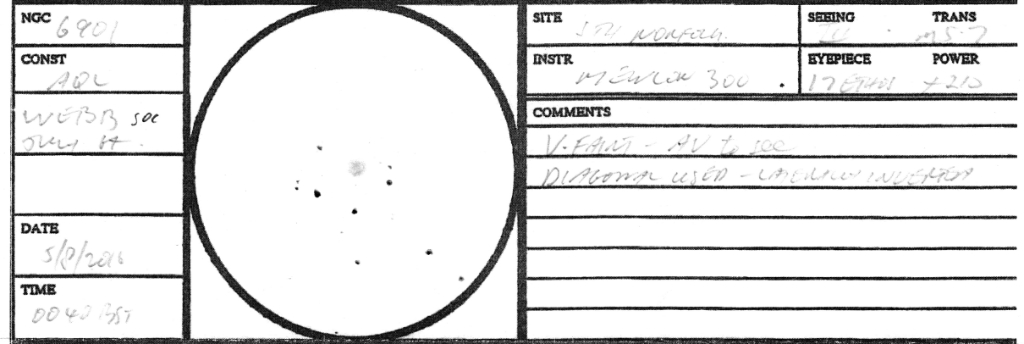
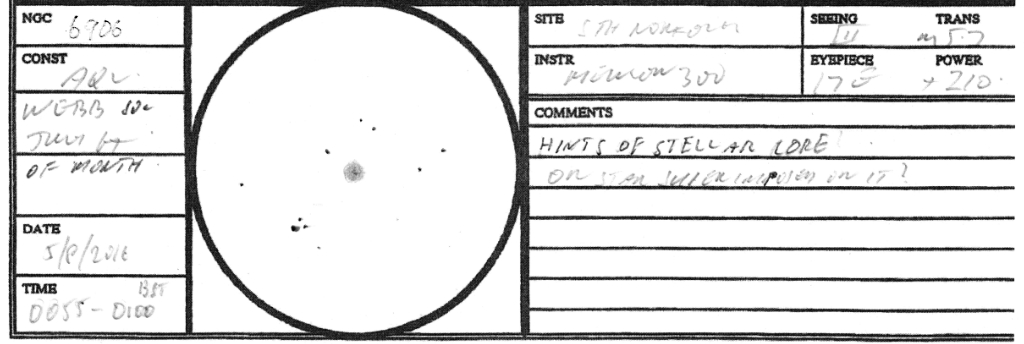
Next was July’s Galaxy of the Month; NGC 6901/6 but I didn’t realise until too late that NGC 6901/6 don’t fit in the same FOV so I’ve had to split them into two different sketches – Doh!
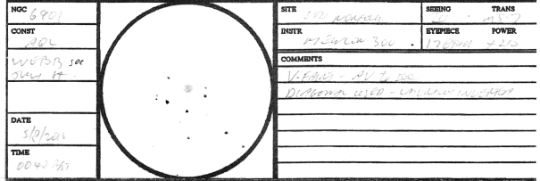
NGC 6901 was very faint, needed Averted Vision (AV) to see it. I thought NGC 6906 had a hint of a stellar core but looking at the maps Owen provided afterwards probably a star superimposed on it.

Andrew Robertson - 5 August 2016
-
The Ring Nebula (M57) in Lyra
For the first time in ages I got out the telescope for a very short session on Sunday night, 17 July 2016. The moon was about 95% full and it was my main target for the two hours I was out. The air was very warm at about 14°C and this was the first time I that I have observed wearing a short sleeve t shirt! It was so warm all my family came out to enjoy spectacular images of the Moon.
However, I did observe M57 and the lovely classic double Alberio in Cygnus. I normally use large dobsonians for my observing but this time I used my (apo) refractor, a CFF 127mm f7 on a NEQ6 mount. This made quite a change for me! I was out in the garden from about 22:00 until 24:00 UT. With a nearly full Moon it was not a night for deep sky objects but I just wanted to be outside with a telescope again.
I made my sketch of M57 using an Ethos 6mm eyepiece giving x148. The low contrast was exacerbated by the closeness of Cygnus to the Moon. The lovely M57 appeared as a dim smoky ring with a dimmer centre. The view was very different to that I normally see with the dobs!

I then turned to Alberio which I often look at. Although it is probably a hackneyed target for double star observers (of which I am not one) I never tire from looking at the lemon and pale blue pair. A real delight.
David Reynolds in South Norfolk (18 July 2015).
-
Observations of the NGC 6702 and NGC 6703
I was pleased to see these two galaxies made Galaxies of the Month. I made observations of both of them a couple of years ago, and have attached these. My observations were made during astronomical twilight, yet I managed to see both clearly (6703 more clearly than 6702). I was using a 12" f4.9 Newtonian reflector and my observation notes were as follows:
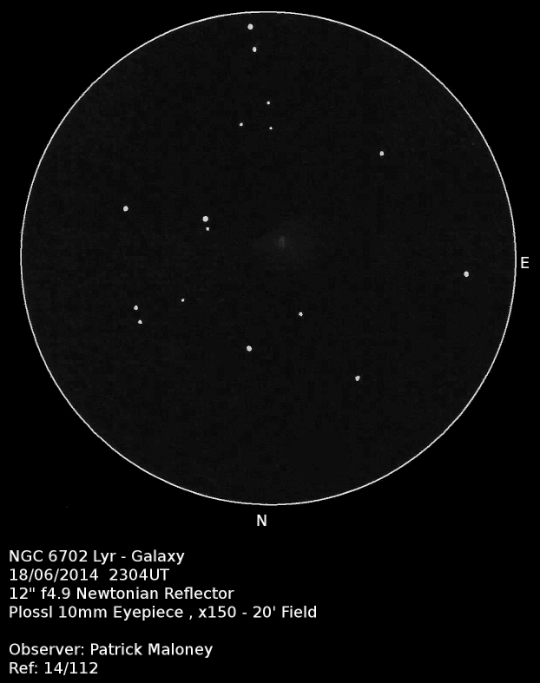
NGC 6702
18/06/2014 - Very small and very faint. Not always visible. Elongation was suspected, but no details were seen. Right on the edge of visibility.
23/07/2014 - Pretty faint and very small but clearly visible. Visible to direct vision at x375. Slightly elongated and slightly brighter in the middle.
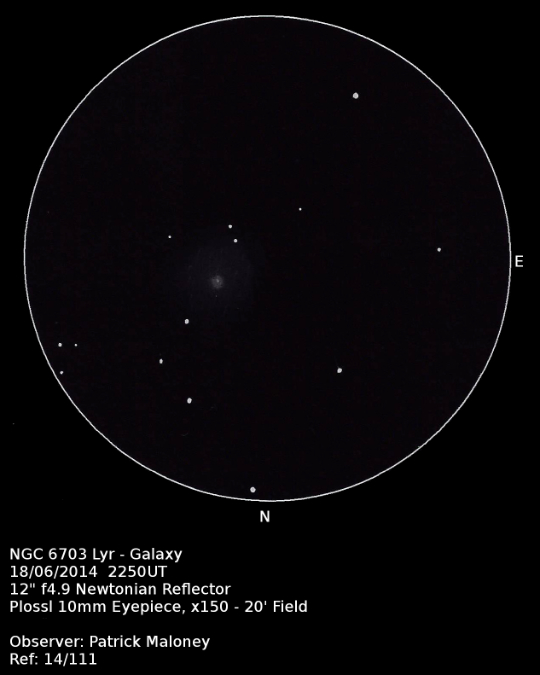
NGC 6703
18/06/2014 - At x150, this galaxy appeared very small, round and pretty faint with a considerably brighter centre. It is visible to direct vision but averted vision increases the outer regions hugely, making visible a large, amorphous outer disc. I think with AV I saw more or less the whole of the galaxy. Still steadily visible to direct vision at x375.
23/07/2014 - Pretty bright. Fairly small. Round at x150. Brighter middle - stellar nucleus? x375 confirms a tiny stellar nucleus. Nice little galaxy. The conditions on 23rd July were noticeably better than those on the 18th June, and this is reflected in my brightness estimates of the two objects.
Patrick Maloney - (10 June 2016).
-
NGC 6702 and NGC 6703 in Lyra
Observation made on 5th June, 2016 at 01.00am BST. NELM – mag 5.4. Steady seeing under summer skies.
I have often visited this pair in Lyra but never spent long observing them. They were both easily visible at x138 using a 17mm ethos eyepiece. NGC 6703 being brighter and larger than NGC 6702.
There is a lovely arc of stars running from NGC 6703 towards NGC 6702 and curving to the North East. They are mainly mag 10–11 stars with one brighter one.
Using the 13 mm ethos, x181, clearly shows NGC 6703 with a large, bright core and a definite circular halo. NGC 6702 shows as very slightly elliptical, with a smaller, less bright core and at least half the size of NGC 6703.
The 8mm ethos revealed no more detail. The best view was in the 13mm ethos. To the south of NGC 6703 lies UGC 11357 but even using AV I could not detect its presence.
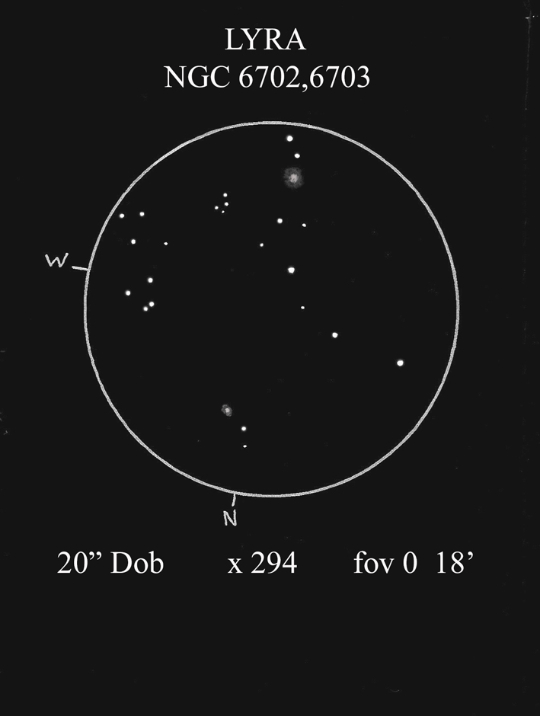
Using my OMC 200 at x133, showed NGC 6703 easily visible with a hint of a core within a halo but no sign of NGC 6702. The wider fov gave a pleasing context to the pair with the arc of stars running from NGC 6703 being identified.
Mike Wood - 5 June 2016
-
Observation Report: NGC 6745 in Lyra
The forum has sparked something a little different this time. There was a discussion about the future of visual observing, and the role of imaging in amateur astronomy. Controversial, I know, but it's also spawned a flurry of observation posts.
The first object to get experienced observers searching their logbooks was our June Galaxy of the Month: NGC 6745. I've chosen to summarise these in a single report. I hope to get the chance to do this again in the future, so keep the observations coming.
Observation by Patrick Maloney

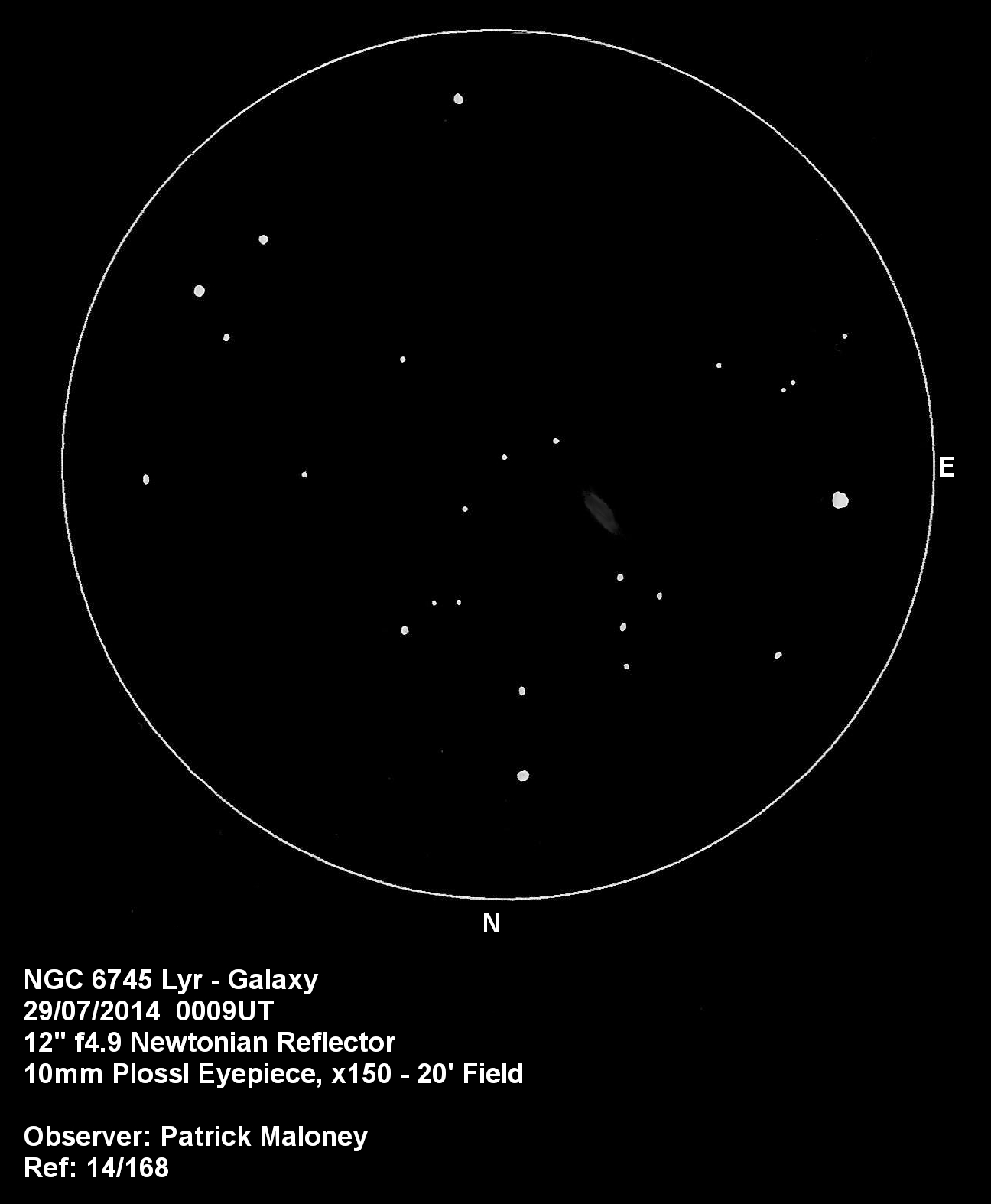
I observed this object in July last year as one of my Twilight Observations, following on from the June observations I wrote about in DSO 167. The observation was made with a 12" reflector from murky, polluted, twilit skies.
This galaxy is clearly very elongated and lenticular. It was reasonably bright, being mostly visible to direct vision. x375 revealed a hint of a stellar nucleus and some darkness along the western edge, a hint of some sort of structure.
Observation by John Vickers

Direct observation:
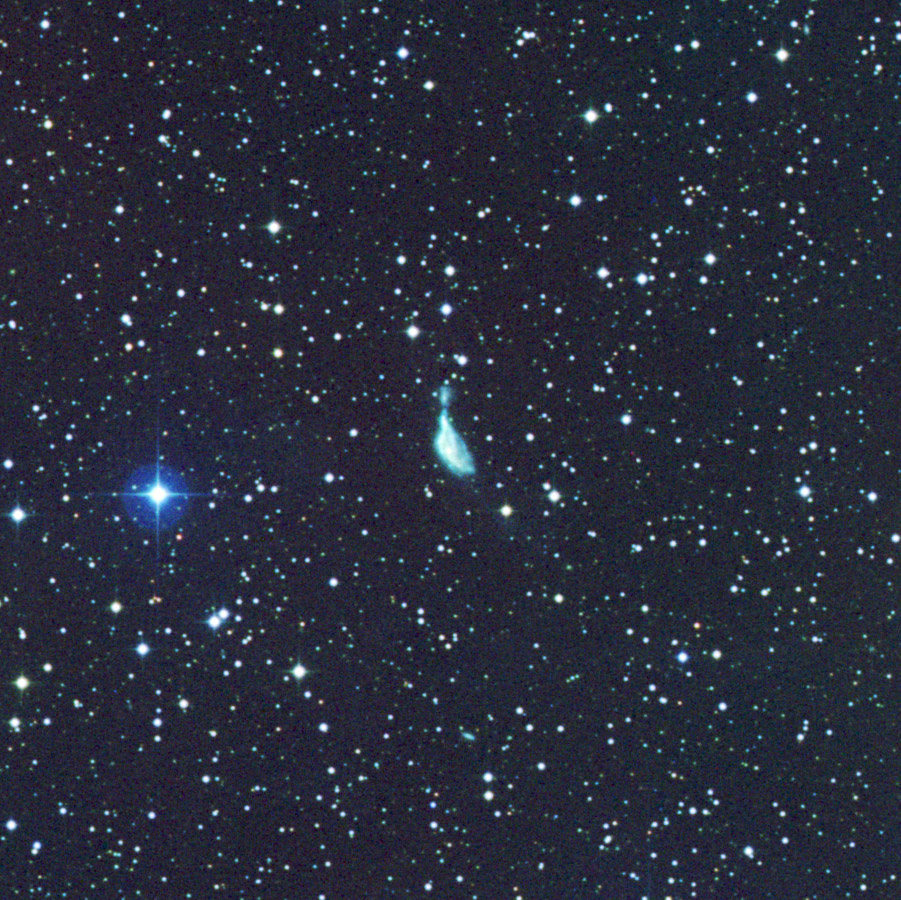
07/2012, 4” maksutov; dark/still/v.clear, Duxbury, MA. Small, faint feather of irregular intensity. Minor "companion" just N not observed.
I've included a POSSII integrated IR-Red-Blue image.
Observation by Andrew Robertson

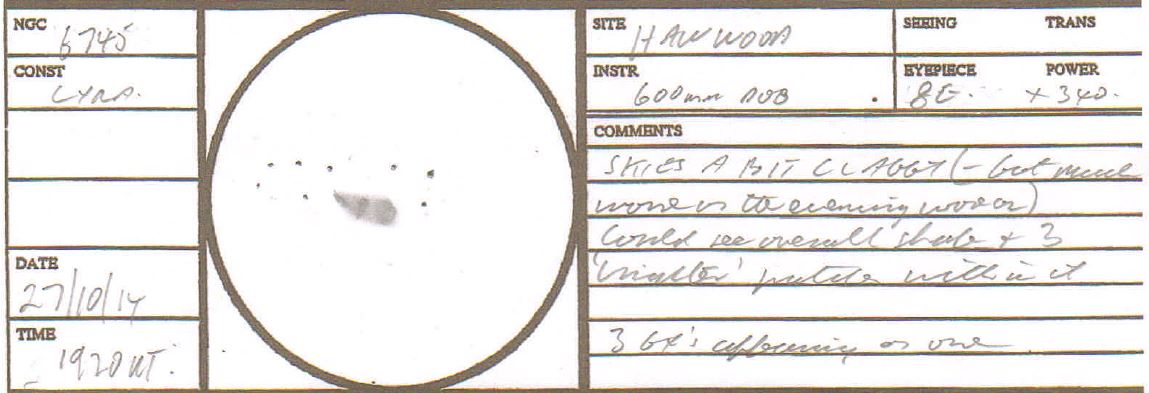
This is my sketch of NGC 6745 that I did in October 2014 with my 600mm Dobsonian at x340.
Observation by Dale Holt

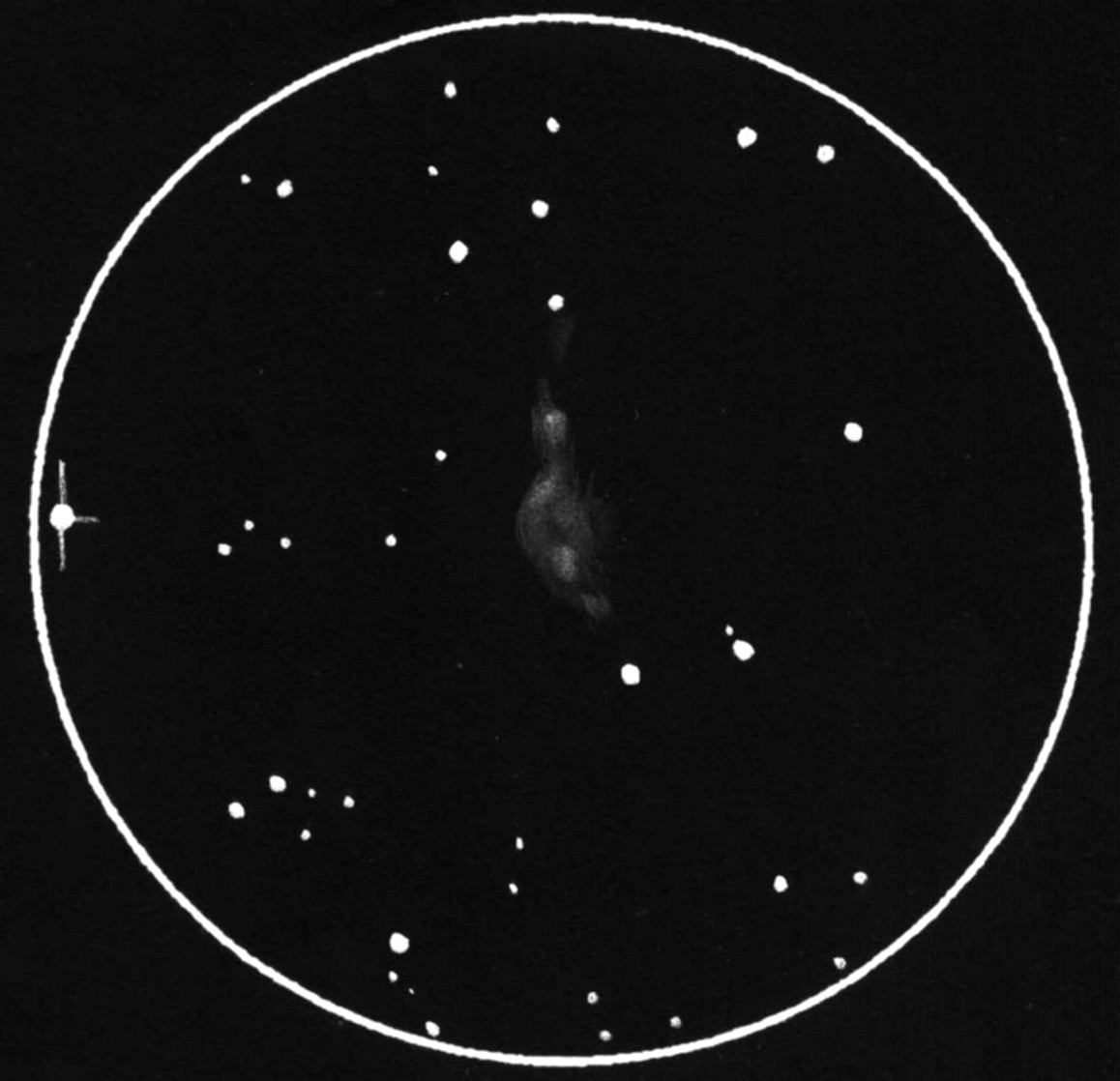
A faint but delightful galaxy in Lyra, it appears to be shaped like a banana when observed visually with the large aperture instrument.
The 505mm F3.7 Newtonian working with the amazing Watec 120N+ Deep Sky video camera revealed very interesting structure which I felt resembled the Treble Clef musical symbol. This observation was made on October 6th 2010.