These are our observations in Coma Berenices
-
Messier 91 (NGC 4548) and Starlink Satellites in Coma Berenices
Messier 91 was discovered by Charles Messier on March 18 1781, and at magnitude 10.2, it is the faintest object in his catalogue. However, he made a mistake recording the position of M91 and other observers could not find any object at its recorded location. William Herschel observed the same galaxy on April 8, 1784.
M 91 became one of the "missing Messier objects", and it wasn't until 1969 that amateur astronomer, W C Williams, reconstructed Messier's mistake in recording the position. There are few bright stars in this area of the sky to provide fixed points, so Messier had recorded the location of M91 relative to another galaxy. Messier had recorded the position relative to M89, but Williams wondered if he should have written M58, rather than M 89. He tested this hypothesis and landed on NGC 4548 to better than one minute of arc. So M91 is now accepted as NGC 4548.
M91 is classified as an anaemic galaxy, that is a spiral galaxy with low star formation and gas content compared with other galaxies of its type. The core and bar are relatively bright, but the outer regions and spiral arms are very faint with a surface brightness around mag 22/arc-seconds-sq, providing a tough observational challenge.

This image of the galaxies Messier 91 (NGC 4548) was provided by David Davies and taken from Cambridge in the UK. To see more of David's work please visit his Flickr Photostream. Click on the image for the larger version. On the evening of April 25, my data gathering was interrupted by the passage of a stream of Starlink satellites. One of my red subs captured the passage of three of them through Coma Berenices around 20:12 to 20:22 UT. The camera shutter closed as the last one crossed the field of view. I've used this sub as a luminance layer on the finished image to give an impression of their appearance.

This image of the Messier 91 (NGC 4548) and intruding Starlink satellites was provided by David Davies and taken from Cambridge in the UK. Image Details
Data were gathered between April 20 and 26, and test subs confirmed the faint nature of the outer regions of the galaxy. The image, therefore, comprises 50 x five-minute luminance and 15 x 10-minutes, each of RGB, binned 2 x 2.
I processed the image in Pixinsight and used the photometric colour calibration tool to check the star colours. The galaxy has a B-V value of 0.8, that is the orange side of white, so I think the presented colour is more or less correct.
- Telescope: 8" Ritchey-Chretien.
- Camera: QSI 683 with Astrodon filters.
- Mount: Skywatcher EQ8.
David Davies - (13 May 2020).
-
NGC 4314 in Coma Berenices
A single sketch of a wonderful face on barred spiral in Coma B NGC 4314 from April 4th. Starlightxpress Ultrastar digital video camera and 505mm mirror used.

A sketch of NGC 4314 by Dale Holt from his Chippingdale observatory in Hertfordshire. Dale Holt - (8 April 2018).
-
Globular Clusters in Coma Berenices
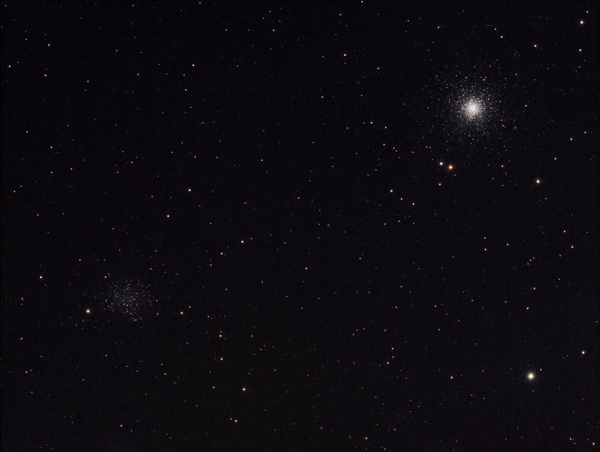
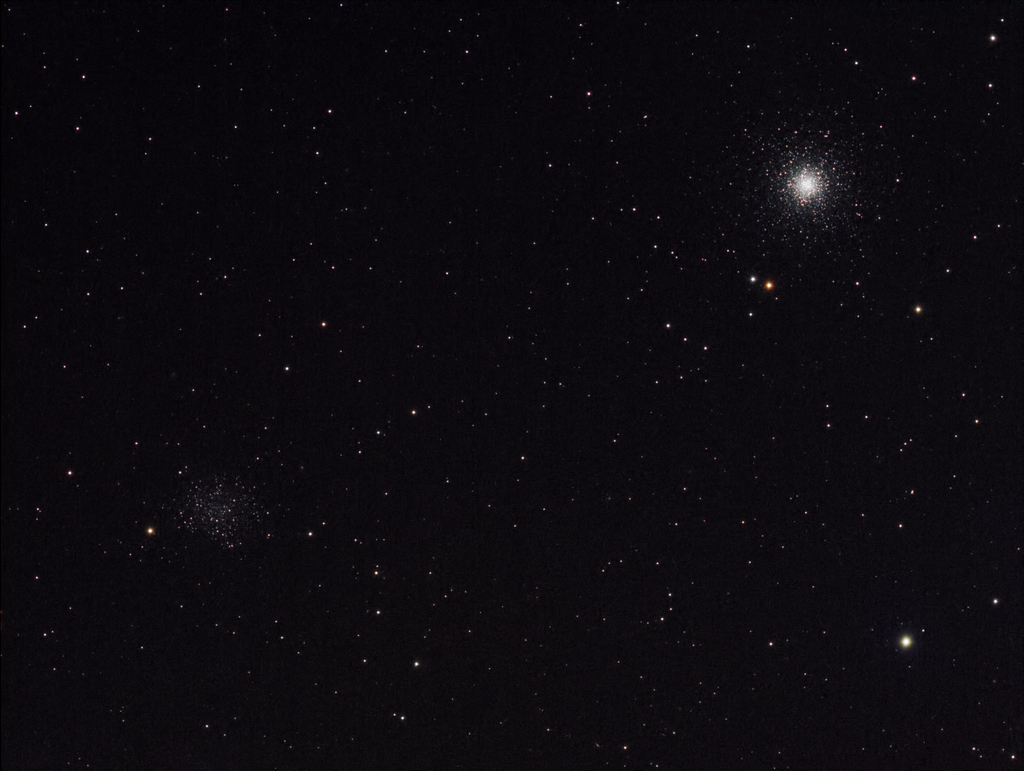
This image was provided courtesy of David Davies from Cambridge in the UK. To see more of David's work please visit his Flickr Photostream. Here is the product of my last successful imaging session before the autumnal rains started.
M53, NGC 5024, in Coma Berenices is at top right of this image. It is around 60,000 light years from us and in absolute terms is larger than M13, but appears smaller and fainter due to its greater distance; the 25 brightest stars have an average magnitude of 15.
To the east of M53, at bottom left, is NGC 5053. This is classified as globular cluster but it has a low star density and low metallicity stars; it is around 53,000 light years from us.
This image was captured in early May under brightening night skies with a 107mm APM refractor and QSI 583 camera. It is a simple RGB image of 30 minutes each colour in 2-minute subs.
David Davies - (6 June 2017).
-
Observation Report: NGC 4725 in Coma Berenices
The second object in my new series – I hope – of observation reports was sparked by our June Picture of the Month: NGC 4725.
David Davies' astrophotographic search for the outer halo of this galaxy was considered on the forum to be one of the ways that astrophotography can work well with visual observation. So several members have submitted their observations to accompany David's image.
The forum discussion was varied, and I hope the gentlemen below won't mind me paraphrasing them a little to focus on the observations. It's an interesting thread. I'd encourage members to join the Yahoo Forum (mailing list) and take a look. Perhaps air your own views too.
It'd be good to spark off joint imaging and visual projects with our monthly features. All contributions are welcome.
Observation by Andrew Robertson

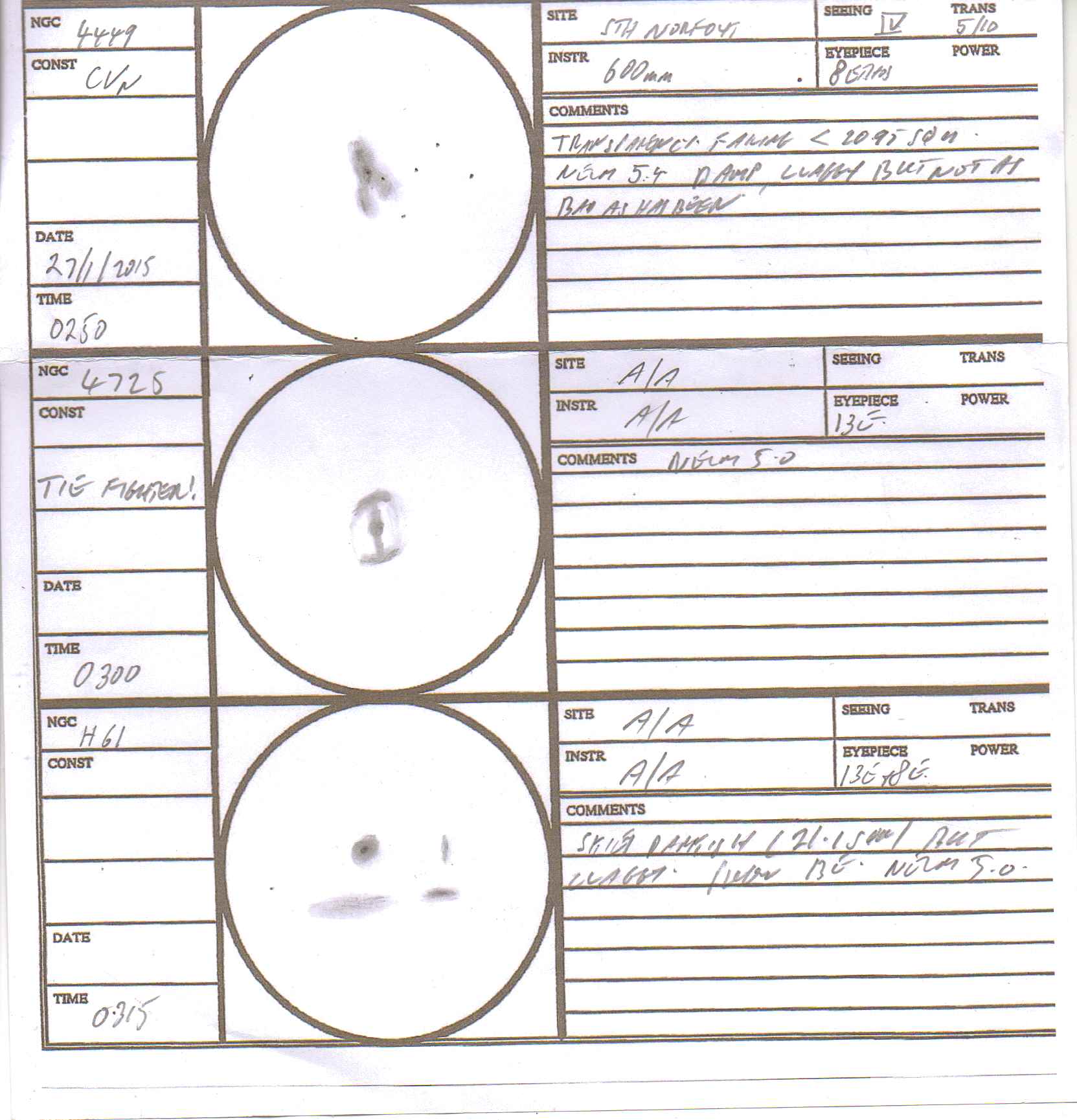
I thought it timely to post a sketch I made of NGC 4725 from home in South Norfolk using my 600mm Dobsonian. The skies were damp, claggy and failing with a NELM of 5.0 when I made the sketch.
I observed the object for several minutes trying various powers. At this point I’m just enjoying the view. NB, I call it ‘the Tie Fighter’ as the arcs at either end are very prominent along with the central bar and core. At moments of better transparency the ring all the way around comes into view, I then think it looks like a ‘Theta’ symbol.
I’m not an artist, I just make a quick crude sketch to assist my record of the observation but as you can see from the attached sketch I enjoyed observing and sketching 3 objects in the space of half an hour.
Observation by Patrick Maloney

I hold my observing sheet on a clip-board as I look through the eyepiece. In this way, every time a detail comes into view, I can make a note of it straight away. Like you, Andrew, I often spend time just looking at and enjoying the object.
As to NGC 4725, I observed this object most recently in April last year. My sky conditions were good (for here) giving me a NELM of around 4.5. I noted the following about the galaxy: Bright, pretty large and elongated. There is a brighter central area that is also elongated. Dark lanes were suspected on either side of the nucleus, that to the south east being the clearer. Visible at x83.
I didn't see the 'Tie-Fighter' effect. I suspect lack of inches and poorer skies hindered me there, though experience tells me that I actually have enough inches, but need a better sky. When I write of suspicions of dark lanes, this is usually prompted by a sharp cutoff of the light in a galaxy, or of a rapid dimming. Having now compared my observation with photographs, I am satisfied that this is the case.
Observation by Dale Holt

Hi All here is my NGC 4725 sketch.
Face on mag 9.4 spiral in Coma Berenicies paired with smaller NGC4712 shown in the sketch. Sketch made using 505mm Newt & Watec 120N+ video camera on April-21-2010 noted as very hazy brightest star visible mag 2.5, need to revisit under better conditions, I still haven't!
-
Sketch of Supernova SN2014L in M99
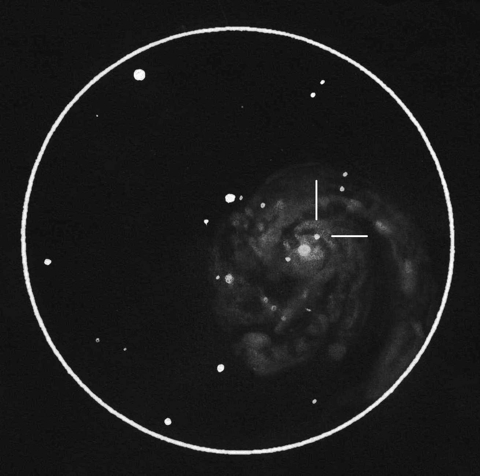
Sketch Courtesy of Dale Holt, Hertfordshire, UK. Please click on the sketch for a higher resolution version.
Dale's Observation Comments
At last I caught the supernova in M99, I made this sketch using the 505mm mirror and Watec 120n+ video camera on Thursday 27th Feb. Clear Skies to you.



.jpg "SN2014L in M99 - Sketch Courtesy of Dale Holt")
