Nebula and Cluster of the Month Archive 2026
In this series of articles we draw your attention to Nebulae, Clusters and other Galactic objects that are particularly worthly of an observer's time.
-
Collinder 95 and NGC 2245 in Monoceros
January 2026 - Nebula and Cluster of the Month
I’d like to start by wishing you all a very happy and prosperous new year.
This month we’re going to look at an object which at first looks straightforward but which presents a conundrum if we dig deeper.
The object is the open cluster Collinder 95 in Monoceros. It’s not a bright, splashy cluster but nevertheless deserves some attention. It was first listed by the Swedish astronomer Per Arne Collinder (1890—1975) in his catalogue of open clusters, published in 1931. Collinder’s catalogue appears as an appendix to his paper On Structural Properties of Open Galactic Clusters and their Spatial Distribution. The purpose of the study was to provide a systematic collection of objects with measured (or at least estimated) quantities – position, apparent diameter, number of stars, total magnitude, concentration, etc. – as the basis for a discussion on how clusters differ in structure, richness and spatial placement within the Galaxy.
Collinder listed 471 objects – not all of which were open clusters. There are a few globular clusters and asterisms, but the vast majority are open clusters. Many of the objects were already known and had previous catalogue entries. About 60 were new identifications. Cr 95 is one of these.
With the proliferation of catalogues these days, Cr 95 now has other designations: Lund 225, OCl 491 and the soulless C0627+099. It also appears to be no. 14 in the obscure Alessi catalogue of ‘unknown open clusters in the Tycho-2 catalogue.’
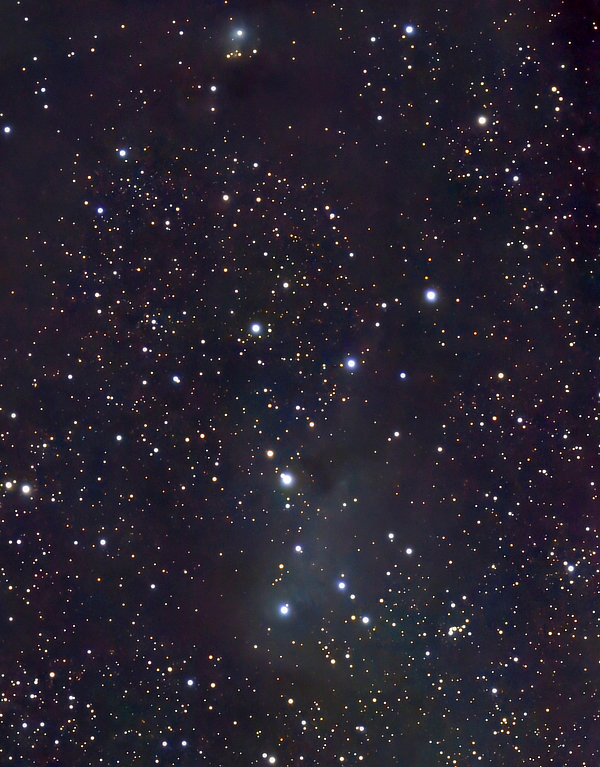
An image of open cluster Cr 95 surrounded by the nebulosity of NGC 2245 in Monoceros by Patrick Maloney with his ZWO Seestar S50. Cr 95 has in the past been rather poorly studied, often being overlooked because of its relative sparseness. The European Gaia satellite, launched in 2013 and operational until 2025, provided unprecedentedly accurate astrometry for billions of Milky Way stars. This dataset has allowed for far more detailed investigation into hundreds of open clusters. Importantly, Gaia data allows for a much more certain membership selection for stars in sparse or widely scattered clusters. In the case of Cr 95, its existence as a true cluster has been confirmed, and that it lies relatively nearby (a few hundred light-years). It is a young cluster, certainly, but here we hit a snag. Two standard ways for determining the age of an open cluster are isochronal aging and kinematic aging. The isochronal age of a cluster is determined, basically, by the spectral analysis of the member stars. Different mass stars will evolve at different rates, and numerical analysis is performed to determine the cluster’s age from the spectra of its member stars. Kinematic ageing is based on the motion of the stars, which are assumed to have had a single place of birth.
The problem with Cr 95 is that these derived values do not match. Specifically, the kinematic studies return an older age than the isochronal studies. The conclusion drawn from this inconsistency is that the member stars of Cr 95 did not have a single birthplace.
Cr 95, then, may be a representative of clusters whose origin is distributed or partly unbound, as opposed to the more common ‘monolithic’ open clusters. The member stars, then, are cousins rather than siblings.
To find Cr 95, you’ll need to move 8.5° east-north-east of Betelgeuse (α Orionis). Alternatively, start at the much better-known open cluster NGC 2264 and move 2.5° due west.
The cluster fills an area about the same size as the full moon. The brightest stars are of eighth- and ninth-magnitude, but do stand out against the background. The cluster is better seen on low, finding powers.
There is much nebulosity mingled with the stars of the cluster. This carries various designations, individual sections being labelled vdB 76, vdB 77, vdB 78 and vdB 79. Overall, it is classed as IC 447.
The brightest of this nebulosity is in the southern half of the cluster, gathered around a triangle of eighth and ninth magnitude stars. Curling north from this, through the rest of the cluster and beyond, is a great semicircular dark nebula, LDN 1599.
The image that I took with my SeeStar 50 shows this clearly. Not visible in the image but just off the top left of it, the dark nebula curls round to a bright patch of nebulosity around a 10.4-magnitude star. The star is 3UC201-059373 and the nebula is NGC 2245.
NGC 2245 is clearly visible in a modest telescope. My observation of it through my 12” Newtonian reflector is shown. On that night, I described it as
A small, bright nebula around a tenth-magnitude star, stretching away from it like a short cometary tail.
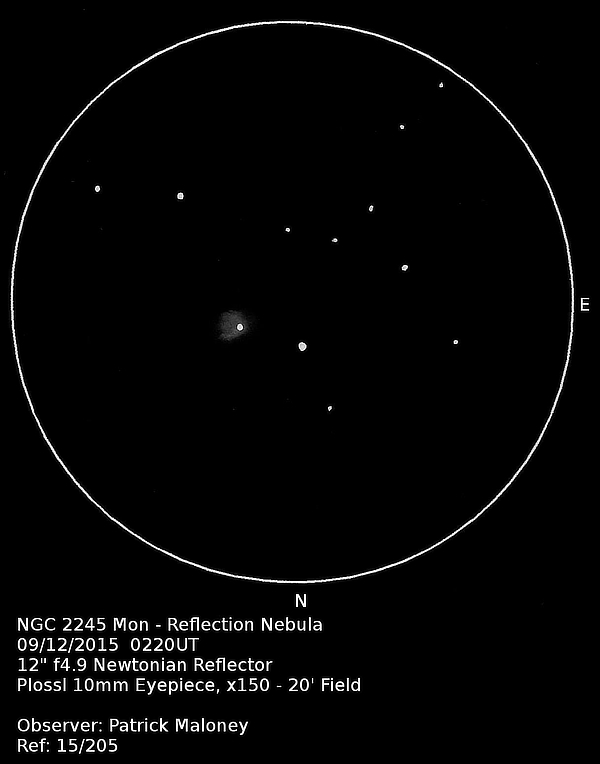
A sketch of reflection nebula NGC 2245 in Monoceros by Patrick Maloney through his 12-inch newtonian telescope at x150 magnification. Whilst the nebulosity around Cr 95 is clear in long-exposure images, it is far from clear visually. I suspect that the clearest sky and some hefty aperture would be needed to see it. I certainly never have.
If you use the Guide 9 planetarium program, note that Cr 95 is immediately to the east of where the cluster is marked. The position is correct in MegaStar.
Object RA Dec Type Magnitude Cr 95 06h 31m 09s +09° 51’ Open cluster 8-ish NGC 2245 06h 32m 42s +10° 09’ Bright nebula - If you'd like to try out the Clear Skies Observing Guides (CSOG), you can download observing guide for the current Cluster of the Month without the need to register. CSOG are not associated with the Webb Deep-Sky Society but the work of Victor van Wulfen.


