The Webb Deep-Sky Society

An international society of amateur and professional astronomers specialising in the observation of double stars and 'deep sky' objects founded in 1967. Membership is open to anyone who shares the interests of the Society.

  • About Us
  • Membership
  • Deep-Sky News
  • Galaxies
  • Nebulae and Clusters
  • Double Stars
  • Publications
  • The DSO
  • May 2014 - Galaxy of the Month

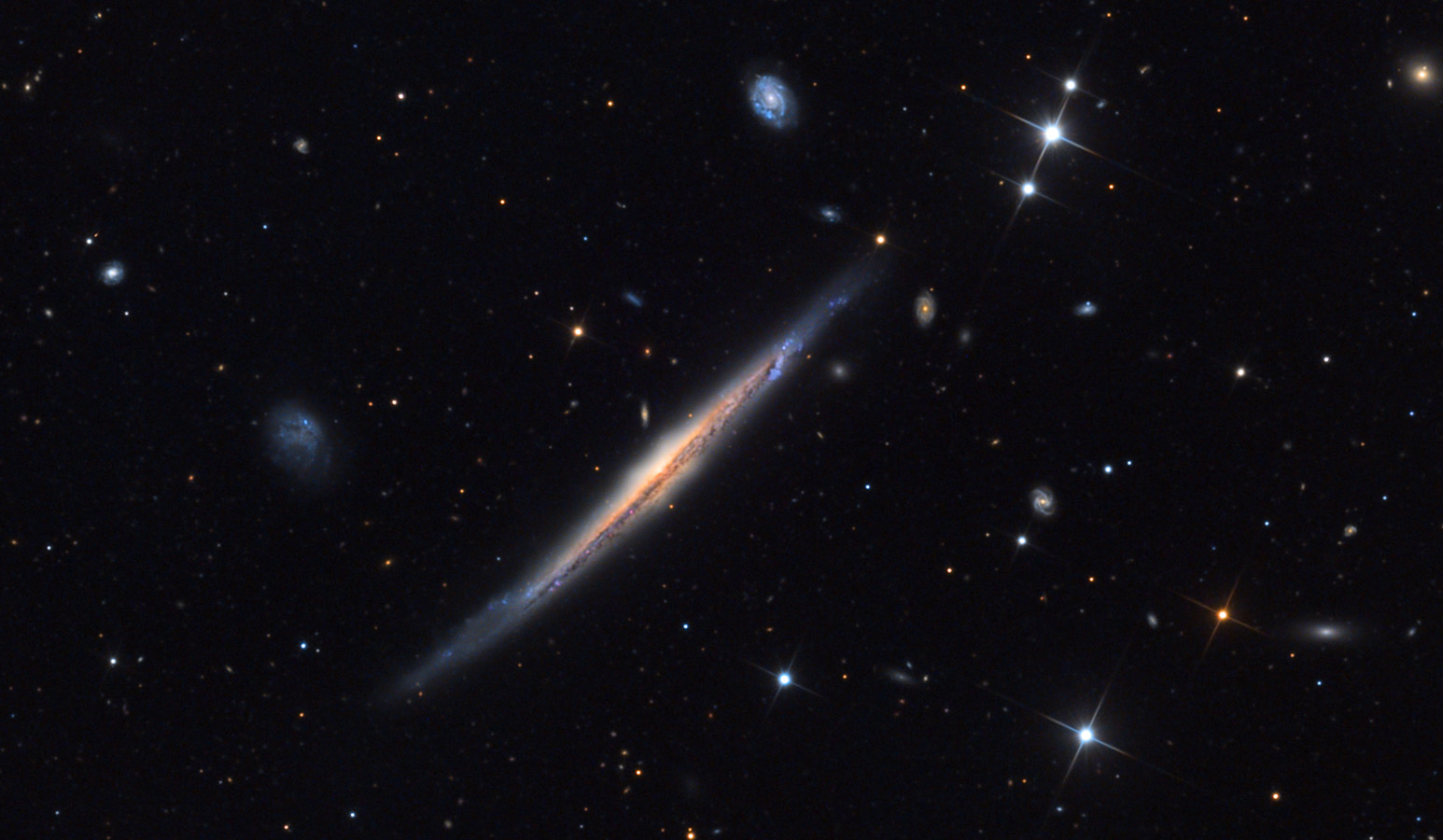
    NGC 5529 in Boötes

    NGC 5529 - Image Courtesy of Adam Block/Mount Lemmon SkyCenter/University of Arizona

    Image Courtesy of Adam Block/Mount Lemmon SkyCenter/University of Arizona. Please click on image for a high resolution version.

    Although as we move into May chasing faint galaxies becomes more problematic with the shortness of the observing window there are still some possibilities early in the month. Although NGC 5529 was first discovered by William Herschel in 1785 this edge on spiral galaxy in Boötes has remained off the radar for many observers, perhaps because of its faintness. Thought to be at a distance of about 140 million light years its size would be about 250000 light years, about twice the size of our galaxy. The nucleus of the galaxy shows a box like shape, often taken as an indication of an interaction and the spiral arms also show a warp. The galaxy itself is classified as an Sc galaxy a few degrees from edge on (86 degrees) it is likely that it is a barred spiral. In this way it is very similar to the better known NGC 4565. In the same field of the galaxy are two other NGC objects in NGC 5524 and NGC 5527. These are both much fainter and were discovered in 1855 by Mitchell using the 72” at Birr. NGC 5527 may be a companion of 5529 but 5524 is likely to be further away. The galaxy that distorted NGC 5529 no longer appears to be in the field with it. Observations using the Infrared satellite ISO showed that NGC 5529 appears to have the largest known halo of PAH molecules yet seen (Polyaromatic Hydrocarbons). This must be symptomatic of some large scale outflow from the galaxy. Herschel observations of NGC 5529 also suggest some oddities with the dusk disk as it does not fit a simple pattern. NGC 5529 appears to be the dominant member of a group of about 17 small galaxies and this may also be the cause of the halo gas. Of these thirteen would appear to be NGC galaxies NGC’s 5529, 5533, 5544, 5545, 5577, 5589, 5590, 5596, 5614, 5656, 5675, 5684 and 5695. Observationally NGC 5529 is going to be a challenge and although observations have been reported with instruments as small as 15cm to see any detail, in particular the dust lane are going to require much larger instruments in the 40cm+ class, certainly from typical UK skies. A nice drawing through a 45cm telescope can be seen at the Astronomy Sketch of the Day website. As can be seen there are many other bright galaxies in the field including NGC 5557. These will fit in the medium power field of many telescopes. However to see the fainter members of the 5529 system you will need to use higher powers.

    A Megastar© identification chart for the galaxies near to NGC 5529.

    Owen Brazell - Galaxy Section Director
  • About the Webb Society

    • Back top of this page
    • Go to our home page
    • About us
    • News
    • Our Annual Meeting
    • Galaxy Section
    • Nebulae and Clusters Section
    • Double Star Section
    • Join the Webb Deep-Sky Society
    • Join our Mailing Group
    • Links to members' websites
    • Contact Us
  • Deep-Sky Objects and Observations

    • Observations home page
    • Object of the Season
    • Double Star Circulars
    • Double Star of the Month archive
    • Double Star of the Month RSSRSS feed icon
    • Galaxy of the Month archive
    • Galaxy of the Month RSSRSS feed icon
    • Picture of the Month archive
    • Picture of the Month RSSRSS feed icon
    • Nebula and Cluster of the Month archive
  • The Deep-Sky Observer

    • DSO digital subscriber login
    • Webb Society Journal archive
  • Publications

    • Handbooks, Guides and Atlases
    • Alvin Huey's Observer's Guides
    • Willman-Bell Publications
    • Free Observing Guide Downloads
  • Featured Articles

    • Where to get reliable NGC/IC data
    • Rediscovering the Bedford Catalogue
    • An Averted Vision Scale
  • Useful Links

    • Astronomy links
    • Astronomy Sketch of the Day website
    • FAS Events Diary

If you have any comments or problems with this page or any other Webb Deep-Sky webpage then please contact the Website Administrator

The Webb Society is registered under The Charities Act 1960 - Registered Charity No. 288384 © 2025 Webb Society except where stated.

The information contained in this website is for general information purposes only. The information is provided by The Webb Deep-Sky Society and while we endeavour to keep the information up to date and correct, we make no representations or warranties of any kind, express or implied, about the completeness, accuracy, reliability, suitability or availability with respect to the website or the information, products, services, or related graphics contained on the website for any purpose. Any reliance you place on such information is therefore strictly at your own risk. In no event will we be liable for any loss or damage including without limitation, indirect or consequential loss or damage, or any loss or damage whatsoever arising from loss of data or profits arising out of, or in connection with, the use of this website. Through this website you are able to link to other websites which are not under the control of The Webb Deep-Sky Society. We have no control over the nature, content and availability of those sites. The inclusion of any links does not necessarily imply a recommendation or endorse the views expressed within them. Every effort is made to keep the website up and running smoothly. However, The Webb Deep-Sky Society takes no responsibility for, and will not be liable for, the website being temporarily unavailable due to technical issues beyond our control.