-
NGC 4567 and NGC 4568 in Virgo
May 2020 - Galaxy of the Month
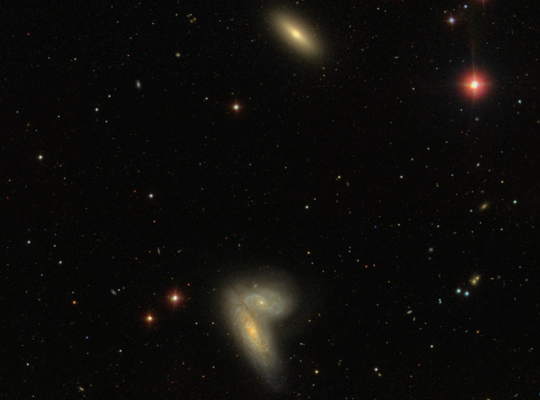
This interactive image of NGC 4567 and NGC 4568 was provided by the Sloan Digital Sky Survey (SDSS) using Aladin Sky Atlas. We also have a finder chart should help you locate these galaxies. From northern latitudes we get little or no astronomical dark from May to August so the targets for the GOM are going to be brighter ones and for this month I have chosen the galaxy pair NGC 4567 and NGC 4568, popularly known as the Siamese twins, or Butterfly Galaxies which were discovered by William Herschel in 1784 and then rediscovered by John Herschel in 1829.
The interacting pair are part of the Virgo cluster and, perhaps surprisingly, did not make Arp’s catalogue, although they did make Vorontsov-Velyaminov’s catalogue of interacting galaxies as VV 219. The pair appear to be in the process of merging.
There have been two supernova seen in the pair with SN 2004cc and SN 2020fqv, discovered on March 31st 2020 at about magnitude 15, there is an image of the supernova at The Virtual Telescope Project.
The galaxies are about 52-60 million light-years distant and if at that distance the two cores would be separated by only perhaps 20000 light-years. Surprisingly for two galaxies so close together they do not appear to be distorted that much by galactic tides so maybe this is just a projection effect or perhaps this is just a very early phase of the interaction as the highest rates of star formation appear to be in the overlap areas. A molecular collision front containing a number of large molecular clouds strung out in a large filament was also found in the overlap region in the CO bands using ALMA.
Both galaxies are spirals with the rather exotic classification of SA(rs)bc. The GALEX UV image of the pair shows a number of large bright star forming regions, particularly in NGC 4567.
The pair would also appear to be part of a subgroup in the Virgo cluster catalogued as LGG 285 which has 44 listed galaxies in it, although not the nearby NGC 4564.
One of the best amateur images of this pair is at the CHART32 website which also shows the nearby lenticular galaxy NGC 4564 (another William Herschel discovery).
Perhaps surprisingly the pair did not make either the H400 or H400 II lists but was added into the H400 III galaxy list, they were in general getting into pretty nondescript galaxies by then 😊
Visually the pair can be a challenge in small telescopes as they are perhaps fainter than expected, even an observation with a 10” from UK skies suggested the pair was not so easy.
Larger telescopes will show the pair relatively easily and start to show some of the structure evident in images. As they are so close together then high power may be useful. They galaxies make a pretty trio with NGC 4564 in a medium power field and using a modern hyperwide eyepiece (one of the advantages of the cost of these things).
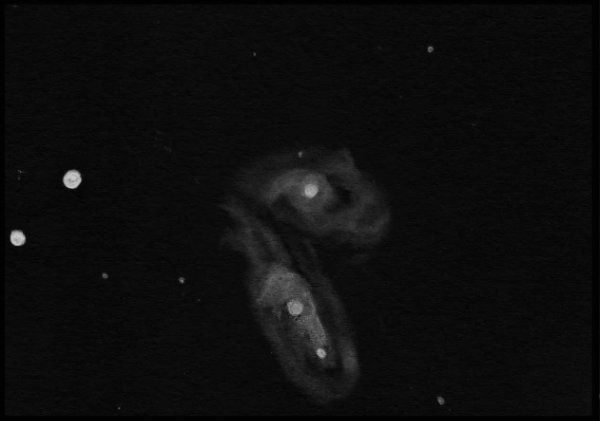
Inverted pencil sketch of NGC 4567 and NGC 4568 in Virgo by Dale Holt from his Chippingdale observatory in Hertfordshire using his 505mm Newtonian with a Watec 120N+ video camera. 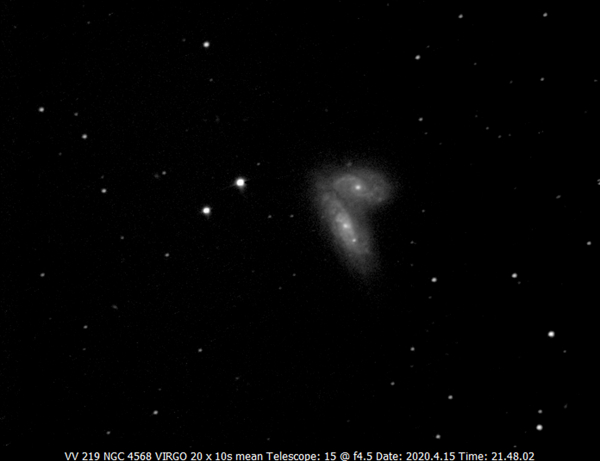
An EAA screen capture of NGC 4567 and NGC 4568 in Virgo. For those with larger telescopes there is also the faint galaxy IC 3578 at 15th magnitude in the same field, this was discovered by Frost photographically using a 24” refractor in 1904.
Owen Brazell - Galaxy Section Director
Observations
We have an observation by Ivan Maly with his 20-inch, observing from a dark site in the Appalachian region of Pennsylvania.
-
Deep-Sky Objects and Observations
