-
NGC 4365 in Virgo
May 2024 - Galaxy of the Month
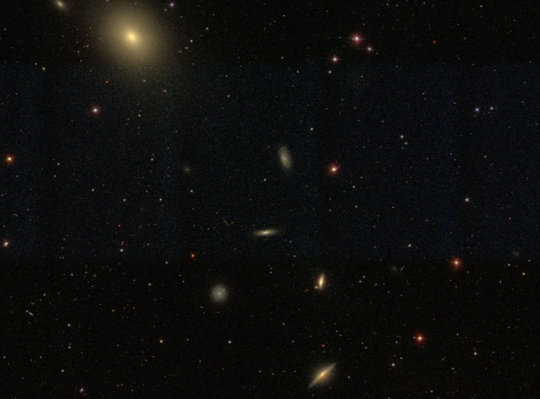
This interactive image of NGC 4365, NGC 4341, NGC 4342 and NGC 4343 was provided by the Sloan Digital Sky Survey (SDSS) using Aladin Sky Atlas. We also have a finder chart should help you locate these galaxies, as will this link for NGC 4365 on the Stellarium Web planetarium. Early May ends the serious galaxy observing season for the Spring in the UK, not that we really had one with the terrible weather in Spring 2024 here, as astronomical dark disappears until mid-August.
I am indebted to Mark Stuart for bringing my attention to this interesting galaxy group in Virgo. NGC 4365 is an interesting and bright galaxy that should be visible in small telescopes, however the interest here lies in the small group of galaxies below it including NGC 4341, NGC 4342 and NGC 4343 along with the fainter galaxies IC 3259 and IC 3267.
All of the NGC galaxies here were found by William Herschel in 1784. The two IC galaxies were found by Bigourdan using the 12.4” refractor from Paris in 1895. Unfortunately, observations in the classical period also rather scrambled the NGC and IC numbering of the galaxies in this group as William and John did not give positions for the individual galaxies they discovered. There does seem to have been a lot of confusion over the galaxy identification in the field but I think what we have now is correct. See Harold Corwin’s notes on these in his Historically-aware NGC/IC Positions and Notes.
The E3 galaxy NGC 4365 is the central galaxy of the W cloud in the Virgo cluster lying about 6 Mpc behind the main supercluster with a distance of about 22.8 Mpc. NGC 4365 appears to be stripping globular clusters and stars from NGC 4362 and the two galaxies are tidally interacting. For more on NGC 4365 see ESO's article Elliptical Galaxy NGC 4365 With Numerous Young Star Clusters.
Interestingly the galaxies in this area appear to be assigned to different galaxy groups in LGG 292 and LGG 295 and the area does seem rather confused as to what galaxies go where. The group is also included in the WBL catalogue of poor clusters as number 403. I note that the group is also suggested to be a Hickson like compact group. There is an interesting wide field view of this region on Jim Thommes' website.
NGC 4341 and NGC 4342 are suspected to be lenticular galaxies, whilst NGC 4343 is an edge on spiral that hosts an AGN of the LINER variety at its centre. NGC 4342 has been suggested to have an unusually massive central black hole for its size and is X-Ray luminous. Both the IC galaxies appear to be spirals, and according to their brightness in the UV from the GALEX satellite are currently undergoing a lot of star formation. The same would apply to NGC 4343. It seems that Hubble imaged part of the galaxy, although I only see this in the Wikipedia entry. Chandra also observed the group in X-Rays and showed that both NGC 4341 and 4342 are surrounded by a large amount of very hot gas.
The observations of this group in the The Night Sky Observer's Guide (NSOG) Vol. 2 are confused as they refer to NGC 4341 and NGC 4342 by IC numbers rather than the NGC numbers assigned to them today. The suggestion is that a 30-35cm scope is needed to see the brighter ones but a 40-45cm will do better. There are no observations of IC 3259 and IC 3267. It is probably worth remembering that the observations the NSOG are based on are over 40 years old now. Steve Gottlieb’s notes suggest that at least 32cm is needed and he normally observers from a high altitude site, to see these galaxies. He suggests that at least a 17.5” is needed to see the IC pair which suggests from the UK that maybe 50cm is needed from a good site. This is the size of scope that Mark Stuart was using for his own observations.
Owen Brazell - Galaxy Section Director
-
Deep-Sky Objects and Observations
