-
NGC 3158 in Leo Minor
April 2026 - Galaxy of the Month

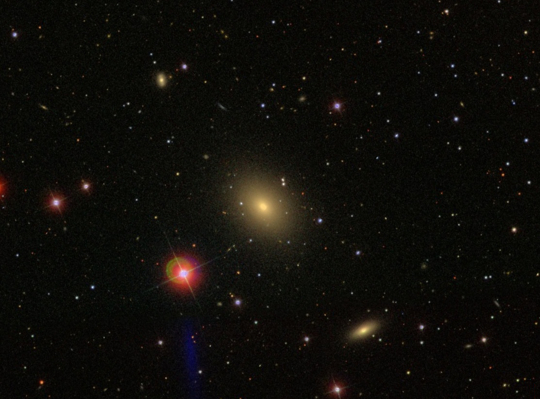
This interactive image of the galaxies surrounding NGC 3158 in Leo Minor was provided by the Sloan Digital Sky Survey (SDSS) using Aladin Sky Atlas. We also have a finder chart should help you locate these galaxies, as will this link for NGC 3158 on the Stellarium Web planetarium. I have chosen the small group of galaxies around NGC 3158 in Leo Minor for this GOM.
NGC 3158 itself was discovered by William Herschel in 1787 along with NGC 3163. The rest of the galaxies in the group were discovered either by Bigourdan in 1886 (NGC 3150, NGC 3151, NGC 3159) using a 12” refractor or by Mitchell (NGC 3152, NGC 3160) using the 72” at Birr. The whole group containing about 8 galaxies included in the NGC is also known as WBL 258 or the NGC 3158 group.
NGC 3158 itself is a giant elliptical with a classification of E3. It is the brightest cluster galaxy (BCG) for the group. NGC 3158 appears to form a non interacting pair with NGC 3160. If the distance is correct then NGC 3158 has a diameter of about 183,000 light-years, so considerably larger than our Milky Way galaxy. However there are suggestions it could be as large as 230,000 light-years in diameter. It is also a radio galaxy, but interestingly for a radio galaxy, it does not appear to have an AGN.
The NASA/IPAC Extragalactic Database (NED) suggests that the total number of galaxies in the cluster is about 30, although many are faint dwarves. The distance to the group is about 84 Mpc.
UV images from GALEX suggest there is not much star forming activity in the group, although the centre of NGC 3158 does show up, possibly from a low level AGN. The majority of the galaxies in the group appear to be early type galaxies although NGC 3160 is an edge on spiral. NGC 3159 is a peculiar galaxy with a faint plume of stars, possibly from an interaction with NGC 3158. In 2018 a type Ia supernova (SN 2018aaz) was seen in NGC 3018.
There is more information on the group at Rick Johnson's Mantrap Skies Catalog website.
The whole of the WBL 258 group is pretty compact and all of them will fit in the field of view of a medium power (say 265x) hyperwide field eyepiece. There is a nice amateur image of the group by Dan Crowson on Flickr. Steve Gottlieb suggests that NGC 3158 will require a 13” to see well. The others in the group may require 45cm or so to find and even then they maybe faint.
For those doing EAA then there is also the group Shakhbazian 49 in the same area but the galaxies in this group are very faint, around 16th magnitude, so probably out of the visual range of all but the very largest telescopes, although Alvin Huey does include it in his Shakhbazian group guide available at www.faintfuzzies.com. You may see suggestions in the internet that the NGC 3158 group and Shak 49 are the same. They are not.
Owen Brazell - Galaxy Section Director
If you'd like to try out the Clear Skies Observing Guides (CSOG), you can download observing guide for the current Galaxy of the Month without the need to register. CSOG are not associated with the Webb Deep-Sky Society but the work of Victor van Wulfen.
A Postscript
When this article arrived in my email inbox with a brief note from Owen I never thought that it would be his last Galaxy of the Month. Yet three days later Owen Brazell died, on the 16th of March 2026, in a road traffic accident on his way to Kelling Health Star Party.
As our current President, Galaxies Director and DSO Editor he leaves a huge gap in the Webb Deep-Sky Society to which he's dedicated an enormous amount of time and effort over many years.
James Whinfrey - Website Administrator
-
NGC 315 in Pisces
August 2022 - Galaxy of the Month
This interactive image of the NGC 315 was provided by the Sloan Digital Sky Survey using Aladin Sky Atlas. We also have a finder chart should help you locate these galaxies, as will this link for NGC 315 on the Stellarium Web planetarium. For the August galaxy of the month I have chosen NGC 315 in Pisces. Although perhaps a bit early for galaxies in Pisces, we are still in Milky Way season. NGC 315 was discovered by William Herschel in 1784. It appears to be part of a small group on the sky that also contains NGC 311 and NGC 318.
NGC 315 contains an AGN, in this case a LINER, with a well collimated radio jet coming from the central black hole. The jet has also been detected in X-Rays. The jet appears as two main parts, a bright main jet and a smaller counter jet. The mass of the central black hole has been calculated to be of the order of 2x10⁹ solar masses from observations of cold molecular gas around it using ALMA. The nucleus also shows up well in the UV images from the GALEX satellite.
There may be upwards of 30 galaxies in the group associated with NGC 315. NGC 315 is part of Zwicky cluster 0107.5+3212 (Zwicky et al. 1961), which is located in the Perseus-Pisces filament. It is also part of the group WBL 22 (which only contains NGC 311, NGC 315 and NGC 318) and LGG 14 (which contains many more). NGC 315 is classified as a cD elliptical galaxy; these are large elliptical galaxies found at the core of clusters. The group is thought to be at a distance of perhaps 55 Mpc. Most studies of this galaxy seem to concentrate on the jet.
Observationally NGC 315 is defined to be part of a trio of galaxies including NGC 311 and NGC 318. NGC 311 and 318 are much fainter than NGC 315. NGC 311 was discovered by John Herschel in 1828 and NGC 318 by Bindon Stoney using Lord Rosse’s 72” telescope in 1850. They both appear to be lenticular type systems. Stoney also thought he discovered another two galaxies in the field that got the NGC numbers NGC 313 and NGC 316 but it turns out these were just stars.
Night Sky Observer's Guide (NSOG) suggests that all three can be seen with a 35cm telescope, although NGC 318 is recorded as difficult to see. My suspicion however is that these observations were made from high altitude sites and from the UK it may require 40cm to see all three given the extra mile of crud above most UK observing sites. The group is a very tight one and will easily fit in a high power eyepiece field. Observations of the group maybe complicated by an 8th magnitude star close by in the field. NGC 315 is included as part of the Astronomical League H400 II list.
Owen Brazell - Galaxy Section Director

-
Deep-Sky Objects and Observations
