-
NGC 2872 in Leo
March 2021 - Galaxy of the Month

This interactive image of the NGC 2872 and was provided by the Sloan Digital Sky Survey using Aladin Sky Atlas. We also have a finder chart should help you locate these galaxies, as will this link for NGC 2872 on the Stellarium Web planetarium. The small trio of galaxies around NGC 2872 in Leo, also known as VV 1284 and Arp 307, where it is included as part of the Double Galaxies class.
The galaxies in the group were discovered by a number of different observers with the brightest pair of galaxies (NGC 2872 and NGC 2874) being discovered by William Herschel in 1784. It took Mitchell using the 72” at Birr to find NGC 2873 in 1857 however. Whilst observing the group he also found a number of other objects that he believed to be nebulae and one of these was later catalogued as NGC 2871. Unfortunately, this later turned out to be just a star. Another case one suspects of poor seeing making stars look nebulous. The Rosse team also thought they had found another nebula in the area, which it turns was actually a knot in one of the spiral arms of NGC 2874, however it got its own NGC number as 2875.
NGC 2872 is an elliptical galaxy and possibly an AGN as it has a bright UV core and radio lobes. The group is also known as Holmberg 130. NGC 2872 is interacting with NGC 2874. NGC 2873 is probably only optically associated as it appears to be at a different redshift, otherwise not much seems to be known about it. The Galaxy Zoo project classifies NGC 2873 as a red spiral, one of the new types of galaxy classification to come out of that project. Intriguingly NGC 2874 also seem to be classified as heading that way although the GALEX images show a lot of star formation happening in its arms which is slightly odd if that is the case. Very deep images of NGC 2874 show signs of tidal streamers, possibly from an interaction or merger with a dwarf galaxy. The distance to the group is probably of the order of 110 million light-years (33Mpc). Arp lists the group under his classification of Double Galaxies.
Hubble does seem to have observed the group a long time ago and no colour images seem to have been made however there is a black and white image.
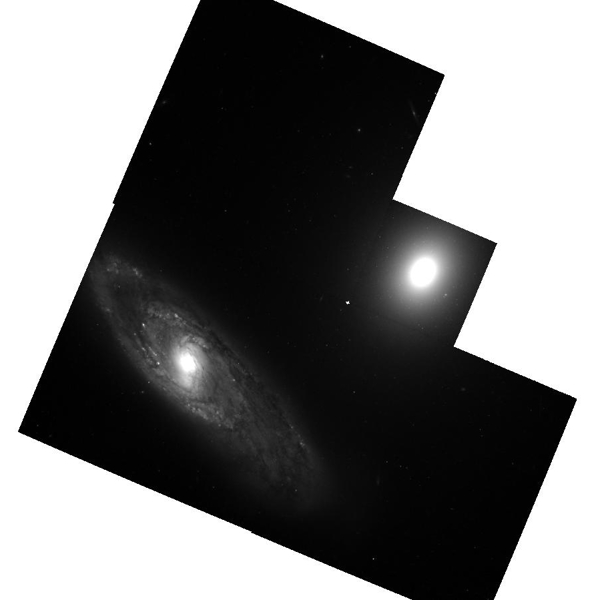
WFC image of NGC 2872 by the Hubble Space Telescope. Interestingly the DSS image of the group shows NGC 2872 as quite a small elliptical. However deeper images from newer surveys (SDSS, PanSTARRS) show it has a bright core and a very much larger extended halo and here it is classified as an E2. Perhaps surprisingly as an Arp galaxy not much research appears to be available on this system.
The group is very tight so observing this will require high power and steady seeing to split the galaxies. NGC 2872 and NGC 2874 should be quite easy but finding NGC 2873 may be a challenge for larger telescopes. Steven Gottlieb found it very faint even with a 24” and requiring averted vision to hold. Interestingly the group does not make the Night Sky Observer's Guide (NSOG), which is perhaps surprising as it has an Arp designation, it is perhaps time to remember that the core NSOG series is now pretty old and telescope sizes in particular have moved on. It does make Luginbuhl and Skiff (L&S) however where the suggestion is that from high altitude the two brighter galaxies are visible in 15cm but a 30cm shows them better. Interestingly they suggest that NGC 2873 should be visible in 30cm which does not tie in with Steve G’s observation above. I note that with a 25cm from the UK the group was not regarded as particularly impressive.
Owen Brazell - Galaxy Section Director
-
Deep-Sky Objects and Observations
