-
NGC 274 in Cetus
September 2025 - Galaxy of the Month
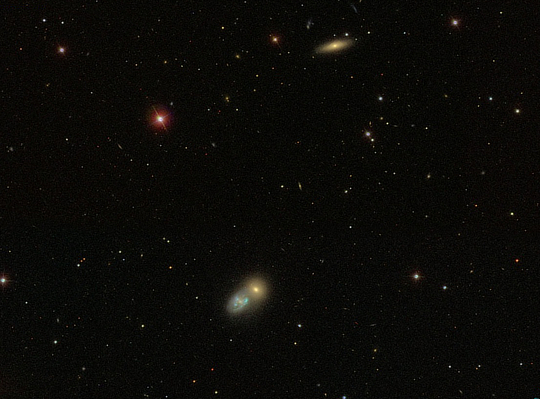
This interactive image of NGC 274, NGC 273 and NGC 275 in Cetus was provided by the Sloan Digital Sky Survey (SDSS) using Aladin Sky Atlas. We also have a finder chart should help you locate these galaxies, as will this link for NGC 274 on the Stellarium Web planetarium. As we move into autumnal skies my challenge for September is the galaxy trio NGC, 273, NGC 274 and NGC 275 in Cetus.
The group has an interesting discovery history with NGC 274 and 273 being discovered by William Herschel in September 1785 and William’s son John discovering the close companion to NGC 274, later numbered as NGC 275, in 1828. The NGC 274/275 pair was later catalogued as Arp 140 in Halton Arp’s catalogue of Peculiar galaxies. Arp classified the NGC 274/275 pair under material emanating from elliptical galaxies. The pair had however already made Vorontsov-Velyaminov’s interacting galaxy catalogue as VV 81. For those that like odd designations the pair is also known as Holmberg 26. The NGC 274/275 pair is also included in the galaxy group LGG 15 along with NGC 298 and NGC 337, although not NGC 273.
Here NGC 274 is actually a lenticular or S0 galaxy. NGC 275 is a spiral galaxy that appears to be very heavily distorted from the encounter and is furiously forming stars and it is dominated by massive star forming regions. Radio observations of the pair show tidal tails coming from both galaxies. In 2018 a Type II supernova was seen in the nuclear region of NGC 274.
There appears to be some debate as to the distance to the NGC 274/275 pair with some sources suggesting it is around 65 million light-years and others pushing it out to 81 million light-years. Based on redshift values NGC 273 will be over twice as far away as NGC 274 so it is not associated with the other two.
Perhaps surprisingly there do not appear to be a lot of papers on this pair. There is a fine Hubble image of the pair. NGC 273 is also a lenticular S0 galaxy seen edge on. Interestingly lenticular galaxies are expected to form in galaxy clusters from RAM pressure stripping but here there is no compact galaxy cluster here.
The group does not make any of the first two Astronomical League Herschel project lists, although it is in the Herschel 3 listing. Splitting the NGC 274/275 pair may not be that easy given that William Herschel did not manage it. It is suggested in the The Night Sky Observer's Guide that probably at least a 12/14 inch telescope may be required to do this. Larger telescopes should find it easier to split. There was a report of the Arp pair in the OOTW forum for 2017, although interestingly there are no observations of NGC 273. NGC 273 plus NGC 274/275 made it into Alvin Huey’s Galaxy Trio guide.
I suspect that medium to high power will be needed to split the NGC 274/275 pair. NGC 273 will also respond to high power and in fact you can use medium powers up to say 265x and still get all the galaxies in the triplet in the same FOV, especially using a modern hyperwide field (100 degree) eyepiece. Steve Gottlieb suggested that with his 17.5” telescope NGC 273 was fairly faint.
Owen Brazell - Galaxy Section Director
-
January 2015 - Galaxy of the Month
NGC 2749 in Cancer
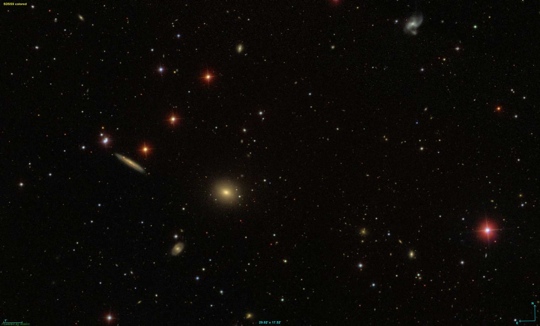
This image was provided by the Sloan Sky Survey, and this finder chart should help you locate these galaxies.
The constellation of Cancer is often overlooked except as a stepping stone between the two richer constellations, in terms of deep sky objects, of Gemini and Leo and if it is considered at all it is for the two open clusters M44 and M67.
The constellation does however have its fair smattering of faint galaxies. Indeed there are over 100 galaxies catalogued in the NGC alone and whilst those hidden amongst the stars of M44 have often been mentioned there is a nice group around NGC 2749.
NGC 2749 itself is a 12th magnitude elliptical galaxy (E2) discovered by d’Arrest in 1862 and is perhaps the brightest of the group. NGC 2745 and 2747 were discovered by Marth along with NGC 2751 and 2752. Remember though that Marth was using Lassell’s 40” speculum metal reflector from Malta so these galaxies are going to be a challenge. Oddly the other galaxy in the field NGC 2744 was discovered by William Herschel so how he missed 2749 must be a mystery as it is a brighter galaxy.
The group is listed as number 202 in the WBL catalogue of poor galaxy clusters with a total of 5 galaxies counted as part of the cluster. These are NGC 2745, 2749, 2747, 2751 and 2752. The group would appear to be at about 192 million light years from us. Interestingly 2744 was not counted by WBL to be part of the group despite showing obvious signs of interaction. With the exception of NGC 2749 all the other galaxies in the group appear to be either spirals or lenticular (2745).
Although the WBL catalogue does not include NGC 2744 within the group more recent papers suggest that in fact NGC 2749 and NGC 2744 are an interacting pair. Here NGC 2749 is classified as a low luminosity AGN (LLAGN). Fundamentally this is not that dissimilar to the activity (or lack of it) we see from the centre of our own galaxy.
The faintness of these galaxies suggests that probably a 30cm telescope will be needed to see NGC 2749 and probably 40cm to find the others, although they will require a dark sky. There seem to be few images of this group so they may also make an interesting target for imagers. The classic references such as NSOG and L&S do not make much mention of the galaxies in this area apart from NGC 2479.
Owen Brazell - Galaxy Section Director


-
Deep-Sky Objects and Observations
