-
NGC 2563 in Cancer
January 2020 - Galaxy of the Month
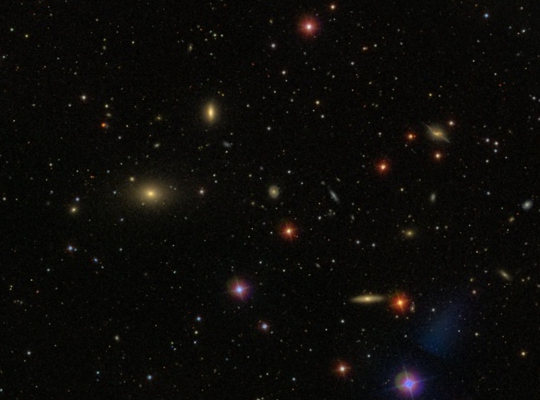
This interactive image of the NGC 2563 group was provided by the Sloan Digital Sky Survey using Aladin Sky Atlas. We also have a finder chart should help you locate these galaxies. The small group of galaxies around NGC 2563 was once through to be part of a larger group known as the Cancer I cluster however this has been shown just to be a collection of disparate groups of galaxies and is not a true cluster. The cluster is now better known as the NGC 2563 group.
The brightest galaxies in the group, NGC 2562 and NGC 2563, were discovered by William Herschel in 1787. NGC 2560 and 2569 were discovered by d’Arrest in 1862 using the 11” refractor at Copenhagen and NGC 2570 by Copeland in 1873 using Lord Rosse’s 72” at Birr.
The group is also catalogued as WBL 178, a group of 11 galaxies which also includes the galaxies NGC 2556 but not NGC 2569 and NGC 2570. The group is also included in the LGG catalogue as LGG 158, a group of 14 galaxies which includes the NGC galaxies 2558, 2562, 2557, 2563, 2556, 2560 and 2569, showing how different selection criteria can include different objects.
A much deeper study has suggested that there may be as many as 64 members of this group, although many are small and faint. NGC 2563 is definitely the brightest cluster galaxy (BCG) for this group and most, if not all, of the galaxies in the core of the group are lenticulars which suggests this is quite an old group. It appears that galaxies on the outside edge may well be still joining the group as they are still gas rich spirals.
The group is also bright in X-Rays and observations suggest that most of the gas has been stripped from the galaxies by RAM pressure stripping and there are signs of interactions within the group, although mostly from observations in the radio region in the 21cm band. The X-Ray emission is probably coming from the hot gas between the galaxies. The group appears to be about 228 million light-years from us.
Observationally the core of the group is quite compact and will fit in the field of view of a medium power eyepiece. If we assume that all the galaxies in the LGG list are actually part of the group then the whole group spans about 45’ on the sky.
There are observations of this group in the book 'Galaxies and How to Observe Them' by Steinicke and Jakiel and also in Night Sky Observer's Guide (NSOG) Volume 1 where they suggest the two brighter galaxies are targets for 12-14” telescopes. There is no individual coverage of the other galaxies in the group there although there is a sketch showing NGC 2560, NGC 2562 and NGC 2563. Luginbuhl and Skiff (L&S) suggest that a 25cm telescope maybe needed to show NGC 2562 and NGC 2563. There are many other fainter galaxies in the core of the group that large telescopes and EAA systems may pick up.
Of particular interest is the galaxy UGC 4332, which appears to be undergoing some form of merger from the distortions visible in it. Observations of the fainter members of the group maybe hampered by the 6th magnitude star just south of it so the use of high power is recommended to keep it out of the field of view.
Owen Brazell - Galaxy Section Director
-
Deep-Sky Objects and Observations
