-
NGC 2389 Group in Gemini
February 2021 - Galaxy of the Month
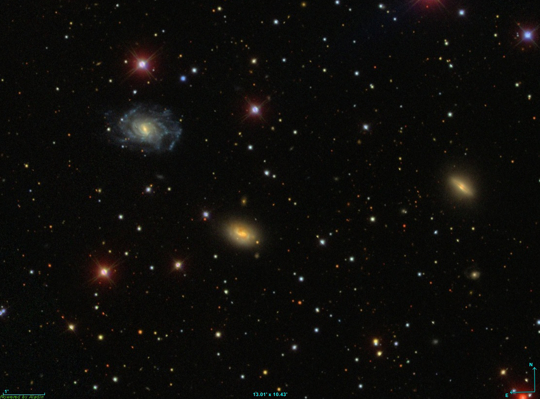
This interactive image of the NGC 2389 and was provided by the Sloan Digital Sky Survey using Aladin Sky Atlas. We also have a finder chart should help you locate these galaxies, as will this link for NGC 2389 on the Stellarium Web planetarium. Although rather late in the season this small group of galaxies in Gemini is still high in the sky at a reasonable hour.
The group, consisting of the galaxies NGC 2389, NGC 2388 and NGC 2385, was all discovered by William Herschel. He first found NGC 2389 itself in 1788 and then the other two galaxies in 1793, perhaps by this time he had moved to front view mode and gained an extra magnitude or so in what he could see.
There are a number of non-existent NGC objects in the area in NGC 2386, NGC 2390 and NGC 2391. These are all stars that were discovered by the Rosse team at Birr and thought to be nebulae but which later turned out to be stars. One suspects that they were fooled on a night of poor seeing/transparency when the stars looked nebulous, an issue that still plagues visual observers in the UK.
The group is also catalogued as WBL 142 which contains just these three galaxies. The group would appear to lie about 200 million light-years from us. NGC 2388 itself is an interesting type of galaxy known as a Luminous Infra-red Galaxy (LIRG). These are normally galaxies where there is a lot of star formation going on that is hidden by dust, which is then heated by the starlight to glow in the Infra-Red. They are also usually very red in colour. All the galaxies in the group are classified as spirals but the type of NGC 2388 is unknown. All the galaxies in the group appear disturbed but there are no obvious signs of interaction, such as tidal tails etc..
NGC 2389 is an almost face on spiral with a relatively bright nucleus and signs of a bar which fits with its SAB(rs)c classification in the rather involved de Vaucouleurs system. For some reason NED also lists this galaxy as NGC 2388E, although this may have come from the RNGC by Sulentic and Tifft. NGC 2389 is a well-developed spiral with lots of young blue stars whilst both of the others are somewhat reddish. The UV GALEX image backs this up with NGC 2389 itself showing lots of star formation and the other two being practically invisible. NGC 2385 appears close to edge on with a well-developed dark dust lane. The suggestion is that NGC 2389 and 2388 form a pair with NGC 2385 a more distant part of the group.
The Night Sky Observer's Guide (NSOG) Vol 1 recommends the group as a target for 40-45cm telescopes but also suggests that the small faint edge on galaxy UGC 3879 nearby should also be visible. I suspect that from UK skies probably 45-50cm may be needed to see all the galaxies in the group. All four should be in the same FOV with a medium power widefield eyepiece. I suspect however that UGC 3879 is going to be a challenge for all but the best nights.
Also in the same medium power field is the faint spiral NGC 2393, a Stephan discovery, so there are a lot of objects to go for in this field. There is also a nice pair of galaxies nearby associated with NGC 2275 which has been covered before in the GOM series.
Owen Brazell - Galaxy Section Director
-
Deep-Sky Objects and Observations
