The Webb Deep-Sky Society

An international society of amateur and professional astronomers specialising in the observation of double stars and 'deep sky' objects founded in 1967. Membership is open to anyone who shares the interests of the Society.

  • About Us
  • Membership
  • Deep-Sky News
  • Galaxies
  • Nebulae and Clusters
  • Double Stars
  • Publications
  • The DSO
  • July 2013 - Galaxy of the Month

    NGC 2276 and Arp 114 in the Constellation of Cepheus
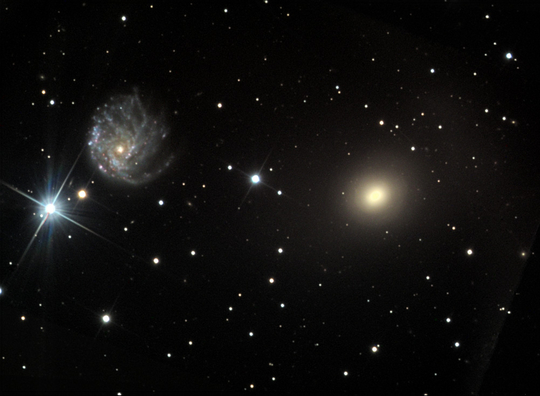
    ngc 2276 - image courtesy of carlos and crystal acosta/adam block/noao/aura/nsf

    Image Courtesy of Carlos and Crystal Acosta/Adam Block/NOAO/AURA/NSF. For more images please visit the NOAO website. You can click on image for a high resolution version, or download our Megastar© finder chart of NGC 2276

    The galaxy NGC 2276, also known as Arp 25, in Cepheus was discovered in 1876 by Winneke using a 6.5" refractor. It is part of a small group of three to four galaxies that also contains the galaxies NGC 2300 and NGC 2289 and possibly one other.

    NGC 2276 is a very oddly shaped spiral galaxy which looks a bit like a tulip. Classified as a Sc I galaxy and it was the asymmetry caused by heavy downstream arc/spiral arm that merited its inclusion in Arp’s atlas of peculiar galaxies. There are some thoughts that the galaxy may be in the process of evolving into a galaxy with a central bar.

    The NGC 2300 galaxy group was one of the first imaged in X-Rays and it showed that the X-Ray emitting gas was not associated with either of the main galaxies, NGC 2300 and NGC 2276, but clumped around something else and this was taken as proof of dark matter being heavily associated with small groups of galaxies. The cloud of hot gas was of the order of 1.3 million light years in diameter and with a temperature of the order of a million degrees to glow in X-ray light.

    The shaping of NGC 2276 has also been a source of much interest. Originally it was thought to have been ram pressure as it moved through the intra-cluster gas that was causing the shape but more recent X- Ray observations show no signs of the heated gas that would be caused by these shock fronts so the current feeling is that it must be caused by tidal interactions. It is not clear if this interaction is caused by NGC 2300 or another galaxy.

    The NGC 2300 group is interesting because it contains NGC 2300 which is an E0/S0 galaxy – a lenticular as well as the spirals NGC 2276 and NGC 2268. Due to the group's proximity to us the angular extent of the group on the sky is large with 1.4 degrees separating the main pair and NGC 2268. The distance to the group is thought to be of the order of 34 Mpc or about 113 million light years.

    There have been several supernovae observed in NGC 2276 in the last hundred years, mostly found in the areas of strong star formation. NOAO provide a detailed view of the galaxy.

    Although NGC 2276 has its own Arp number as mentioned previously the grouping with NGC 2300 also has the Arp number of 114. In some ways it is difficult to understand elliptical/spiral galaxy pairs as one assumes both galaxies were formed in the same environment and you would assume therefore that they would be of the same type.

    Observationally these galaxies may be tricky to find. NGC 2300 is the brighter of the pair and the bright core should show in a 20-22cm telescope. NGC 2276 is fainter and larger and although it may be seen in 22cm it is going to require much larger telescopes to show any detail of its spiral arms.

    Owen Brazell - Galaxy Section Director
  • About the Webb Society

    • Back top of this page
    • Go to our home page
    • About us
    • News
    • Our Annual Meeting
    • Galaxy Section
    • Nebulae and Clusters Section
    • Double Star Section
    • Join the Webb Deep-Sky Society
    • Links to members' websites
    • Useful astronomy links
    • Contact Us
  • Deep-Sky Objects and Observations

    • Observations home page
    • Object of the Season
    • Double Star Circulars
    • Double Star of the Month archive
    • Double Star of the Month RSSRSS feed icon
    • Galaxy of the Month archive
    • Galaxy of the Month RSSRSS feed icon
    • Picture of the Month archive
    • Picture of the Month RSSRSS feed icon
    • Nebula and Cluster of the Month archive
  • The Deep-Sky Observer

    • DSO digital subscriber login
    • Webb Society Journal archive
  • Publications

    • Handbooks, Guides and Atlases
    • Alvin Huey's Observer's Guides
    • Willman-Bell Publications
    • Free Observing Guide Downloads
  • Featured Articles

    • Where to get reliable NGC/IC data
    • Rediscovering the Bedford Catalogue
    • An Averted Vision Scale

If you have any comments or problems with this page or any other Webb Deep-Sky webpage then please contact the Website Administrator

The Webb Society is registered under The Charities Act 1960 - Registered Charity No. 288384 © 2025 Webb Society except where stated.

The information contained in this website is for general information purposes only. The information is provided by The Webb Deep-Sky Society and while we endeavour to keep the information up to date and correct, we make no representations or warranties of any kind, express or implied, about the completeness, accuracy, reliability, suitability or availability with respect to the website or the information, products, services, or related graphics contained on the website for any purpose. Any reliance you place on such information is therefore strictly at your own risk. In no event will we be liable for any loss or damage including without limitation, indirect or consequential loss or damage, or any loss or damage whatsoever arising from loss of data or profits arising out of, or in connection with, the use of this website. Through this website you are able to link to other websites which are not under the control of The Webb Deep-Sky Society. We have no control over the nature, content and availability of those sites. The inclusion of any links does not necessarily imply a recommendation or endorse the views expressed within them. Every effort is made to keep the website up and running smoothly. However, The Webb Deep-Sky Society takes no responsibility for, and will not be liable for, the website being temporarily unavailable due to technical issues beyond our control.