-
NGC 1723 in Eridanus
December 2021 - Galaxy of the Month
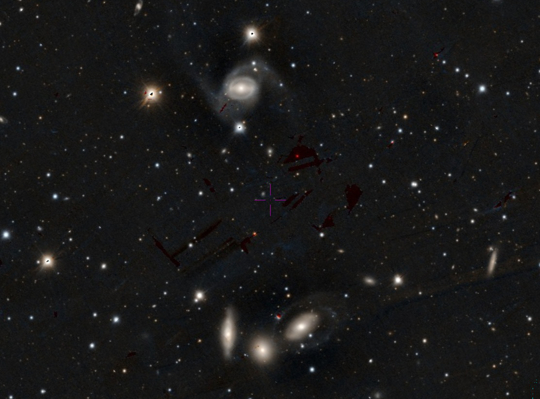
This interactive image of the NGC 1723 was provided by the Pan-STARRS1 Surveys using Aladin Sky Atlas. We also have a finder chart should help you locate these galaxies, as will this link for NGC 1723 on the Stellarium Web planetarium. NGC 1723, along with NGC 1721, NGC 1725 and NGC 1728, forms a nice quartet of galaxies in Eridanus. Perhaps surprisingly they were not found by William Herschel. NGC 1723 was discovered by Tempel using a 11” refractor in 1882 and the other trio by Barnard in 1885 using the 6” refractor at Vanderbuilt university, and independently by Lewis Swift using a 16” refractor a month later.
Although the group only just rises above one air mass from the southern UK (it is just below Rigel) it should not be that difficult to observe, although to be fair the discoverers all regarded the objects as quite faint.
The NGC 1721, NGC 1725 and NGC 1728 trio are also classified as VV 699 in the Vorontsov-Velyaminov interacting galaxy catalogue. Interestingly though whilst NGC 1723, NGC 1724 and NGC 1728 have similar redshifts NGC 1721 seems to have a much higher redshift. The distances to the first 3 would be around 55Mpc whilst, if the redshift velocity is a true distance indicator, NGC 1721 is at around 66 Mpc. I wonder then if NGC 1721 is purely a line-of-sight galaxy and the others are an interacting triplet. However, given that NGC 1721, NGC 1725 and NGC 1728 seem to be interacting the redshift for NCG 1721 may just reflect peculiar motions within the group rather than a true distance. The discrepancy would not be out of the range for intra group movements. Unfortunately, there are no redshift independent distance measurements to the group.
NGC 1723 is sometimes referred to as part of this group, although it may be unrelated to the other three galaxies it is an odd galaxy with its spiral arms coming off a ring and a prominent bar. The ends of the spiral arms show some signs of distortions, although it is not clear what galaxy NGC 1723 maybe interacting with. There are a number of other faint galaxies nearby. NGC 1721 is also a spiral galaxy and appears to have signs of an interaction given the way its outer spiral arms are behaving. Neither NGC 1725 or NGC 1728 show much signs of an interaction.
All the galaxies in the group are spirals with the possible exception of NGC 1725 which is classified as an S0, a lenticular. The NGC 1721 trio has also had the designation KTS28 in the catalogue of isolated southern triplets by Karachentseva, although of course if NGC 1723 is part of the group then this designation would be somewhat misleading. Perhaps surprisingly there has not been that much research done on the group.
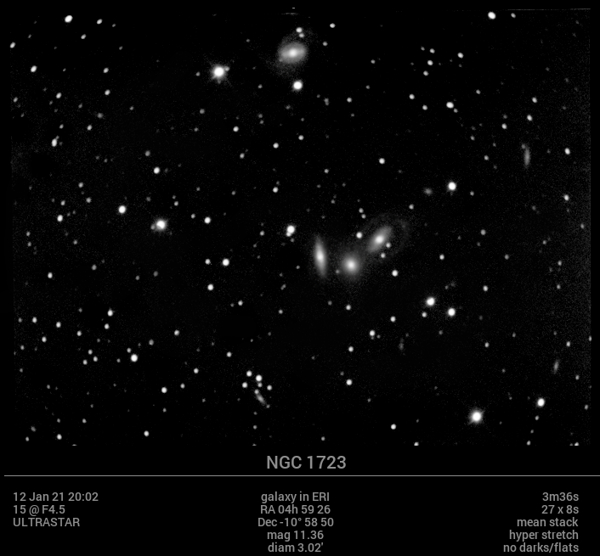
A stacked EAA capture of the NGC 1723 galaxy group in Eridanus by Mike Wood from Suffolk in the UK. The group is included in the Interstellarum Field guide where it suggests they are targets for 8” telescopes but as usual I suspect that this is optimistic unless you are observing from 2000m in the Alps. The Night Sky Observer's Guide (NSOG) Vol 1 suggests the group are more likely to be challenges for 40-45cm telescopes and I suspect from the UK that this maybe more likely. The group is sufficiently tight that all the main galaxies will appear in the field of a medium to high power modern hyperwide field eyepiece. Given their altitude I suspect that trying to observe them within an hour of meridian transit and a good southern horizon may be needed.
Owen Brazell - Galaxy Section Director
-
Deep-Sky Objects and Observations
