-
NGC 128 Group in Pisces
October 2020 - Galaxy of the Month
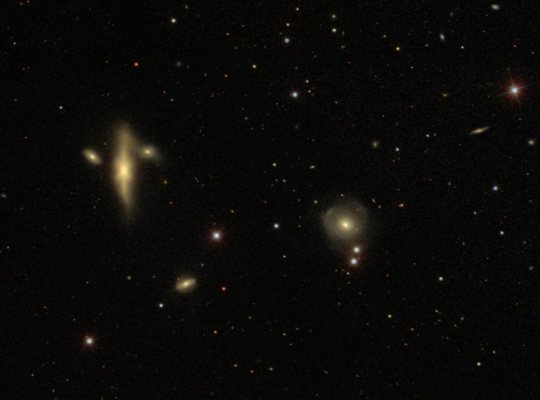
This interactive image of the NGC 128 group was provided by the Sloan Digital Sky Survey (SDSS) using Aladin Sky Atlas. We also have a finder chart should help you locate these galaxies. The small group of galaxies around NGC 128 in Pisces, also designated as LGG 6, was first discovered by William Herschel who found NGC 128 itself along with NGC 125 in 1790 using his 18.7” 20 foot reflecting telescope. NGC 126, NGC 127 and NGC 130 had to wait until 1850 when Bindon Stoney discovered them whilst examining the area using Lord Rosse’s 72” telescope.
The LGG 6 group is composed of 11 galaxies including NGC 128, NGC 126, NGC 127 and NGC 130. Nearby MCG +0-2-45 is also associated with the group.
NGC 128 itself appears to be interacting with NGC 127 and there is a tidal tail between the two. NGC 128 itself is an interesting galaxy as, although it is classified as a lenticular, it shows a boxy or peanut shaped nucleus with a strange X form. This could be the result of a previous merger or the ongoing interaction between itself and NGC 127. Although NGC 125 is also a disturbed galaxy it does not appear to be associated with NGC 128.
NGC 125 appears to be a form of shell galaxy. This is shown up well in the image on the CHART32 website. Deep images suggest that NGC 126 also shows some sign of tidal tails so it is also undergoing a gravitational interaction, probably also with NGC 128. It appears that NGC 130 is also interacting with NGC 128 as well.
There were some suggestions that NGC 125 might also be part of the group but its recession velocity is much larger than the others. The possibility remains however that NGC 128 and 125 have interacted in the past. The interaction of NGC 128 with NGC 127 is thought however to be a relatively recent phenomenon and has produced a counter rotating disk of stars in NGC 128 aligned with NGC 127.
The interacting part of the group was also catalogued in the Vorontsov-Velyaminov of interacting galaxies as VV 894. The group also makes it into the WBL catalogue of poor clusters as WBL 10 and that group includes NGC 125 but not some of the others included in LGG 6. The group lies at a distance of perhaps 190 million light years from us.
The group may be a tough one to observe with smaller telescopes. The Night Sky Observer's Guide (NSOG) suggests that only NGC 125 and NGC 128 will be visible in 10-12” scopes whilst the others may need telescopes in the 20” class to see, at least from UK skies. Observations with a 22cm from the UK suggest that NGC 128 was hard and that NGC 125 was not seen. Using a 37cm scope under mediocre skies showed NGC 128 as an edge on and NGC 125 as a circular patch. The other galaxies were not seen.
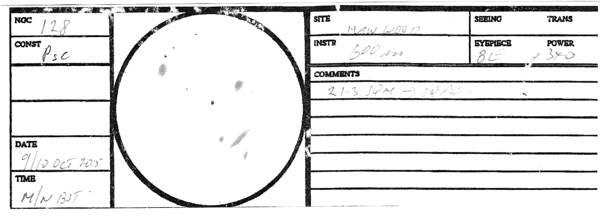
A sketch of the NGC 128 group by Andrew Robertson using his 24 inch reflector. Please click on the image for a larger version. The group is fairly tight so the use of high power is recommended in order to pick up the fainter members. They should all fit in the field of a modern hyperwide eyepiece at 350x. The fainter MCG member of the group is still close by and will again fit in the same field as the others when using a power around 260x. This is likely to be a challenge however for telescopes in the 20”+ class.
Owen Brazell - Galaxy Section Director
-
December 2013 - Galaxy of the Month
NGC 1300 in Eridanus
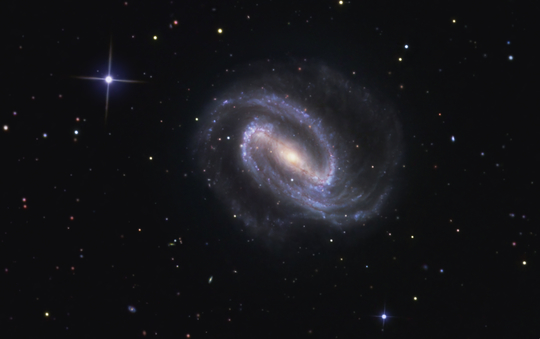
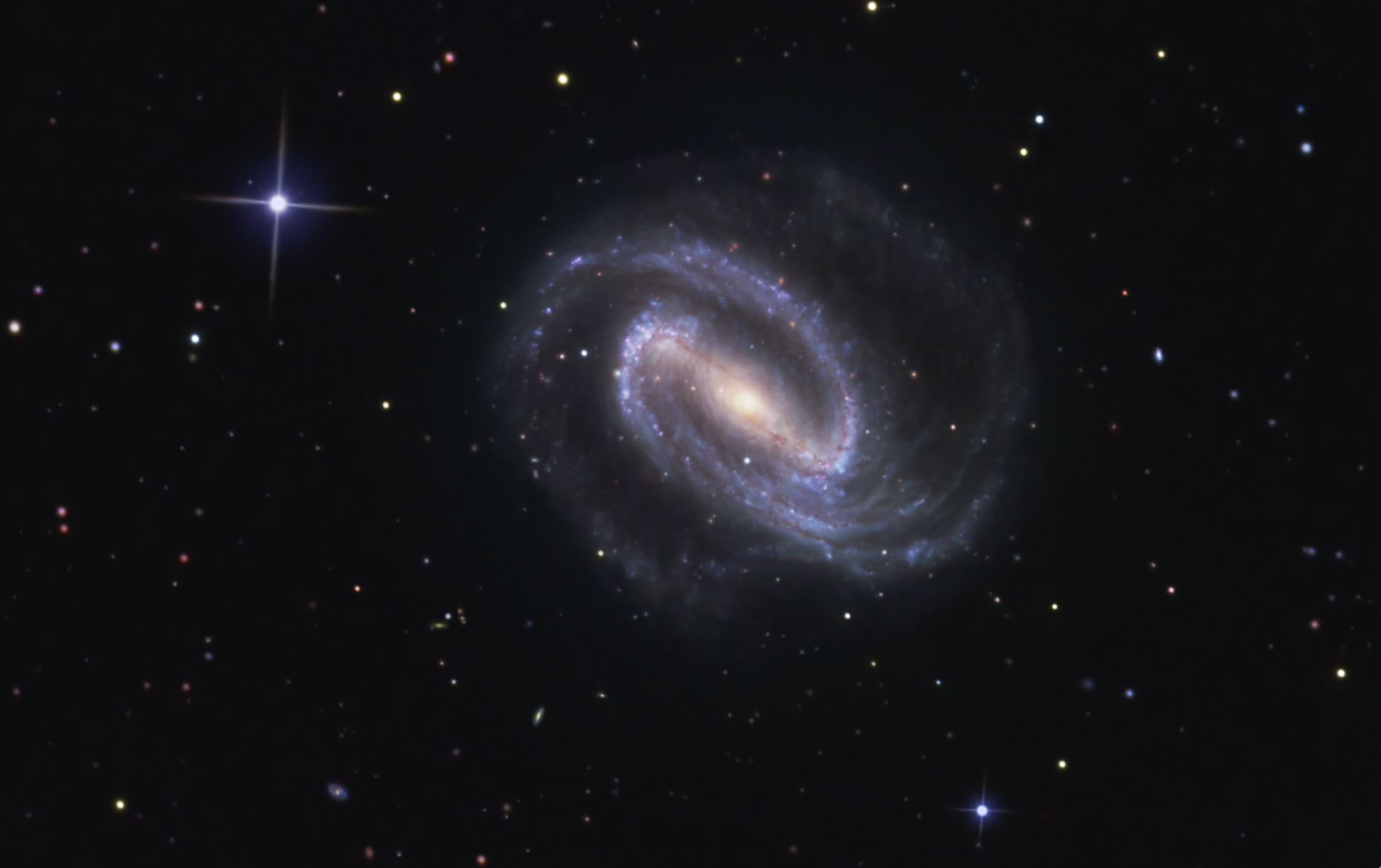
Image Courtesy of R Jay GaBany, USA. For more images from R Jay GaBany please visit the Cosmotography website. You can click on image for a high resolution version.
Most of the galaxies we have covered so far in the galaxy of the month column have been primarily aimed at northern observers. This month’s object is perhaps aimed more at mid northern observers. NGC 1300 lies in the constellation of Eridanus and was discovered by John Herschel in 1835 using the 18.7" reflector from his observatory at Feldhausen on the Cape.
It is a classic barred spiral that has, amongst other things, the distinction of being one of the largest images of a single galaxy made by the Hubble Space Telescope. It is often touted as the finest example of a barred spiral, although many would suggest the great Fornax spiral NGC 1365 is a better example.
The galaxy is unusual for a spiral in that it does not appear to contain a black hole at the centre. The main features of the galaxy as can be seen is that it is a barred spiral, however detailed observations of centre disk of the galaxy suggest it shows its own grand design spiral pattern which does not necessarily tie up with the larger pattern. This structure is actually not that unusual in some of the larger barred spirals.
The NGC 1300 lies about 69 million light years away and appears to be part of the Eridanus galaxy group (Or Fornax II cluster) which is in turn a sub group of the Eridanus Cloud. This is a loose cluster of galaxies that appears to include about 200 galaxies that are condensing out of the general Hubble flow. The Eridanus Cloud also includes as a separate subgroup the better known Fornax cluster. The majority of galaxies (70%) in the Eridanus cloud appear to be either spiral or irregular. The size of NGC 1300 at a suspected 110,000 light years puts it at about the size of our Milky Way galaxy.
Observationally from northern latitudes NGC 1300 is going to be a challenge as it is always going to lie low on the southern horizon. Using a 15" telescope shows a nice bar with a bright core surrounded by a haze even though the altitude of observation was only about 19 degrees. Observations with larger telescopes and from more southerly location suggest that it will show nice spiral arms along with some detail in the spiral arms. In the same medium power field of view there is also the tight spiral galaxy NGC 1297 which is also part of the same group.
Owen Brazell - Galaxy Section Director
-
Deep-Sky Objects and Observations
