-
NGC 1275 and ACO 426 in Perseus
November 2024 - Galaxy of the Month
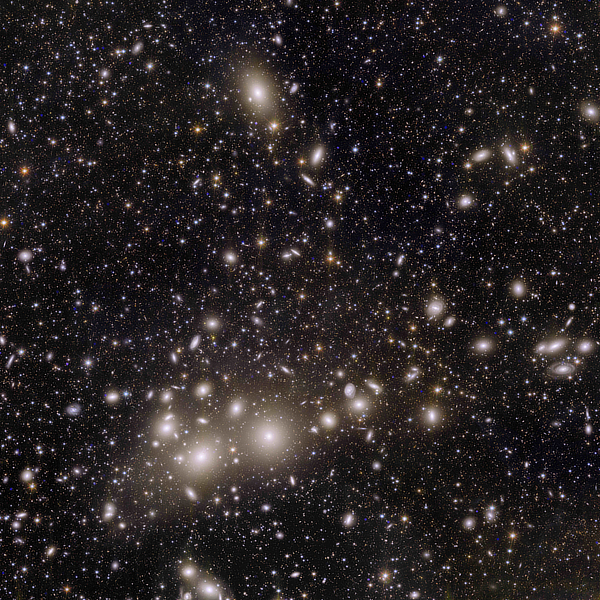
This interactive image of the ACO 426 in Perseus was provided by ESA/Euclid/Euclid Consortium/NASA, image processing by J.-C. Cuillandre (CEA Paris-Saclay), G. Anselmi. There's an interactive version of this image superimposed on the PanSTARRS survey data on ESASky. We also have a finder chart should help you locate these galaxies, as will this link for Perseus Cluster on the Stellarium Web planetarium. I am surprised I have not covered this Abell cluster in Perseus in the GOM series before as it is the standout galaxy cluster in the autumn sky. The cluster lies at a distance of about 240 million light-years from us and is the major component of the Pisces-Perseus super cluster.
This cluster contains thousands of galaxies immersed in a halo of hot X-Ray emitting gas and is believed to be one of the most massive objects in the local universe. The cluster is of the linear type in the Rood-Shastry galaxy cluster classification. This can be seen well in the wide field image from the Euclid satellite. It has an Abell richness class of 2, so it is not regarded as a terribly rich cluster but its closeness to us means there are many galaxies that can be seen ( a richness class of 2 suggests there are between 80 and 129 galaxies in the range m3 to m3+2).
The BCG is the active galaxy NGC 1275 which in deep images shows streams of H-Alpha emission. NGC 1275 is also the Perseus A radio source, the brightest radio source in Perseus. NGC 1275 is at the right-hand side of the cluster along with the other bright galaxies NGC 1272 and NGC 1278. Most of the rest of the galaxies lie along the line to NGC 1250. There are however a couple of bright galaxies that are often missed as they are off the centre line, NGC 1265 and NGC 1282. The total cluster diameter is 17.9’.
The whole Pisces-Perseus cluster stretches perhaps 40 degrees across the sky. An observing guide to the supercluster can be found at Adventures in Deep Space.
Most of the galaxies in Abell 426 appear to be early types (i.e. elliptical and lenticular galaxies) although there are a fair number of spiral galaxies as well. The cluster was also recently shown to contain a large number of low surface brightness dwarf ellipticals. The presence of the spiral galaxies suggests that the cluster is still evolving by accreting local galaxy groups. X-Ray observations suggest that the gas in the cluster is sloshing around generating very low frequency sound waves.
For those interested in future telescopes the following video shows the FOV of the upcoming Nancy Roman telescope compared to Hubble. There is also a recently released image of part of the cluster from the Gemini North telescope.
Although the brighter members of the cluster can be seen with smaller telescopes the cluster really comes into its own when viewed with larger instruments when more than 10 galaxies can be seen in the same field of view when looking at the centre of the cluster. I find that using a medium to high power eyepiece will help bring out the majority of the galaxies in the field and then moving along the main band of the cluster will bring out many more. When looking at the cluster do not forget to view the larger off band galaxies as well.
The cluster is well covered in the Webb Society Deep-Sky Observer's Handbook (WSDSOH) Vol. 5 and makes the Astronomical League clusters of galaxies list as well. There is also a nice report on Cloudy Nights. The cluster is also in Alvin Huey’s Abell clusters guide at FaintFuzzies.com and there is a chart for it in Luginbuhl and Skiff (L&S).
Owen Brazell - Galaxy Section Director
-
NGC 128 Group in Pisces
October 2020 - Galaxy of the Month
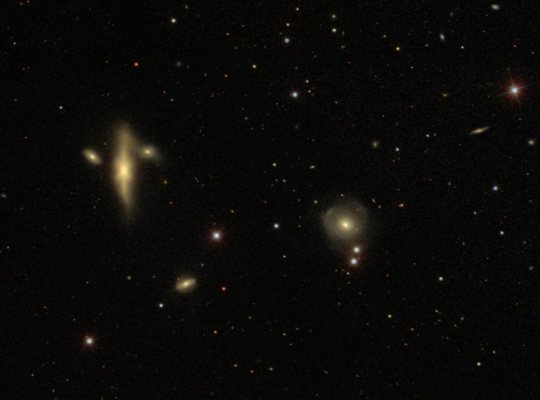
This interactive image of the NGC 128 group was provided by the Sloan Digital Sky Survey (SDSS) using Aladin Sky Atlas. We also have a finder chart should help you locate these galaxies. The small group of galaxies around NGC 128 in Pisces, also designated as LGG 6, was first discovered by William Herschel who found NGC 128 itself along with NGC 125 in 1790 using his 18.7” 20 foot reflecting telescope. NGC 126, NGC 127 and NGC 130 had to wait until 1850 when Bindon Stoney discovered them whilst examining the area using Lord Rosse’s 72” telescope.
The LGG 6 group is composed of 11 galaxies including NGC 128, NGC 126, NGC 127 and NGC 130. Nearby MCG +0-2-45 is also associated with the group.
NGC 128 itself appears to be interacting with NGC 127 and there is a tidal tail between the two. NGC 128 itself is an interesting galaxy as, although it is classified as a lenticular, it shows a boxy or peanut shaped nucleus with a strange X form. This could be the result of a previous merger or the ongoing interaction between itself and NGC 127. Although NGC 125 is also a disturbed galaxy it does not appear to be associated with NGC 128.
NGC 125 appears to be a form of shell galaxy. This is shown up well in the image on the CHART32 website. Deep images suggest that NGC 126 also shows some sign of tidal tails so it is also undergoing a gravitational interaction, probably also with NGC 128. It appears that NGC 130 is also interacting with NGC 128 as well.
There were some suggestions that NGC 125 might also be part of the group but its recession velocity is much larger than the others. The possibility remains however that NGC 128 and 125 have interacted in the past. The interaction of NGC 128 with NGC 127 is thought however to be a relatively recent phenomenon and has produced a counter rotating disk of stars in NGC 128 aligned with NGC 127.
The interacting part of the group was also catalogued in the Vorontsov-Velyaminov of interacting galaxies as VV 894. The group also makes it into the WBL catalogue of poor clusters as WBL 10 and that group includes NGC 125 but not some of the others included in LGG 6. The group lies at a distance of perhaps 190 million light years from us.
The group may be a tough one to observe with smaller telescopes. The Night Sky Observer's Guide (NSOG) suggests that only NGC 125 and NGC 128 will be visible in 10-12” scopes whilst the others may need telescopes in the 20” class to see, at least from UK skies. Observations with a 22cm from the UK suggest that NGC 128 was hard and that NGC 125 was not seen. Using a 37cm scope under mediocre skies showed NGC 128 as an edge on and NGC 125 as a circular patch. The other galaxies were not seen.
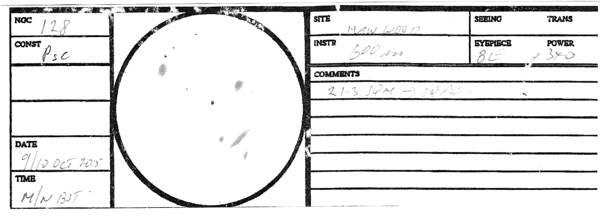
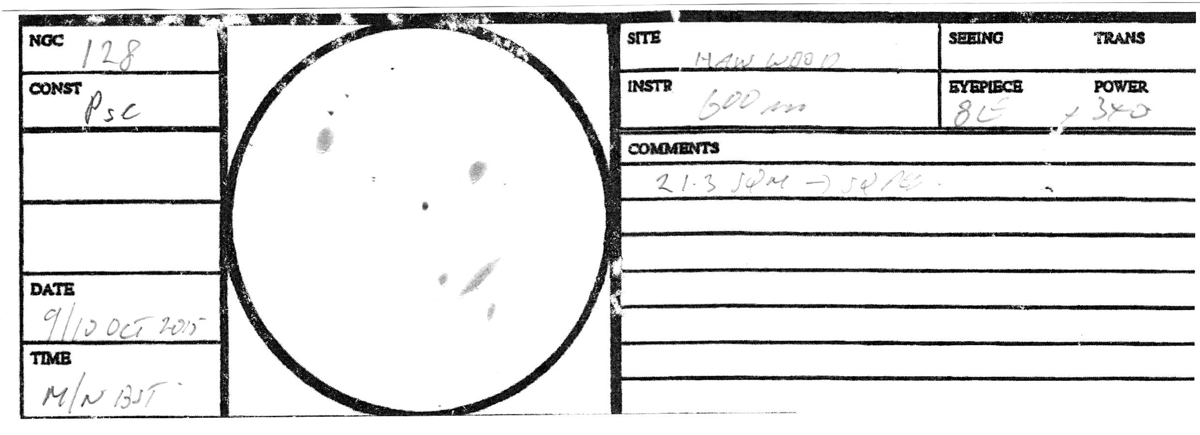
A sketch of the NGC 128 group by Andrew Robertson using his 24 inch reflector. Please click on the image for a larger version. The group is fairly tight so the use of high power is recommended in order to pick up the fainter members. They should all fit in the field of a modern hyperwide eyepiece at 350x. The fainter MCG member of the group is still close by and will again fit in the same field as the others when using a power around 260x. This is likely to be a challenge however for telescopes in the 20”+ class.
Owen Brazell - Galaxy Section Director

-
Deep-Sky Objects and Observations
