The Webb Deep-Sky Society

An international society of amateur and professional astronomers specialising in the observation of double stars and 'deep sky' objects founded in 1967. Membership is open to anyone who shares the interests of the Society.

  • About Us
  • Membership
  • Deep-Sky News
  • Galaxies
  • Nebulae and Clusters
  • Double Stars
  • Publications
  • The DSO
  • NGC 1024 in Aries

    December 2018 - Galaxy of the Month
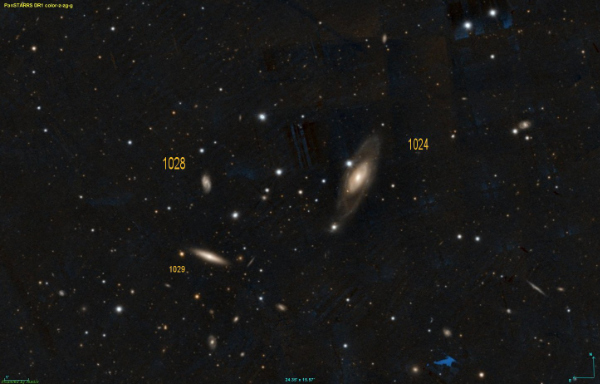
    Galaxies NGC 1024, NGC 1028 and NGC 1029 in Aries - Image was provided by the Pan-STARRS1 Surveys
    This image of the galaxies NGC 1024, NGC 1028 and NGC 1029 in Aries was provided by the Pan-STARRS1 Surveys. We also have a larger marked up version of this image to help you locate these galaxies.

    NGC 1024 is part of a group of three galaxies, including NGC 1028 and NGC 1029.

    First discovered by William Herschel in 1786, NGC 1024 was included by Arp in his catalogue of peculiar galaxies as number 333, under the classification of Miscellaneous galaxies. Arp classified it as such because it had very thin spiral arms coming from a pseudo ring. As such it does have the very complex morphological classification of (R')SA(r)ab. NGC 1028 and NGC 1029 are very much fainter and were first discovered by Albert Marth using William Lassell’s 48” reflector from Malta.

    There are some issues over whether the group is physically related and it is included in the WBL catalogue as number 82. The WBL group only consists of these three galaxies. Just to show how confusing cataloguing groups of galaxies is, the NGC 1024 group is also included in the LGG catalogue as number 69. The LGG group also makes the group count as three galaxies, but in this case NGC 1024 and NGC 1029 make the cut and NGC 1028 is dropped from the group to be replaced by the elliptical galaxy NGC 990, which is over a degree away on the sky.

    If you look at the redshifts of the galaxies then the redshift for NGC 1028 is more than twice that for NGC 1024 and NGC 1029, whilst that for NGC 990 is pretty much the same, as always showing that proximity on the sky is no substitute for proximity in space.

    At the very least NGC 1024 is thought to form a physical pair with NGC 1029. NGC 1029 is classified as a lenticular galaxy whilst NGC 1028 appears to be a Sa spiral.

    The NGC 1024 group is thought to be about 158 million light years away.

    Visually NGC 1024 will be challenging in 20-cm but should be visible relatively easily in 37cm. The companions are going to be a challenge I think for 37cm and may require 50cm to see easily. The three NGC galaxies are a tight group and you may need to use medium to high power to cleanly separate them.

    For masochists there is also a much fainter (16th magnitude) galaxy in the field known as LEDA 1385855. Steve Gottlieb suggests that even in his 17.5” both NGC 1028 and NGC 1029 are pretty faint.

    There is a 7th magnitude star close by the group which will need to be kept outside the field in order to pick up the fainter members I would think.

    Owen Brazell - Galaxy Section Director

  • About the Webb Society

    • Back top of this page
    • Go to our home page
    • About us
    • News
    • Our Annual Meeting
    • Galaxy Section
    • Nebulae and Clusters Section
    • Double Star Section
    • Join the Webb Deep-Sky Society
    • Links to members' websites
    • Useful astronomy links
    • Contact Us
  • Deep-Sky Objects and Observations

    • Observations home page
    • Object of the Season
    • Double Star Circulars
    • Double Star of the Month archive
    • Double Star of the Month RSSRSS feed icon
    • Galaxy of the Month archive
    • Galaxy of the Month RSSRSS feed icon
    • Picture of the Month archive
    • Picture of the Month RSSRSS feed icon
    • Nebula and Cluster of the Month archive
  • The Deep-Sky Observer

    • DSO digital subscriber login
    • Webb Society Journal archive
  • Publications

    • Handbooks, Guides and Atlases
    • Alvin Huey's Observer's Guides
    • Willman-Bell Publications
    • Free Observing Guide Downloads
  • Featured Articles

    • Where to get reliable NGC/IC data
    • Rediscovering the Bedford Catalogue
    • An Averted Vision Scale

If you have any comments or problems with this page or any other Webb Deep-Sky webpage then please contact the Website Administrator

The Webb Society is registered under The Charities Act 1960 - Registered Charity No. 288384 © 2025 Webb Society except where stated.

The information contained in this website is for general information purposes only. The information is provided by The Webb Deep-Sky Society and while we endeavour to keep the information up to date and correct, we make no representations or warranties of any kind, express or implied, about the completeness, accuracy, reliability, suitability or availability with respect to the website or the information, products, services, or related graphics contained on the website for any purpose. Any reliance you place on such information is therefore strictly at your own risk. In no event will we be liable for any loss or damage including without limitation, indirect or consequential loss or damage, or any loss or damage whatsoever arising from loss of data or profits arising out of, or in connection with, the use of this website. Through this website you are able to link to other websites which are not under the control of The Webb Deep-Sky Society. We have no control over the nature, content and availability of those sites. The inclusion of any links does not necessarily imply a recommendation or endorse the views expressed within them. Every effort is made to keep the website up and running smoothly. However, The Webb Deep-Sky Society takes no responsibility for, and will not be liable for, the website being temporarily unavailable due to technical issues beyond our control.