-
M101 in Ursa Major
June 2018 - Galaxy of the Month
This interactive image of the M101 was provided by the Sloan Digital Sky Survey using Aladin Sky Atlas. We also have a finder chart that should help you locate all those extra NGCs. It always feels slightly pointless writing a GOM article for June as it never gets dark here in northern latitudes so rather than going for something faint we will go with the relatively easy challenge of M101.
M101 was first discovered by Pierre Mechain in March 1781 and has been the subject of some controversy as it has also been suggested that it is the same as M102 as Mechain listed M102 as a duplicate observation of M101. There are suggestions however that M102 was in fact really a different object and modern Messier books seem to randomly choose what object to associate with M102.
Lord Rosse observing with the 72” at Birr added M101 to his list of nebulae that showed spiral structure and made a drawing of it that compares favourably with modern images.
When it is dark and at a high altitude M101 is easily visible in binoculars, even my 10x42 Canon IS binoculars will show it, to see detail requires a somewhat larger aperture.
M101 is such a complex galaxy that it has been given an Arp designation (Arp 26) and two designations in the VV catalogue of interacting systems (394 and 456). It is complex enough that it contains 10 objects within it that have NGC designations (mostly HII regions). The included finder chart shows many of these.
A recent study suggested that there are upwards of 1264 HII regions in M101. This may be due to gravitational perturbations raised by its companion galaxies (in particular NGC 5474, just over 45’ south of M101, and NGC 5477). In return the gravitational effects on these two caused by M101 is making them form stars at a fast rate.
M101 is about 23 million light-years away and has a size of perhaps 170,000 light-years, so substantially larger than our own Milky Way, despite recent estimates suggesting our galaxy is much larger than previously thought.
M101 is part of a small group of galaxies catalogued as LGG 371 which contains perhaps 8-9 other galaxies. The distance of the M101 group is similar to that of the M51 and NGC 5866 groups which suggests they maybe subgroups within a much larger loose group.
I have found that when observing M101 with my larger telescopes I am caught between using the widefield view which sets the galaxy nicely off in its surroundings and using higher power to tease out the detail. As M101 is a face on spiral then under poor conditions you may only see a haze with a central core but under better conditions the spiral arms and HII regions will leap out at you.
Note that on the SDSS image the bright blue object on the left at about 9 o’clock is not a plate defect but the giant HII region NGC 5471. Under very steady conditions with a large telescope and high power NGC 5471 may also show structure. It shows up very prominently on the UV images from GALEX. To see multiwavelength images of objects I recommend using the free viewer Aladin.
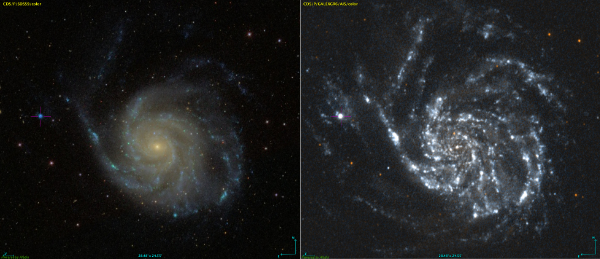
Sloan Digital Sky Survey (SDSS) image on the left and GALEX UV image on the right of M101. NGC 5471 is marked in very faint crosshairs to the left of M101. If finding M101 is not enough of a challenge then perhaps a nice observing project will be to see how many of the M101 group galaxies you can find. These are NGC 5204, NGC 5474, NGC 5477, NGC 5585, UGC 8837 and UGC 9405. Most of them are relatively bright but UGC 9405 is at around 17th magnitude so it may be rather more difficult to see.
M101 has had one supernova in recent times with sn2011fe which was observed in August 2011 and reached 10th magnitude at its peak. I do remember observing this one although M101 was relatively low at the time using my 15”. Given the amount of star forming activity it is probably a likely source for more supernovae.
M101 made the OOTW on the DSF forum in 2015 and there are some interesting drawings there made with large telescopes.
There is interesting web page showing Lord Rosse’s drawings of the spiral nebulae. It is in German but if using Chrome you can ask it to translate the page.
Owen Brazell - Galaxy Section Director
I've received an image of M101 captured by Paul Whitmarsh in March this year.
-
Deep-Sky Objects and Observations
