-
ACO 194 Group of Galaxies in Cetus
November 2017 - Galaxy of the Month
This interactive image of the ACO 194 group was provided by the Sloan Digital Sky Survey using Aladin Sky Atlas. We also have a finder chart should help you locate these galaxies. Our object this month is the galaxy cluster in Cetus ACO 194.
The cluster has not been well covered in amateur observing guides despite it having a number of pages dedicated to it in the venerable Webb Deep-Sky Society Observer's Handbook (WDSSOH) Vol. 5. It does not appear in Night Sky Observers Guide (NSOG) or in Luginbuhl and Skiff (L&S) much to my surprise. There is a small piece on it in the book Galaxies and How to Observe them.
This may be due to it low altitude it culminates at as seen from northern latitudes. The galaxies themselves are not so bright and although there are 14 galaxies in the NGC listed in the group most are quite faint.
The main galaxies in the group NGC 545 and NGC 547, also known as Arp 308, were discovered by William Herschel in 1785, whilst it took d’Arrest to find the next brightest, NGC 541, almost 100 years later in 1864. Most of the other NGC galaxies in the group were found by Swift and d’Arrest.
The cluster is classed 0 based on its Abell richness class and structurally it is classed as L on the Rood-Sastry class.
The SAO/NASA ADS Astronomy Abstract Service provides a link to the PDF of the paper "Tuning Fork" Classification of Rich Clusters of Galaxies describing the cluster classification schemes.
Basically the classification suggests that it is a linear string of galaxies. Of course this can only ever be a 2D representation of the cluster as we have no idea of their motions in the plane of the sky. Richness class 0 objects are the least impressive of all the Abell clusters as they contain the least number of bright galaxies but ACO 194 is close enough (in Abell cluster terms) to show a number of galaxies.
The group is also interesting because it contains a strange galaxy known as Minkowski’s object. Originally thought to be a dwarf galaxy it is now thought to be a cloud of gas in the inter galactic medium that has been compressed by the radio jet from NGC 541 to form a bunch of stars.
There is an interesting discussion about it to be found in the GalaxyZoo Forum and it was also the Deep-Sky Forum (DSF) object of the week in November 2014.
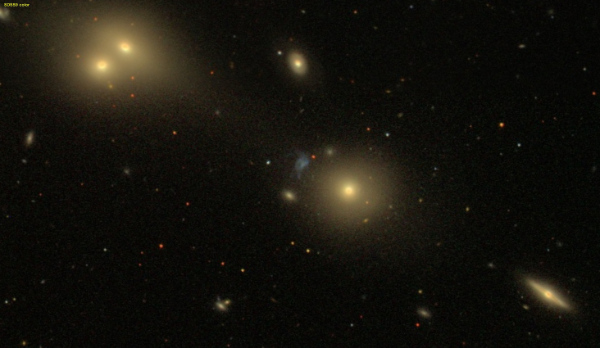
Minkowski’s object in the centre of the field (Image Credit Sloan Digital Sky Survey). Minkowski’s object is the bluish object to the left of NGC 541 in the SDSS image and you can see a more detailed view in the Hubble legacy image. Not unsurprisingly given its colour it is very bright in the UV images from GALEX.
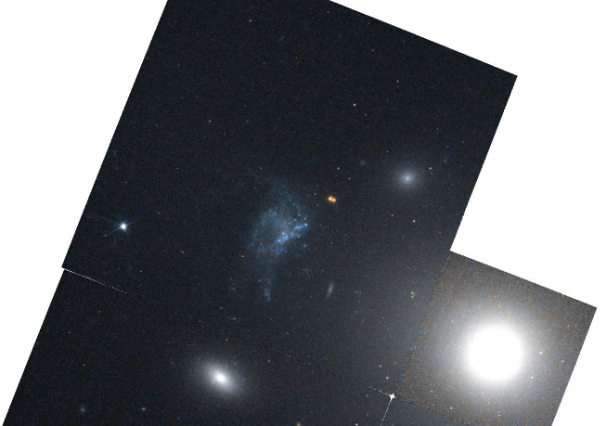
Hubble Space Telescope (HST) image of Minkowski's object. Courtesy the Hubble Legacy Archive (STScI/ST-ECF/CADC) There is some discussion over whether this object can be seen with amateur scopes but it will certainly require a large aperture at high power I think to find.
Interestingly it would seem that NGC 541 along with NGC 545 and NGC 547 have interacted in the past as there is some evidence of a star stream between them. The centre of the cluster is probably around NGC 541 itself. Both NGC 541 and 545 show large radio jets and lobes.
Visually I guess that the brighter galaxies in the group could be seen with 35-cm telescopes but to get all the main NGC galaxies from UK latitudes will probably require 50cm.
Andrew Robertson and I observing with 55 and 60-cm telescopes at the recent Kelling Heath star party counted at least 14 galaxies in the group, perhaps 16 although we may have double counted. It is not always so easy when going along a linear group to make sure that some galaxies have not already been seen. We did not stray much off the main band and therefore would not have picked up the outlying NGC objects, something to go back for.
I would suggest that to pick up the fainter galaxies will require a high power and possibly a driven telescope. A chart may have also have helped to track them down.
Coincidentally the November 2017 edition of Sky and telescope also carries an article on ACO 194. There is also an interesting article on observing ACO 194.
Owen Brazell - Galaxy Section Director
-
Deep-Sky Objects and Observations
