The Webb Deep-Sky Society

An international society of amateur and professional astronomers specialising in the observation of double stars and 'deep sky' objects founded in 1967. Membership is open to anyone who shares the interests of the Society.

  • About Us
  • Membership
  • Deep-Sky News
  • Galaxies
  • Nebulae and Clusters
  • Double Stars
  • Publications
  • The DSO
  • June 2014 - Galaxy of the Month

    NGC 6118 in Serpens Caput
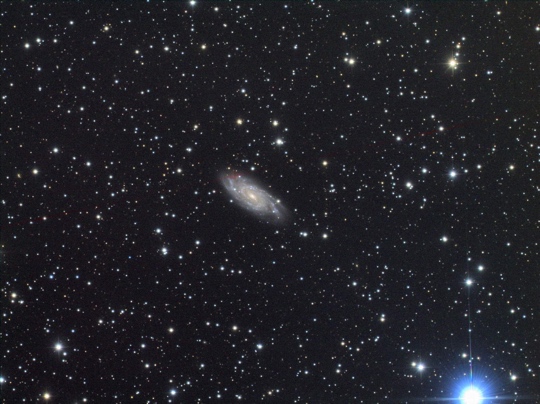
    NGC6118 - Image Courtesy of Norma Rose Observatory, Queensland, Australia

    Image Courtesy of Astro Works Corporation and the Norma Rose Observatory, Queensland, Australia.

    Summer is not the best time for viewing galaxies as the northern skies never really get dark and the sky is dominated by the Milky Way and its attendant star clusters and nebulae. There are however some galaxies to be seen and my choice this month is the galaxy NGC 6118 in Serpens Caput.

    First discovered by William Herschel in 1785 this is a nearly edge on spiral galaxy. Classified as a grand design spiral NGC 6118 is believed to lie at a distance of about 83 million light years and at that distance its size would be about 110000 light years across, making it almost the same size as our Milky Way.

    Its full classification is SA(s)cd suggesting it has tightly wound spiral arms along with a small bar. Deep images show that it has a lot of star formation going on in its arms which are highlighted by the blue star clusters.

    In 2004 NGC 6118 was host to the type Ib/c supernova 2004dk. These are relatively unusual objects that are thought to occur in binary systems where mass is stripped from one star by the other.

    Unusually NGC 6118 does not appear to be part of any galaxy group but appears to be an isolated field galaxy. As such it is of interest is determining how galaxies evolve when found in isolation rather than the usual groups.

    As the galaxy is large and faint it can be a challenge to see with smaller telescopes and has earned the name of the Blinking Galaxy because of its tendency to flicker in and out when different eye positions are used (I suspect this is a reference to the use of averted vision). Even though its total magnitude is fairly bright the size of the galaxy suggests that its surface brightness will be quite low and you will need a medium/large aperture telescope and a dark sky to see more than the core. It is regarded as one of the toughest of the Herschel 400 objects to find because of its faintness. Strangely based on this it appears in Michael Bakich’s book 1001 Celestial Wonders to see before you die !!.

    A fine image of the object can be found at the European Southern Observatory (ESO) website

    Owen Brazell - Galaxy Section Director

  • About the Webb Society

    • Back top of this page
    • Go to our home page
    • About us
    • News
    • Our Annual Meeting
    • Galaxy Section
    • Nebulae and Clusters Section
    • Double Star Section
    • Join the Webb Deep-Sky Society
    • Links to members' websites
    • Useful astronomy links
    • Contact Us
  • Deep-Sky Objects and Observations

    • Observations home page
    • Object of the Season
    • Double Star Circulars
    • Double Star of the Month archive
    • Double Star of the Month RSSRSS feed icon
    • Galaxy of the Month archive
    • Galaxy of the Month RSSRSS feed icon
    • Picture of the Month archive
    • Picture of the Month RSSRSS feed icon
    • Nebula and Cluster of the Month archive
  • The Deep-Sky Observer

    • DSO digital subscriber login
    • Webb Society Journal archive
  • Publications

    • Handbooks, Guides and Atlases
    • Alvin Huey's Observer's Guides
    • Willman-Bell Publications
    • Free Observing Guide Downloads
  • Featured Articles

    • Where to get reliable NGC/IC data
    • Rediscovering the Bedford Catalogue
    • An Averted Vision Scale

If you have any comments or problems with this page or any other Webb Deep-Sky webpage then please contact the Website Administrator

The Webb Society is registered under The Charities Act 1960 - Registered Charity No. 288384 © 2025 Webb Society except where stated.

The information contained in this website is for general information purposes only. The information is provided by The Webb Deep-Sky Society and while we endeavour to keep the information up to date and correct, we make no representations or warranties of any kind, express or implied, about the completeness, accuracy, reliability, suitability or availability with respect to the website or the information, products, services, or related graphics contained on the website for any purpose. Any reliance you place on such information is therefore strictly at your own risk. In no event will we be liable for any loss or damage including without limitation, indirect or consequential loss or damage, or any loss or damage whatsoever arising from loss of data or profits arising out of, or in connection with, the use of this website. Through this website you are able to link to other websites which are not under the control of The Webb Deep-Sky Society. We have no control over the nature, content and availability of those sites. The inclusion of any links does not necessarily imply a recommendation or endorse the views expressed within them. Every effort is made to keep the website up and running smoothly. However, The Webb Deep-Sky Society takes no responsibility for, and will not be liable for, the website being temporarily unavailable due to technical issues beyond our control.