The Webb Deep-Sky Society

An international society of amateur and professional astronomers specialising in the observation of double stars and 'deep sky' objects founded in 1967. Membership is open to anyone who shares the interests of the Society.

  • About Us
  • Membership
  • Deep-Sky News
  • Galaxies
  • Nebulae and Clusters
  • Double Stars
  • Publications
  • The DSO
  • February 2012 - Galaxy of the Month

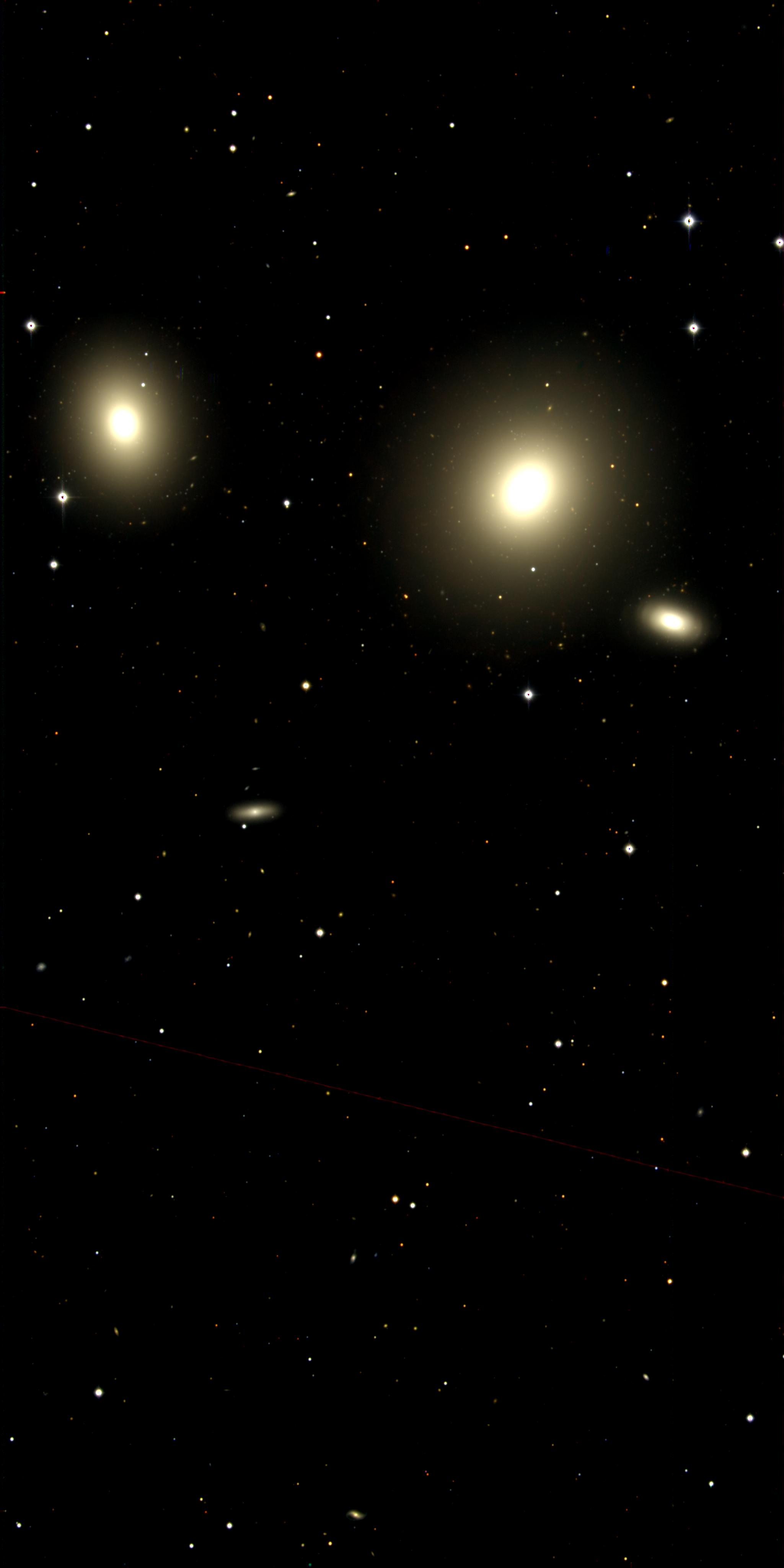
    NGC 3607 Group in Hercules

    NGC 3607 - image courtesy of Prof. Duncan A Forbes

    Image Credit - Prof. Duncan A. Forbes, Swinburne University of Technology, Australia. Click on the image above for a larger version or visit Prof. Forbes web pages for more of his images. We also have a Megastar© chart of the NGC 3607 region.

    Our challenge for February is the galaxy group associated with NGC 3607. There are 3 galaxies intimately involved with this group which are NGC 3607, NGC 3608 and NGC 3605. The first two should be relatively easily seen in small telescopes.

    NGC 3607 is classified as SA(0) which is a lenticular galaxy. These are galaxies that appear to have the luminosity profile of a spiral but have no (or little) gas and dust and are normally found in clusters. NGC 3608 is an early type elliptical. It would appear that NGC 3607 and NGC 3608 are interacting and that the former maybe stealing material from its neighbour. Backing this theory up is the fact that NGC 3607 is a low luminosity active galaxy.

    NGC 3505 is much fainter and will require a larger telescope to see. It is also an elliptical galaxy but with a classification of E5 much more squashed. It is probably not associated with 3607 and 3608 but a background galaxy.

    The NGC 3607 group contains perhaps 14 galaxies and is part of the much larger Leo II groups of galaxies. This is a collection of small galaxy groups, probably not that much dissimilar to our own local group at a distance of perhaps 70-90 million light years. There appear to be 11 major groups in the Leo II cluster along with a number of other NGC galaxies. They are all part of the Virgo cluster.

    In the same medium power field as NGC 3607 there is also the galaxy NGC 3599 which is another relatively bright lenticular. All of these galaxies were discovered by William Herschel in 1784. NGC 3599 is not physically associated with the 3607 group.

    Much closer in to NGC 3607 is the very much fainter galaxy MCG +3-29-18 which at magnitude 16.3 is going to be a challenge for large scope observers and is perhaps more suited to imagers. This is also probably a background galaxy.

    NGC 3607 itself is a part of the RASC’s (Royal Astronomical Society of Canada) finest NGC list and as such should perhaps be better known that it is. The brightest galaxies in the NGC 3607 group are NGC 3607, NGC 3626, NGC 3686, NGC 3608 and NGC 3684. Because of its relative nearness the group spreads across perhaps 4 degrees of sky. If you like galaxy trios then NGC 3681, 3684 and 3691 are also a nice trio of galaxies that should show in the same medium power field with a medium sized telescope.

    Owen Brazell - Galaxy Section Director
  • About the Webb Society

    • Back top of this page
    • Go to our home page
    • About us
    • News
    • Our Annual Meeting
    • Galaxy Section
    • Nebulae and Clusters Section
    • Double Star Section
    • Join the Webb Deep-Sky Society
    • Links to members' websites
    • Useful astronomy links
    • Contact Us
  • Deep-Sky Objects and Observations

    • Observations home page
    • Object of the Season
    • Double Star Circulars
    • Double Star of the Month archive
    • Double Star of the Month RSSRSS feed icon
    • Galaxy of the Month archive
    • Galaxy of the Month RSSRSS feed icon
    • Picture of the Month archive
    • Picture of the Month RSSRSS feed icon
    • Nebula and Cluster of the Month archive
  • The Deep-Sky Observer

    • DSO digital subscriber login
    • Webb Society Journal archive
  • Publications

    • Handbooks, Guides and Atlases
    • Alvin Huey's Observer's Guides
    • Willman-Bell Publications
    • Free Observing Guide Downloads
  • Featured Articles

    • Where to get reliable NGC/IC data
    • Rediscovering the Bedford Catalogue
    • An Averted Vision Scale

If you have any comments or problems with this page or any other Webb Deep-Sky webpage then please contact the Website Administrator

The Webb Society is registered under The Charities Act 1960 - Registered Charity No. 288384 © 2025 Webb Society except where stated.

The information contained in this website is for general information purposes only. The information is provided by The Webb Deep-Sky Society and while we endeavour to keep the information up to date and correct, we make no representations or warranties of any kind, express or implied, about the completeness, accuracy, reliability, suitability or availability with respect to the website or the information, products, services, or related graphics contained on the website for any purpose. Any reliance you place on such information is therefore strictly at your own risk. In no event will we be liable for any loss or damage including without limitation, indirect or consequential loss or damage, or any loss or damage whatsoever arising from loss of data or profits arising out of, or in connection with, the use of this website. Through this website you are able to link to other websites which are not under the control of The Webb Deep-Sky Society. We have no control over the nature, content and availability of those sites. The inclusion of any links does not necessarily imply a recommendation or endorse the views expressed within them. Every effort is made to keep the website up and running smoothly. However, The Webb Deep-Sky Society takes no responsibility for, and will not be liable for, the website being temporarily unavailable due to technical issues beyond our control.