The Webb Deep-Sky Society

An international society of amateur and professional astronomers specialising in the observation of double stars and 'deep sky' objects founded in 1967. Membership is open to anyone who shares the interests of the Society.

  • About Us
  • Membership
  • Deep-Sky News
  • Galaxies
  • Nebulae and Clusters
  • Double Stars
  • Publications
  • The DSO
  • August 2011 - Galaxy of the Month

    IC10 - Irregular Galaxy in Cassiopeia
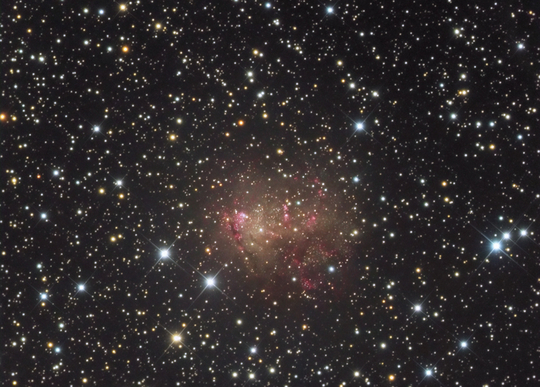
    image of ic10 - courtesy of mike siniscalchi

    Image Courtesy of Mike Siniscalchi - Long Island, New York. Click on image for a larger version. For more astrophotography images from Mike please visit his website Reflections from Heaven

    Although August is perhaps not the best month to study the dwarf irregular galaxy IC 10 it does start to rise high enough to be seen reasonably by the month end.

    IC 10 was first discovered by Lewis Swift in 1885 using the 16" refractor at the Warner observatory. Swift described it as a faint star involved in a very large, extremely faint nebulosity, extremely diffuse. Hubble suggested that it might be a member of the Local group of galaxies in 1935 but it wasn’t until the 1960’s that its status as a member of the local group was confirmed when its radial velocity suggested it was approaching the Milky Way at around 350 km’s. Measurements in the 1990’s using Cepheid variables confirmed its membership.

    IC 10 appears to be part of the Andromeda subgroup along with M33 and is also unusual in that it is the only starburst galaxy in the Local Group. It has a much higher density of Wolf-Rayet (WR) stars than the LMC which suggests that there was relatively brief period of time when all these stars formed, perhaps only 10 million years ago. The current star formation rate suggests that all the mass available to form stars will be used up in a few billion years.

    Recent observations have led to the discovery of 27 planetary nebulae in IC10, although these are all far beyond visual reach. The spatial distribution of these planetary nebulae may indicate that the galaxy is larger than thought. Infrared observations suggest that IC 10 is depleted in small dust grains and they have been blown out of the galaxy by strong winds associated with the WR stars. IC 10 also has a very large hydrogen envelope surrounding it which appears to rotate in the opposite direction to the main visual part of the galaxy. IC 10 also appears to contain one of the largest known stellar mass black holes.

    IC 10’s location within the Milky Way in Cas means that it is a relatively difficult object to observe, see the finder chart. Its size also means that you need to use a medium power eyepiece to fit it all in. There are many HII regions in the galaxy and these might respond to a nebula filter. It would be interesting to hear if these are within range of large sized amateur instruments. Because of the structure of its HII regions it does provide a good target for imagers.

    Owen Brazell - Galaxy Section Director

  • About the Webb Society

    • Back top of this page
    • Go to our home page
    • About us
    • News
    • Our Annual Meeting
    • Galaxy Section
    • Nebulae and Clusters Section
    • Double Star Section
    • Join the Webb Deep-Sky Society
    • Links to members' websites
    • Useful astronomy links
    • Contact Us
  • Deep-Sky Objects and Observations

    • Observations home page
    • Object of the Season
    • Double Star Circulars
    • Double Star of the Month archive
    • Double Star of the Month RSSRSS feed icon
    • Galaxy of the Month archive
    • Galaxy of the Month RSSRSS feed icon
    • Picture of the Month archive
    • Picture of the Month RSSRSS feed icon
    • Nebula and Cluster of the Month archive
  • The Deep-Sky Observer

    • DSO digital subscriber login
    • Webb Society Journal archive
  • Publications

    • Handbooks, Guides and Atlases
    • Alvin Huey's Observer's Guides
    • Willman-Bell Publications
    • Free Observing Guide Downloads
  • Featured Articles

    • Where to get reliable NGC/IC data
    • Rediscovering the Bedford Catalogue
    • An Averted Vision Scale

If you have any comments or problems with this page or any other Webb Deep-Sky webpage then please contact the Website Administrator

The Webb Society is registered under The Charities Act 1960 - Registered Charity No. 288384 © 2025 Webb Society except where stated.

The information contained in this website is for general information purposes only. The information is provided by The Webb Deep-Sky Society and while we endeavour to keep the information up to date and correct, we make no representations or warranties of any kind, express or implied, about the completeness, accuracy, reliability, suitability or availability with respect to the website or the information, products, services, or related graphics contained on the website for any purpose. Any reliance you place on such information is therefore strictly at your own risk. In no event will we be liable for any loss or damage including without limitation, indirect or consequential loss or damage, or any loss or damage whatsoever arising from loss of data or profits arising out of, or in connection with, the use of this website. Through this website you are able to link to other websites which are not under the control of The Webb Deep-Sky Society. We have no control over the nature, content and availability of those sites. The inclusion of any links does not necessarily imply a recommendation or endorse the views expressed within them. Every effort is made to keep the website up and running smoothly. However, The Webb Deep-Sky Society takes no responsibility for, and will not be liable for, the website being temporarily unavailable due to technical issues beyond our control.