Galaxy of the Month in Serpens
-
NGC 6070 in Serpens Caput
June 2025 - Galaxy of the Month

This interactive image of NGC 6070 in Serpens Caput was provided by the Sloan Digital Sky Survey (SDSS) using Aladin Sky Atlas. We also have a finder chart should help you locate these galaxies, as will this link for NGC 6070 on the Stellarium Web planetarium. Our galaxy for this month is the near face on spiral galaxy NGC 6070 in Serpens Caput.
Discovered by William Herschel in 1786 it has the SA(s)cd classification and along with the fainter galaxies PGC 57350 and PGC 1175364 it forms a trio. NGC 6070 is also part of the galaxy group LGG 404 along with UGC 10288 and 10294. If LGG 404 is a true group then the galaxies are spread quite a way apart on the sky. The situation gets confusing but the three galaxies with NGC 6070 are also known as Holm 729.
NGC 6070 is thought to be about 92 million light-years away and if at that distance would have a diameter of about 105,000 light-years. It was one of the first light images for the SDSS. NGC 6070 itself is at magnitude 11.8 but the two companions are around 14.4 or so and will be a challenge for larger telescopes.
The three galaxies are not a physical system with the two PGC galaxies probably being about 580 million light-years away and part of another cluster. If they are this far out then they are probably quite large as well. PGC 57350 is also a double galaxy system, probably undergoing a merger.
The images in the UV from the GALEX satellite show that there is a lot of star formation going on in NGC 6070 and a couple of the brighter giant HII regions in the NE of the galaxy maybe visible and are in fact covered in Alvin Huey’s latest guide on Observing Extragalactic Objects Within Host Galaxies. It is worth noting that the two small companions are sometimes called NGC 6070B and C, although sources frequently change which galaxy is which.
For those that follow the Deep Sky Forum, NGC 6070 was included in both 2019 and 2022. NGC 6070 is also included in the Astronomical League's Herschel II list.
As the galaxy is close to face on it is likely that in most telescopes only the bright core may be seen. The spiral arms maybe seen with larger telescopes from dark sites. The group is very tight and will fit in the field of a high-power eyepiece and this may be the best way to see them, in particular to pick out the faint companions.
The group is also covered in Alvin Huey’s Galaxy Trios guide. The The Night Sky Observer's Guide Vol. 2 suggests that a 30—35cm scope will show the core and 40—45cm will show the core surrounded by a haze. Steve Gottlieb in his complete collection of NGC observations at Adventures in Deep Space suggests that a 24” telescope maybe required to see the companions, certainly to split the double pair whilst using a 48” will show them well.
It is likely that the 7th magnitude star nearby will impact on observations of the group. The star is a red star catalogued as Espin-Birmingham 449.
Owen Brazell - Galaxy Section Director
-
NGC 5921 in Serpens Caput
June 2021 - Galaxy of the Month

This interactive image of the NGC 5921 was provided by the Sloan Digital Sky Survey using Aladin Sky Atlas. We also have a finder chart should help you locate these galaxies, as will this link for NGC 5921 on the Stellarium Web planetarium. June at the latitude of the UK has to be one of the worst two months for galaxy observing, at least visually, as we do not get astronomical dark until mid-August again. As such any object for the GOM has to be brighter than the usual case.
My choice this month is the 11th magnitude galaxy NGC 5921 in Serpens Caput. NGC 5921 was discovered by William Herschel in 1786. Mitchell using Lord Rosse’s 72” at Birr suggested that it showed spiral structure, although it does not seem to have been added to their list of spiral galaxies.
NGC 5921 is a barred spiral classified as SBbc, although it has also been classified as SB(r)bc, which suggests that the spiral arms may start from a circumnuclear ring. In this case the spiral arms start from the end of the bar but appear to form a ring afterwards. The galaxy has a small bright nucleus with open spiral arms containing a lot of HII regions. The central bar does appear to have a prominent dust lane across it. Interestingly the form of the galaxy depends on what wavelength it is photographed in and only the blue images show spiral structure. The red image just show dust.
The distance measurements seem uncertain and vary between 65 and 80 million light-years. Hubble has imaged the galaxy. There is also a superb amateur image of it by Adam Block. NGC 5921 does appear to contain a supermassive black hole at its centre. If this is the case the galaxy may also be a mild form of AGN known as a LINER.
Unusually NGC 5921 does not appear to be a part of any galaxy group and is a field galaxy. It was home to the Type II supernova 2001x. If the longer distance computations are right then NGC 5921 is a relatively large galaxy at about 100,000 light-years across, about the size of our own Milky Way.
Interestingly the Night Sky Observer's Guide (NSOG) Vol. 2 suggested that you need a 30cm telescope to see it and then it only shows the bright core and a faint haze. NSOG suggests that a 40-45 cm telescope should show some detail in the haze. Observations from the UK suggest that the core at least can be seen in 25cm from moderately dark skies. NGC 5921 is also featured in The Cambridge Photographic Atlas of Galaxies. For those that like working from lists, NGC 5921 is included in the Herschel 3 list: a list of 300 galaxies after the H400 and H400 part II from the Astronomical League.
Owen Brazell - Galaxy Section Director
-
NGC 5954 in Serpens Caput
June 2019 - Galaxy of the Month
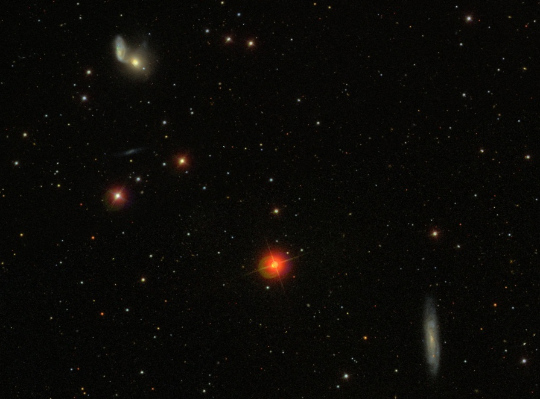
This interactive image of the Arp 91 galaxy group and NGC 5951 was provided by the Sloan Digital Sky Survey using Aladin Sky Atlas. We also have a finder chart should help you locate these galaxies. The summer months in the UK are not really dark enough for any kind of astronomical observing, let alone galaxy observing. As such I have chosen a relatively bright pair of galaxies in NGC 5953 and NGC 5954, collectively known as Arp 91 for this month’s column.
This pair of galaxies in Serpens Caput was first discovered by William Herschel in 1784. William Herschel was able to split the pair and recorded it as a double nebula.
Both NGC 5953 and NGC 5954 are individually classified as active galaxies with NGC 5953 being classified as a Seyfert type 2 with a circumnuclear ring and NGC 5954 being classified as a LINER.
The interaction between the pair has caused areas of star formation in the nuclear regions and as such it is unclear that the nuclei are truly active or we are just seeing the emission from massive star burst regions in the centre. Its interacting nature also meant it was included in the earlier catalogue of interacting galaxies by Vorontsov-Velyaminov as VV 244.
It is believed that the pair lies at about 96 million light-years from us. Both of the galaxies in the pair appear to have the same mass but NGC 5953 is the more disrupted of the pair with tidal tails and plumes surrounding it.
Arp 91 is included in the galaxy group LGG 400 which also includes NGC 5951 and NGC 5962 as well as UGC 9902. This classification may be based on spatial coincidence rather than redshift data.
Visually because of the closeness of the pair this is going to require high power to split. Night Sky Observer's Guide (NSOG) thinks the group is a target for 16/18” telescopes but it should be visible as a nebulous patch in much smaller telescopes, after all William Herschel’s 18.7” speculum metal telescope was probably equivalent to a modern 11-12”, although I am sure that some would claim they can see all the H2500 with much smaller instruments. However observations with a 14” from UK skies suggest that both NGC 5954 and 5953 are both small and faint.
About 16’ away from the Arp 91 pair is the edge on spiral NGC 5951 and all three galaxies will fit in a medium power field. NGC 5951, as it is an edge on galaxy, may also require a telescope in the 40-cm class to see.
The galaxies did make it as an Object of the Week (OOTW) at the DeepSkyForum. Alvin Huey suggests in his Arp Observing Guide that with his 22” and a magnification of around 500x he scan see the extension between NGC 5953 and NGC 5954.
Interestingly in ST4I the group is listed as the NGC 5953, 5954, 5951 Trio. I have no idea where this naming came from, although it does appear in Alvin Huey’s listing of Galaxy Trio’s, it is not as far as I can see in Miles Paul’s listing of triples.
Owen Brazell - Galaxy Section Director
-
June 2014 - Galaxy of the Month
NGC 6118 in Serpens Caput
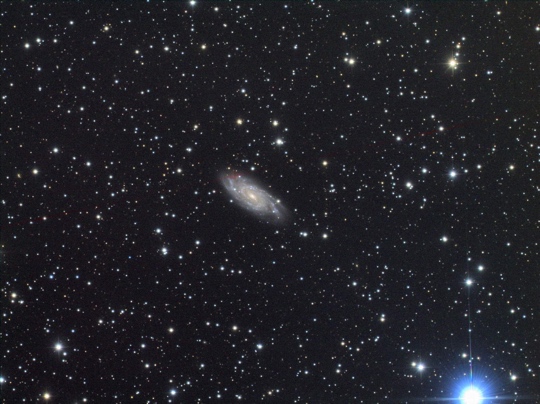
Image Courtesy of Astro Works Corporation and the Norma Rose Observatory, Queensland, Australia.
Summer is not the best time for viewing galaxies as the northern skies never really get dark and the sky is dominated by the Milky Way and its attendant star clusters and nebulae. There are however some galaxies to be seen and my choice this month is the galaxy NGC 6118 in Serpens Caput.
First discovered by William Herschel in 1785 this is a nearly edge on spiral galaxy. Classified as a grand design spiral NGC 6118 is believed to lie at a distance of about 83 million light years and at that distance its size would be about 110000 light years across, making it almost the same size as our Milky Way.
Its full classification is SA(s)cd suggesting it has tightly wound spiral arms along with a small bar. Deep images show that it has a lot of star formation going on in its arms which are highlighted by the blue star clusters.
In 2004 NGC 6118 was host to the type Ib/c supernova 2004dk. These are relatively unusual objects that are thought to occur in binary systems where mass is stripped from one star by the other.
Unusually NGC 6118 does not appear to be part of any galaxy group but appears to be an isolated field galaxy. As such it is of interest is determining how galaxies evolve when found in isolation rather than the usual groups.
As the galaxy is large and faint it can be a challenge to see with smaller telescopes and has earned the name of the Blinking Galaxy because of its tendency to flicker in and out when different eye positions are used (I suspect this is a reference to the use of averted vision). Even though its total magnitude is fairly bright the size of the galaxy suggests that its surface brightness will be quite low and you will need a medium/large aperture telescope and a dark sky to see more than the core. It is regarded as one of the toughest of the Herschel 400 objects to find because of its faintness. Strangely based on this it appears in Michael Bakich’s book 1001 Celestial Wonders to see before you die !!.
A fine image of the object can be found at the European Southern Observatory (ESO) website
Owen Brazell - Galaxy Section Director

