Galaxy of the Month in Perseus
-
NGC 1129 in Perseus
December 2024 - Galaxy of the Month
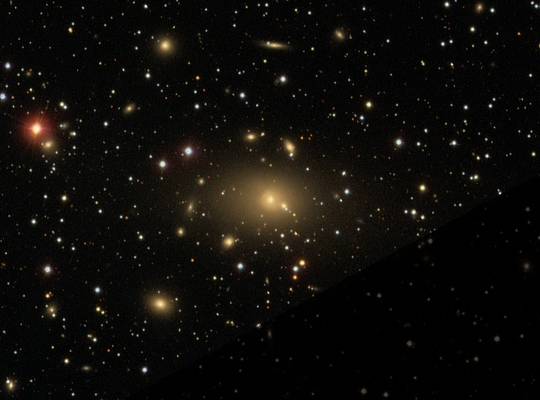
This interactive image of NGC 1129 in Perseus was provided by the Sloan Digital Sky Survey (SDSS) using Aladin Sky Atlas. We also have a finder chart should help you locate these galaxies, as will this link for NGC 1129 on the Stellarium Web planetarium. Our target this month is the small galaxy group surrounding NGC 1129 in Perseus.
NGC 1129 itself was first discovered by William Herschel in 1786 and is a giant elliptical galaxy (E5?) listed as the brightest cluster galaxy of a small cluster. It is by far the brightest galaxy in the group with NGC 1131 coming in at around 15.2 and IC 265 coming in at 15.5. The Rosse team examined this field with the 72” in 1855 and found two other galaxies which got labelled as NGC 1130 and NGC 1131. However, it Is not actually clear which galaxies they saw and the MCG messed up the identifications further. The only one that is clear is NGC 1129. It is not clear how Lord Rosse missed the brighter galaxy MCG 7-7-8 close by if he found the fainter ones. IC 265 was picked up by Lewis Swift using the 16” refractor in 1888, one assumes from Rochester, New York as he did not move to Echo Mountain until 1893.
There is a small galaxy within the halo of NGC 1129 and this pair was catalogued in Vorontsov-Veleyaminov’s catalogue of interacting galaxies as VV 85. As can be seen there is actually a small chain of three galaxies here. The distance to the group is not well known but the Hubble (redshift) distance gives about 74 Mpc. The group is also known as WBL 88 which lists 7 galaxies in the group. Perhaps unsurprisingly for such a faint group there have not been many studies of the galaxies, although the globular clusters in the group do appear to have come under recent study. It seems that the cluster is filled with hot X-Ray emitting gas, although there is no obvious current AGN in the group. The cluster is also classified as AWM 7 and is part of the Pisces-Perseus supercluster.
NGC 1129 itself may be relatively easy to find but I suspect the other galaxies in the group are going to be far more challenging to observe given their faintness. The group does make it into the Astronomical League’s Galaxy Groups and clusters list and also, perhaps surprisingly in the compilation of Walter Scott Houston’s columns where it is suggested that they may be visible in a 10” scope. I find this rather unlikely. Perhaps as expected NGC 1129 is too far off the beaten track to appear in The Night Sky Observer's Guide (NSOG) Volume 1 or any of the other standard observing guides.
Owen Brazell - Galaxy Section Director
-
NGC 1275 and ACO 426 in Perseus
November 2024 - Galaxy of the Month
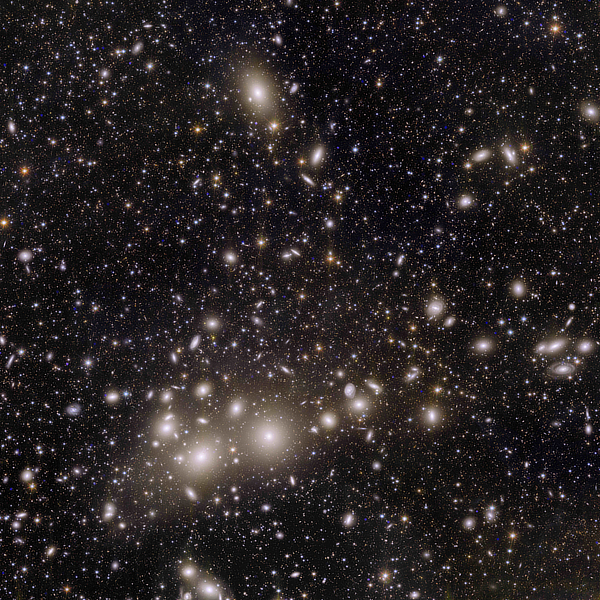
This interactive image of the ACO 426 in Perseus was provided by ESA/Euclid/Euclid Consortium/NASA, image processing by J.-C. Cuillandre (CEA Paris-Saclay), G. Anselmi. There's an interactive version of this image superimposed on the PanSTARRS survey data on ESASky. We also have a finder chart should help you locate these galaxies, as will this link for Perseus Cluster on the Stellarium Web planetarium. I am surprised I have not covered this Abell cluster in Perseus in the GOM series before as it is the standout galaxy cluster in the autumn sky. The cluster lies at a distance of about 240 million light-years from us and is the major component of the Pisces-Perseus super cluster.
This cluster contains thousands of galaxies immersed in a halo of hot X-Ray emitting gas and is believed to be one of the most massive objects in the local universe. The cluster is of the linear type in the Rood-Shastry galaxy cluster classification. This can be seen well in the wide field image from the Euclid satellite. It has an Abell richness class of 2, so it is not regarded as a terribly rich cluster but its closeness to us means there are many galaxies that can be seen ( a richness class of 2 suggests there are between 80 and 129 galaxies in the range m3 to m3+2).
The BCG is the active galaxy NGC 1275 which in deep images shows streams of H-Alpha emission. NGC 1275 is also the Perseus A radio source, the brightest radio source in Perseus. NGC 1275 is at the right-hand side of the cluster along with the other bright galaxies NGC 1272 and NGC 1278. Most of the rest of the galaxies lie along the line to NGC 1250. There are however a couple of bright galaxies that are often missed as they are off the centre line, NGC 1265 and NGC 1282. The total cluster diameter is 17.9’.
The whole Pisces-Perseus cluster stretches perhaps 40 degrees across the sky. An observing guide to the supercluster can be found at Adventures in Deep Space.
Most of the galaxies in Abell 426 appear to be early types (i.e. elliptical and lenticular galaxies) although there are a fair number of spiral galaxies as well. The cluster was also recently shown to contain a large number of low surface brightness dwarf ellipticals. The presence of the spiral galaxies suggests that the cluster is still evolving by accreting local galaxy groups. X-Ray observations suggest that the gas in the cluster is sloshing around generating very low frequency sound waves.
For those interested in future telescopes the following video shows the FOV of the upcoming Nancy Roman telescope compared to Hubble. There is also a recently released image of part of the cluster from the Gemini North telescope.
Although the brighter members of the cluster can be seen with smaller telescopes the cluster really comes into its own when viewed with larger instruments when more than 10 galaxies can be seen in the same field of view when looking at the centre of the cluster. I find that using a medium to high power eyepiece will help bring out the majority of the galaxies in the field and then moving along the main band of the cluster will bring out many more. When looking at the cluster do not forget to view the larger off band galaxies as well.
The cluster is well covered in the Webb Society Deep-Sky Observer's Handbook (WSDSOH) Vol. 5 and makes the Astronomical League clusters of galaxies list as well. There is also a nice report on Cloudy Nights. The cluster is also in Alvin Huey’s Abell clusters guide at FaintFuzzies.com and there is a chart for it in Luginbuhl and Skiff (L&S).
Owen Brazell - Galaxy Section Director
-
NGC 1161 and NGC 1160 in Perseus
October 2024 - Galaxy of the Month

This interactive image of the NGC 1161 and NGC 1160 in Perseus was provided by the Sloan Digital Sky Survey (SDSS) using Aladin Sky Atlas. We also have a finder chart should help you locate these galaxies, as will this link for NGC 1161 on the Stellarium Web planetarium. For this month I am choosing the nice pair of galaxies in Perseus, NGC 1161 and NGC 1160. Both of these galaxies were discovered by William Herschel in 1784, although NGC 1160 was also independently rediscovered by R.J. Mitchell using Lord Rosse’s 72” at Birr.
NGC 1161 is classified as a Seyfert galaxy with a classification of 1.9 (or possibly type 2), it is also classified as an AGN of the LINER type. NGC 1161 is a lenticular galaxy of type S0 whilst NGC 1160 is classified as a flocculent spiral of type SBc, or possibly Scd, seen close to edge on. The distance given for NGC 1160 is about 116 million light-years so it lies quite a bit beyond NGC 1160 which lies at about 90 million light-years.
NGC 1160 does seem to have a lot of star formation going on in it given the blue nature of its spiral arms. This is slightly unusual as lying in the void there is nothing for it to interact with to cause all this star formation. The galaxies are not a physical pair but both lie near the centre of the local void between our local supercluster and the Perseus cluster, Abell 426.
As a quick aside it appears that most galaxies lie on filaments on the edge of voids where very few galaxies appear to be. This means by studying galaxies in voids we can see how they evolve when not disturbed by interactions.
There is a nice amateur image of the pair by José Manuel López Arlandis on Astrobin. See also the Mantrap Skies Catalog entry for these galaxies which shows an interesting HST image of the internal part of NGC 1161 which appears to show an inner ring of dust clouds.
There does not appear to be much research done on either of these two which I find quite surprising as there is always interest in galaxies that are evolving without interacting with others. Perhaps as expected the area also has issues with galactic cirrus for imagers.
NGC 1161 does make it into the Astronomical League's Herschel II list but, perhaps as expected, not into any other observing lists.
The galaxies are a very tight pair and will fit into the field of view of a high-power eyepiece. There is a bright double star on the edge of NGC 1161 which may hinder viewing, HJ 2167. It is actually a triple star system with the third star lying in NGC 1161. The The Night Sky Observer's Guide (NSOG) Volume 1, now sadly out of print, suggests that the pair are targets for 40-45cm telescopes but I would have thought that since William Herschel found both of them, they should be visible in smaller apertures, perhaps down to 20-25cm.
Owen Brazell - Galaxy Section Director


