Galaxy of the Month in Corona Borealis
-
NGC 6109 in Corona Borealis
April 2019 - Galaxy of the Month
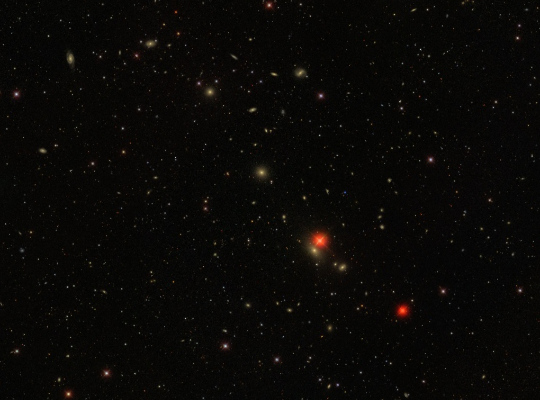
This interactive image of the NGC 6109 group was provided by the Sloan Digital Sky Survey using Aladin Sky Atlas. We also have a finder chart should help you locate these galaxies. The small group of galaxies around NGC 6109 were discovered by Edouard Stephan over several nights in July 1880 using the Foucault designed 31” silver on glass reflector at Marseille, they must have dark nights in the summer there and good weather as the telescope seems to have sat outside rather than in any kind of enclosure.
The group of galaxies including NGC 6109 is also included in the WBL catalogue as number 612. It lists 10 galaxies including NGC 6105, NGC 6107, NGC 6108, NGC 6109, NGC 6110, NGC 6112, NGC 6114 and NGC 6116 as being part of the group. The group appears to be known after its brightest galaxy, NGC 6107. It is considered to be a dynamically young poor cluster.
Zwicky also noted this group as a cluster with the designation Zwicky 1615.8+3505. The Zwicky cluster listing also included NGC 6104 as part of the group but it is quite a long way out from the main group and the WBL listing does not include it as part of the group. It is also odd in that only NGC 6104 shows any signs of star formation.
The group forms a nice line of galaxies but as Stephan found them faint these may turn out to be a bit of a challenge.
NGC 6109 is both a radio source and a point X-Ray source and is currently classified as a LINER type AGN with an unusual doughnut shaped jet. Oddly for a galaxy of this type it is suspected to be an S0, lenticular. It also shows a typical head-tail radio structure, which is unusual as these galaxies are normally only found in rich clusters of galaxies, although this interpretation has been challenged and various models have been put forward to explain this feature, including a deflected jet. NGC 6109 was also home to supernova 2010an.
With the exception of NGC 6107, which is classified as an elliptical (E3?), most of the galaxies in the group are suspected to be spirals. NGC 6107 is also a radio and X-Ray source. The group is suspected to be about 400 million light years away.
There are also a large number of much fainter galaxies in the field which may be visible in very large amateur telescopes. Steve Gottlieb in his NGC notes describes all of the galaxies in the group as faint with an 18” from good skies so they are likely to challenge 20” and above from typical UK skies. Both NGC 6107 and NGC 6109 are included in the Night Sky Observer's Guide (NSOG) Volume 2 as targets for 16-18 inch telescopes.
Owen Brazell - Galaxy Section Director
-
May 2015 - Galaxy of the Month
NGC 6085 in Corona Borealis
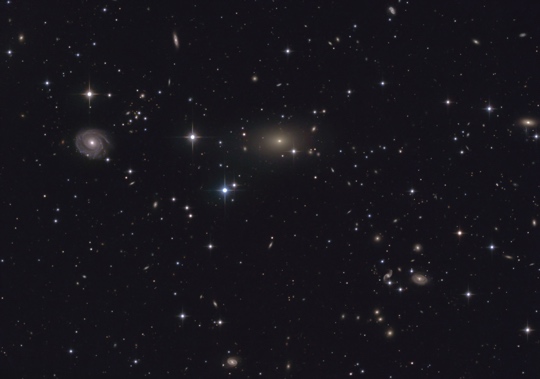
Image credit (Josef Pöpsel and Stefan Binnewies, Capella Observatory.)
This finder chart should help you locate these galaxies.
If Corona Borealis pops into the deep sky observers mind it is either because it is on the way to Hercules or because they are hunting the challenging Abell cluster AGC 2065. Home of numerous faint galaxies even in the standard references Corona Borealis hardly gets a mention.
This months challenge however are the two faint galaxies NGC 6085 and 6086 which form the core of the galaxy cluster Abell 2162. Both of the objects were discovered by Albert Marth using William Lassell’s 48" speculum telescope from Malta and were described by him as quite faint so you need to be up for the challenge.
NGC 6086 is a giant elliptical galaxy classified as a cD is at the centre of AGC 2162. Recently NGC 6086 has been shown to a harbour a billion solar mass black hole, although depending on the amount of dark matter involved that mass may drop. It also appears to be one of the brightest galaxies in the nearby universe.
NGC 6085 is a face on spiral, although except with very large telescopes, it will probably only show the core region. There are suggestions that NGC 6085 may also be a Seyfert galaxy, however this may just be a misreading of a number of papers on Seyferts where NGC 6085 was used as a control galaxy.
These two galaxies are by far the brightest members of AGC 2162. All the other members are substantially fainter as can be seen by the fact that perhaps only another half dozen made any of the older galaxy catalogues such as the UGC or CGCG. Neither the NGC galaxies nor the cluster itself make any of the venerable references such as the WSDSO Vol. 5 or, L&S or NSOG.
Abell 2162 itself is part of a filament of galaxies that joins the northern and southern Hercules superclusters together. For an expanded history of this supercluster try the atlas of the universe. This group of clusters along with the Coma supercluster have been nicknamed the Great Wall. Deep images seem to suggest that like the better known Hercules cluster Abell 2151 Abell 2162 does have a high proportion of spiral and lenticular galaxies.
Both NGC 6085 and 6086 are going to be challenging to see visually although there are a number of nice images of the field. Give it a go and see what you can find.
Owen Brazell - Galaxy Section Director

