Galaxy of the Month in Canes Venatici
-
NGC 5223 in Canes Venatici
April 2025 - Galaxy of the Month

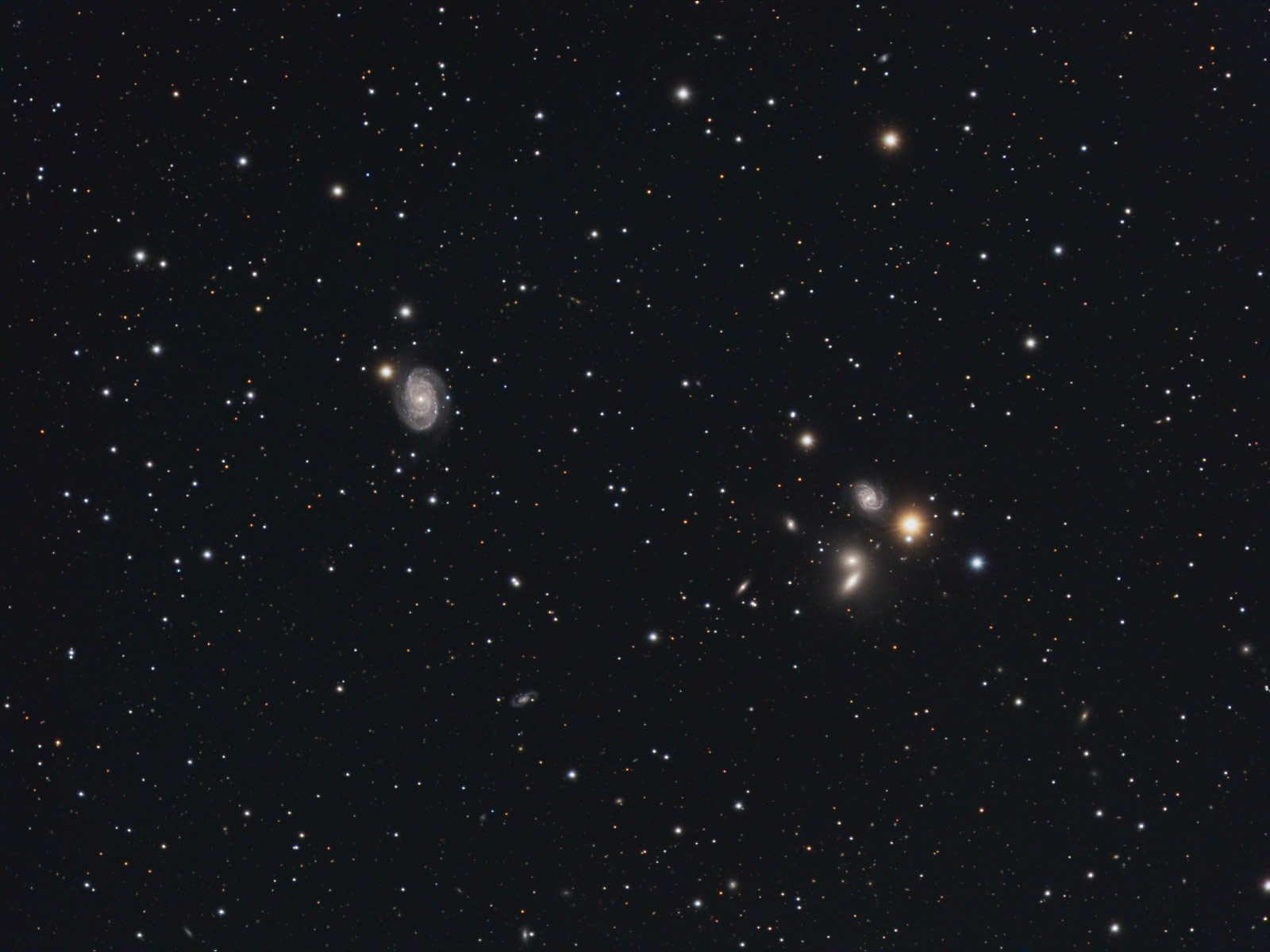
This interactive image of NGC 5223 in Canes Venatici was provided by the Sloan Digital Sky Survey (SDSS) using Aladin Sky Atlas. We also have a finder chart should help you locate this galaxy, as will this link for NGC 5223 on the Stellarium Web planetarium. April skies give us the last chance to see fainter galaxies before the end of astronomical dark in early May. Mark Stuart suggested to me that the trio of galaxies in Canes Venatici around NGC 5223 might make an interesting GOM. All three of the galaxies, NGC 5223, NGC 5228 and NGC 5233 were discovered by William Herschel in 1785.
It is suggested that NGC 5223 may contain an AGN due to the fact that it contains a bright X-Ray source at its centre. It is classified as an elliptical galaxy, possibly E2. NGC 5228 is suggested to be a lenticular galaxy of type S0 and also a radio source. NGC 5233 is a spiral. There is an ESO image which suggests this is a blue dwarf galaxy with a large star cluster, but I am not sure if they have the right designation associated with this observation. There certainly does not appear to be any confusion in the NGC as to its identification. NGC 5233 is also suggested to have an AGN of the LINER type.
It is unclear whether this is a physical group as the distances to them are either not defined or widely different, although the redshift based distances are similar so they could be a physical group. The whole field is also littered with other much fainter galaxies. The group has not been catalogued in either the LGG or WBL catalogues which suggests either it was too faint for them or it is not a true group.
Unfortunately, there is not much other information on the galaxies available so I apologise for the somewhat shorter GOM this month. All the galaxies appear to be somewhat smaller than our Milky Way galaxy.
The galaxies are fairly faint so the group is going to be challenging to see. The group is quite tight and all three galaxies will fit in the same field of view with a modern hyperwide (100 degree) high power eyepiece. The group does not make it into either Miles Paul’s Atlas of Galaxy Trios (available for free from our website) or Alvin Huey’s Galaxy Trios and Triple Systems guide (available for free from Alvin's website).
William Herschel discovered the group with his 18.7” speculum metal mirror reflector, although he described all three of the galaxies as very faint, it probably needs at least a 40-45cm telescope to see the main components. It would be interesting to see what size telescope is needed to see the other galaxies in the group. Perhaps as expected there are no observations of the group in any of the standard references. Steve Gottlieb described them all as faint with his 17.5” Dobsonian. It would be interesting to know what size telescope is needed to see the small edge-on UGC 8547 as I note that Steve Gottlieb did not include it in his UGC notes.
Owen Brazell - Galaxy Section Director
-
May 2016 - Galaxy of the Month
NGC 4111 in Canes Venatici
This interactive image of the NGC 4111 group was provided by the Sloan Digital Sky Survey using Aladin Sky Atlas. We also have a finder chart should help you locate these galaxies.
As the summer approaches and dark skies end from northern latitudes I thought I would give the bright galaxy NGC 4111 its turn as the galaxy of the month. Completely independently I found that it had already been chosen as object of the week on the Deep Sky Forum and also as the ESO/Hubble picture of the week, obviously a galaxy whose time has come.
On the border of Canes Venatici and Ursa Major, NGC 4111 was first discovered by William Herschel in 1788. NGC 4111 is a near edge on lenticular galaxy showing a boxy central core and tapering spiral arms. The galaxy is thought to be at a distance of about 50 million years.
Deep images from Hubble show a disk of dust and gas orbiting at right angles to the main disk, possibly forming a polar ring galaxy. These are often associated with the mergers of galaxies and this may be all that is left after a merger with a smaller spiral galaxy.
NGC 4111 itself should be visible in telescopes of 20-22cm in aperture but to see much detail will probably require 40cm. Night Sky Observer's Guide (NSOG) reports that with telescopes of 45cm aperture structure can be seen in the disk.
NGC 4111 is part of a group of galaxies but there seems to be some disagreement about how many and which galaxies it is associated with. The WBL catalogue lists it as group number 380 consisting of three galaxies NGC 4111, UGC 7094 and a third galaxy, whilst the LGG catalogue lists NGC 4111 as part of a group of 18 galaxies as group 269 but does not include UGC 7094 as part of the group.
There are also three other NGC galaxies in the immediate area. NGC 4117 was also discovered by William Herschel later in 1788 but the other two are much fainter and were discovered by Stoney in 1851 (NGC 4109) and Mitchell (NGC 4118) in 1854 using Lord Rosse’s 72” reflector at Birr.
If the NGC galaxies are not enough of a challenge then there are two edge on UGC galaxies UGC 7094 and UGC 7089 in the same field but I think these may require large telescopes in the 20” (50cm) category to see, especially from typical UK skies.
All the NGC galaxies will fit in the same field of a high power eyepiece as will NGC 4111 and the two UGC galaxies so before we lose the dark skies for the year try and chase down this small group. For double star fans there is also a nice coloured double star HJ 2596 in the same field.
Owen Brazell - Galaxy Section Director
Observations of NGC 4111 and the surrounding galaxies: Mike Wood and Andrew Robertson use their large reflectors. It appears that the UGC galaxies do require lots of aperture, but Patrick Maloney suggests that might not be as large as you think.
-
April 2014 - Galaxy of the Month
Hickson 68 in Canes Venatici
Image Courtesy of Bernhard Hubl, Nussbach (Austria). Please click on image for a high resolution version.
The 68th member of Paul Hickson’s catalogue of 100 compact groups unusually consists of five NGC objects, numbers 5353, 5354, 5350, 5358, 5355. NGC’s 5350, 5353, 5354 and 5355 were all discovered by William Herschel in 1788 using his 18.7” reflector whilst NGC 5358 was discovered by Stephan in 1880 using a 31" reflector. This tight group of galaxies is well placed in Canes Venatici in late Spring and has the added bonus of the bright galaxy NGC 5371 nearby. The group is located about 8 degrees south east of the Whirlpool galaxy M51. NGC 5371 is not part of the group. As one of the brighter Hickson (HCG) groups most of the galaxies should be visible in a 22cm telescope under dark skies however probably 30cm+ will be needed to see the fainter members of the group. The group appears to be at a distance of about 100 million light years. Interestingly NGC 5371 is also at the same distance and appears to be physically associated with the HCG 68 group. If so this group of galaxies may contain over 20 galaxies. The whole group appears to lie on a filament of galaxies connecting the Coma cluster (AGC 1656) to the Virgo cluster. Hickson 68 and NGC 5371 make up the Big Lick Group. It is not clear why it should have be so named as this is after the town of Roanoke in Virginia which itself was named after the local salt pan. This may just be a case of people randomly attaching names to objects in the sky with no real association. A fine image and identification chart appears at the Distant Lights website. This also shows the many faint background galaxies in the same area. A nice sketch of the area can also be found on the ASOD website. Interestingly NGC 5371 is probably the same as NGC 5390 being a re-observation by John Herschel and a case of mistaken identity. NGC 5353 and NGC 5354 appear to be interacting and both galaxies are producing large amounts of radiation on the radio spectrum. Although NGC 5354 is classified as a lenticular galaxy, SA0, it does show a dust lane in deep images which would be unusual for this type of galaxy. They both show distortions arising from this interaction. It would appear that these galaxies are separated by only about 9kpc and are the process of merging. This merger should take place in the near future in astronomical terms. The other bright member of the group, NGC 5350, is also classified as a Type A Seyfert galaxy so it has an active galactic nucleus. This is altogether a fascinating group of galaxies that should repay study with both medium and large telescopes.'
The Megastar© finder chart shows the Hickson 68 region.
Owen Brazell - Galaxy Section Director
-
May 2012 - Galaxy of the Month
NGC 4449 in Canes Venatici
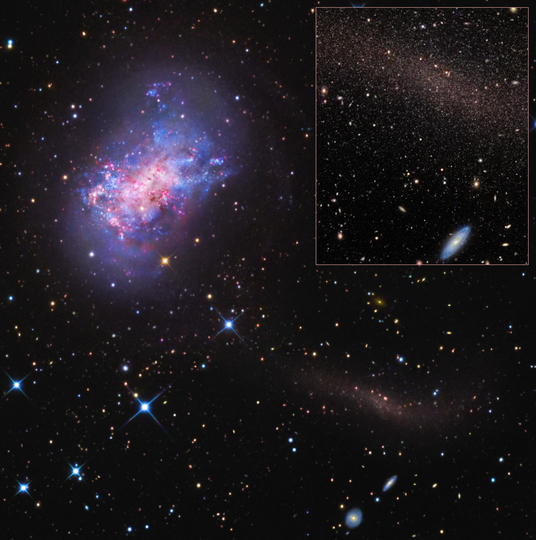
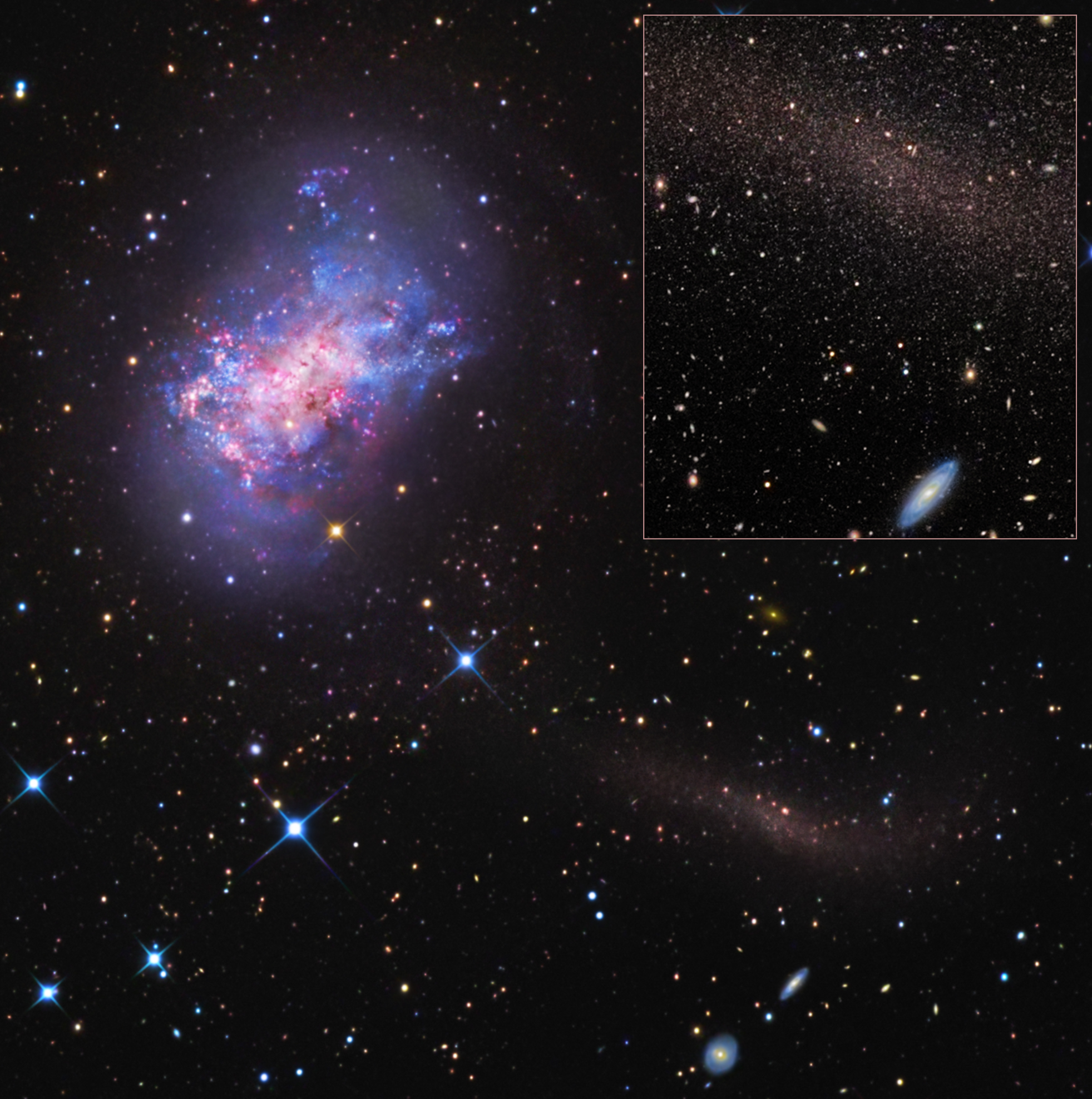
Image copyright R Jay GaBany; Inset by: R. J. GaBany (Blackbird Observatories), Aaron Romanowsky (UCSC) & and Jacob Arnold (UCSC) in collaboration with D. Martínez-Delgado (MPIA); National Astronomical Observatory of Japan (NAOJ). Click on image for a larger version. For more images from R. Jay GaBany please visit his Cosmotography website.
The dwarf irregular galaxy NGC 4449 is part of the M94 group of galaxies in Canes Venatici. Also known as the Canes Venatici I group this is a loosely bound group of galaxies that is one of the nearest groups to our own.The brightest member of this group is M94, although M106 has also occasionally been suggested to be part of this group.
NGC 4449 is dwarf irregular galaxy similar to the Large Magellanic cloud and like the LMC appears to be undergoing vigorous star formation(See NASA APOD from 25 Feb 2011). The cause of all this activity may have been a recent interaction with the dwarf galaxy DDO 125 (UGC 7577) which currently lies about 38’ south of NGC 4449.
The age of the stars in the central bar is thought to be not much more than 5 million years or so. NGC 4449 is thought to be less than 20,000 light years across and about 12 million light years distant. It is however also surrounded by a much larger halo of neutral hydrogen gas.
First discovered by William Herschel in 1788 it is visible in telescopes as small as 8cm and because of its distinctive shape has become known as the Box galaxy.
Recent deep images of the galaxy have shown that even small galaxies like NGC 4449 can grow by merging with other galaxies and the remnants of such a merger are shown by a faint tidal stream of stars (sometimes catalogued as NGC 4449B). This is thought to be the remnant of a massive dwarf spheroidal galaxy from the type of stars in the steam and will deposit as much material again as is already in the halo of NGC 4449 (See NASA APOD from 26 Jan 2012).
Interestingly this faint companion was independently discovered by two teams of astronomers both using amateur collaborators for the deep wide field images.
Due to its proximity NGC 4449 has been well studied by the Hubble space telescope (See Hubblesite Tour - NGC 4449).
Observations recently made at the Kelling Spring star party of this galaxy using Andrew Robertson’s 24" suggest a better moniker for this galaxy might be the Lobster galaxy as coming out from the box shape are two claws. The upper one was well defined and appears in images as a row of HII regions but the lower was perhaps best defined by one large spot, which is also an HII region. The main part of the galaxy itself also shows a mottled form which is from the various star forming regions.
Much of this detail has been reported with much smaller telescopes and indeed Herschel himself was able to resolve structure with his 18.7" speculum which is probably equivalent to a modern 25 cm telescope.
Unfortunately at the time we were not aware of the UGC companion so did not seek it out. DDO galaxies do however tend to be low surface brightness objects so it is not clear we would have seen it.
There are also numerous observations of NGC 4449 in Webb Society Deep-Sky Observer's Handbook (WSDSOH) Volume 4 with telescopes up to 36".
Owen Brazell - Galaxy Section Director
-
April 2012 - Galaxy of the Month
M106
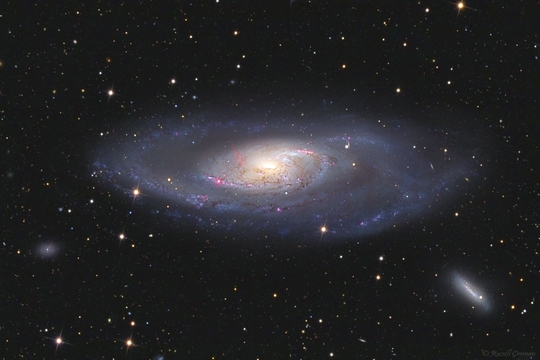
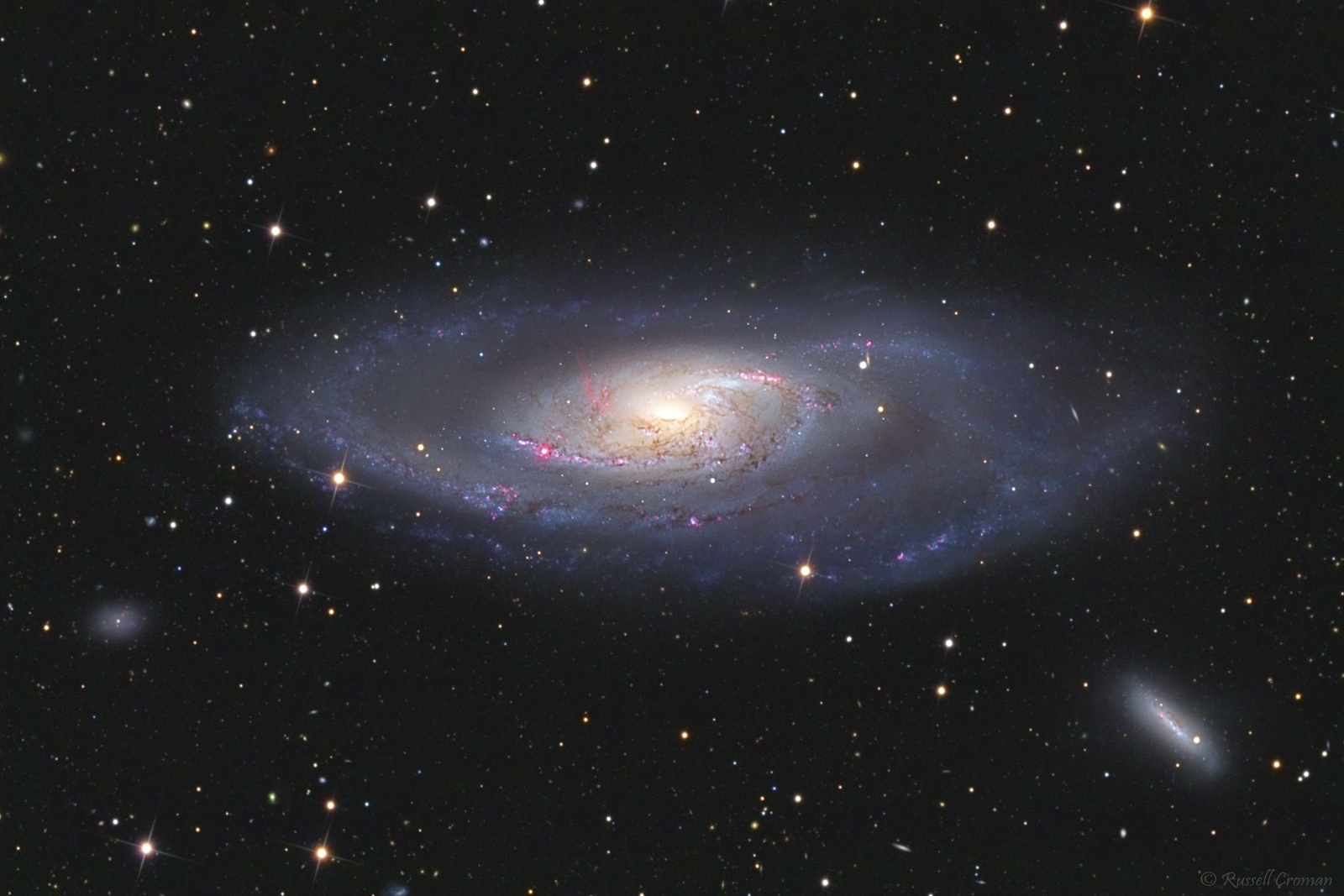
Image Credit - Russell Croman, Austin, Texas. Please click on image for a larger version and for more images from Russell please visit his website.
The galaxy Messier 106 in Canes Venatici was originally discovered by Pierre Mechain in 1781. It is however unlikely that Messier ever saw the object that now bears his name. It was added as the 106th object in his catalogue by Helen Hogg in 1947 along with M105 and M107 based on the fact that it was communicated to him and had been marked on one of his star charts.
It is believed that Messier did intend to add to his catalogue but was overtaken by William Herschel in terms of discovering nebulae. M106 was later independently rediscovered by William Herschel in 1788.
M106 is a large spiral galaxy inclined to our line of sight that is has been classified as a Seyfert 2 type with an active nucleus and disturbed spiral arms, probably from an encounter with one of its neighbouring galaxies, possibly NGC 4217. It is also of interest because it appears to have two sets of spiral arms with those in the optical not matching up with those seen in the radio and X-ray. The radio and X-ray arms appear between the main optical arms as ghostly apparitions. M106 also has radio jets from the activity in its central region. And it is likely that these arms are being caused by the main jets being tipped at angle of 30 degrees to the disk and as they pass causing shock waves that propagate into the disk heating the gas.
The strong dust lanes block our views into the core of the galaxy in the optical. At a distance of perhaps 22 million light years it is also one of the nearest Seyfert galaxies with a supermassive black hole. The APOD image shows not just the galaxy but the H-alpha jets that appear to come out of the disk. M106 has had one supernova in the recent past in 1981K which reached 16th mag.
M106 is often overlooked by observers which is a pity because it is big and bright and being at around 9th magnitude can be seen in binoculars from dark skies. Larger telescopes will show increasing amounts of detail in the galaxy including the outer spiral arms and perhaps some of the star clouds and HII regions.
The immediate area around M106 also contains a large number of other galaxies that can be seen in amateur sized telescope. An identification chart from Megastar V5 shows the galaxies in the area. The two edge on spirals should be seen in relatively small instruments but the smaller ones may require a medium aperture telescope to see. All of these are, as expected, easy to see in my 22".
For a list of historical and current observations visit the DOCdb online database.
Owen Brazell - Galaxy Section Director