Galaxy of the Month in Aries
-
NGC 877 in Aries
October 2021 - Galaxy of the Month
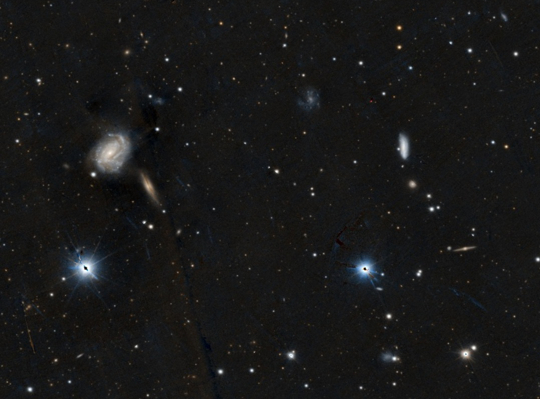
This interactive image of the NGC 877 and was provided by the Pan-STARRS1 Surveys using Aladin Sky Atlas. We also have a finder chart should help you locate these galaxies, as will this link for NGC 877 on the Stellarium Web planetarium. NGC 877 is part of a small group of galaxies in Aries that includes NGC 870, NGC 871 and NGC 876. NGC 871 and NGC 877 were both discovered by William Herschel in October 1784 and R.J. Mitchell using Lord Rosse’s 72” found the other two in 1854.
NGC 877 and NGC 876 lie at the same distance from us, approximately 160 million light-years. NGC 877 appears to be interacting, probably with NGC 876. NGC 877 is the brightest galaxy in the LGG 53 group, an 8 galaxy group, which appears to include NGC 871 as well, but not NGC 870, which is interesting as NASA/IPAC Extragalactic Database (NED) describes NGC 871 as in a non-interacting pair with the compact elliptical galaxy NGC 870. The redshift of NGC 870 however suggests that it is a long way behind NGC 871. The group is also sometimes known as the NGC 877 group.
NGC 877 itself is classified as an intermediate spiral galaxy but also seems to be classified as a LIRG (Luminous Infrared galaxy) so one assumes there is quite a lot of star forming activity going on, indeed images in the UV from the GALEX satellite show numerous large areas of star formation going on in its spiral arms. Conversely NGC 876 shows very little activity in the UV. There appear to be some faint plumes coming off NGC 877. NGC 871 also appears very bright in the UV. It too is a spiral galaxy.
A low surface brightness bridge appears to connect NGC 877 and 876 which would confirm the interaction theory. NGC 876 is an edge on spiral with a central bulge and a distinctive dust lane, not unlike the one in NGC 891. Hubble has imaged both NGC 877 and 876 with the WPC 3 but only in the near IR and I have seen no processed images from this.
The group also has an extensive neutral hydrogen (HI) envelope, which suggests the group is gas rich. There is also an interesting gas cloud in the system which may be a tidally formed galaxy, although this appears to be a radio only object. NGC 870 maybe one of the most distant galaxies in the NGC.
The Night Sky Observer's Guide (NSOG) Volume 1 suggests the two brighter galaxies NGC 877 and NGC 871 should be in range of a 25cm telescope but the other two are probably going to require 45cm, at least from UK skies. A UK observation of NGC 877 suggests however that it is tough even with 40cm. The group is quite tight so will fit in the field of a medium to high power eyepiece. Indeed it is probably going to require a high power eyepiece to darken the field enough to catch the fainter pair.
It should be noted that Steve Gottlieb found both NGC 870 and NGC 876 very difficult even with a 18”. Owners of large telescopes may also be able to catch the galaxy UGC 1781 between the two pairs, however this is a face on spiral and at magnitude 14 is going to be a hard catch except among the best skies, at least for visual observers. I have seen no recorded observations of it.
NGC 877 was one of the galaxies reported by the Rosse team as spiral in nature. It also makes the Herschel 3 list and is listed, although not described, in Burnham's Celestial Handbook (BCH) Vol 1. There is a nice image of the group by Adam Block at Caelum Observatory.
Owen Brazell - Galaxy Section Director
-
NGC 1024 in Aries
December 2018 - Galaxy of the Month
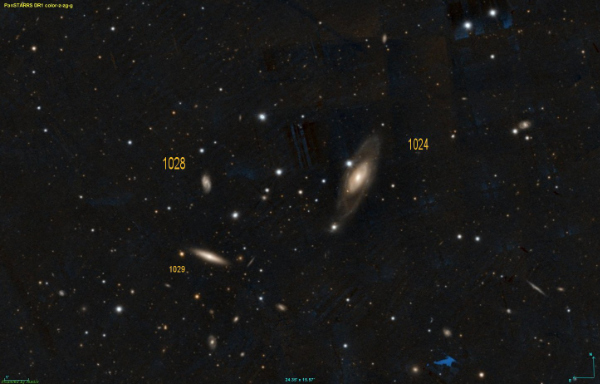
This image of the galaxies NGC 1024, NGC 1028 and NGC 1029 in Aries was provided by the Pan-STARRS1 Surveys. We also have a larger marked up version of this image to help you locate these galaxies. NGC 1024 is part of a group of three galaxies, including NGC 1028 and NGC 1029.
First discovered by William Herschel in 1786, NGC 1024 was included by Arp in his catalogue of peculiar galaxies as number 333, under the classification of Miscellaneous galaxies. Arp classified it as such because it had very thin spiral arms coming from a pseudo ring. As such it does have the very complex morphological classification of (R')SA(r)ab. NGC 1028 and NGC 1029 are very much fainter and were first discovered by Albert Marth using William Lassell’s 48” reflector from Malta.
There are some issues over whether the group is physically related and it is included in the WBL catalogue as number 82. The WBL group only consists of these three galaxies. Just to show how confusing cataloguing groups of galaxies is, the NGC 1024 group is also included in the LGG catalogue as number 69. The LGG group also makes the group count as three galaxies, but in this case NGC 1024 and NGC 1029 make the cut and NGC 1028 is dropped from the group to be replaced by the elliptical galaxy NGC 990, which is over a degree away on the sky.
If you look at the redshifts of the galaxies then the redshift for NGC 1028 is more than twice that for NGC 1024 and NGC 1029, whilst that for NGC 990 is pretty much the same, as always showing that proximity on the sky is no substitute for proximity in space.
At the very least NGC 1024 is thought to form a physical pair with NGC 1029. NGC 1029 is classified as a lenticular galaxy whilst NGC 1028 appears to be a Sa spiral.
The NGC 1024 group is thought to be about 158 million light years away.
Visually NGC 1024 will be challenging in 20-cm but should be visible relatively easily in 37cm. The companions are going to be a challenge I think for 37cm and may require 50cm to see easily. The three NGC galaxies are a tight group and you may need to use medium to high power to cleanly separate them.
For masochists there is also a much fainter (16th magnitude) galaxy in the field known as LEDA 1385855. Steve Gottlieb suggests that even in his 17.5” both NGC 1028 and NGC 1029 are pretty faint.
There is a 7th magnitude star close by the group which will need to be kept outside the field in order to pick up the fainter members I would think.
Owen Brazell - Galaxy Section Director
-
NGC 938 Group of Galaxies in Aries
October 2017 - Galaxy of the Month
This interactive image of the NGC 938 group was provided by the Sloan Digital Sky Survey using Aladin Sky Atlas. We also have a finder chart should help you locate these galaxies. The group of galaxies around NGC 938 in Aries, (including NGC 932 and NGC 924), has an interesting discovery history and the usual NGC confusing identity conundrums.
NGC 932 was first discovered by William Herschel in 1785, however in 1872 Ralph Copeland observing with the 72” at Birr thought he saw another object just north of the main galaxy which was entered into the NGC as number 930.
Unfortunately there is nothing at Copelands position, but the identities of NGC 930 and NGC 932 became confused and the bright galaxy has, for some reason, has been referred to as NGC 930 for the last 100 years or so even though it is correctly catalogued as NGC 932. There is nothing at the position that Copeland gave for NGC 930. Most modern databases and star charting programs unfortunately refer to NGC 932 as NGC 930.
Herschel also found NGC 924 but missed NGC 938 and that was discovered by D’Arrest in 1863.
The group is also classified as LGG 61. The LGG catalogue counts 11 galaxies in the group also including the NGC galaxies 935 and 976. There are 9 other galaxies that are also included in this grouping but the others will be much fainter.
The three core galaxies should fit in a medium power field of view using a modern hyperwide eyepiece as they are separated by perhaps 30’.
If we use the historically correct designation then NGC 932 is interesting because there are several faint knots seen which are actually background galaxies seen through the disk, whether these can be seen except with the very largest telescopes in amateur hands is debatable.
NGC 932 itself is a classic face on spiral with a prominent nucleus and two blue spiral arms. These are likely to be too faint to be seen with normal amateur telescopes.
The core group consists of one each of the three main galaxy types. NGC 938 is classified as an elliptical, NGC 932 as a Sa spiral and NGC 924 as an S0, a lenticular.
The main group is perhaps 60 Mpc from us. The other two NGC galaxies in the group are quite a distance away on the sky from the main core as shown in the chart.
IC1797 and IC1801 are also part of the group with IC1801 making a nice pair with NGC 935. NGC 935 is also classified as Arp 276, an interacting system. It has been suggested that they are in the early stages of the collision. NGC 935 was found by Lewis Swift but it took Javelle with a 30” to find IC 1801 so this again is likely to be one for owners of large telescopes.
Owen Brazell - Galaxy Section Director
-
December 2015 - Galaxy of the Month
NGC 691 Group in Aries
This interactive image of the NGC 691 group was provided by the Sloan Digital Sky Survey using Aladin Sky Atlas.
The NGC 691 group is a collection of 9 galaxies consisting of NGC 678, 680, 691, 694, 695 and NGC 695 along with IC 1730 and IC 167.
The group is spread over quite a wide area with almost a degree spanning NGC 691 and 695. The core of the group is centred around NGC 691, 678, 680 and NGC 694. NGC 678 and 680 were discovered in William Herschel in 1784 but it was two years later in 1786 before he found 691. Heinrich d’Arrest found NGC 694 in 1861 as it is much fainter than the others. Perhaps unusually for an IC object Bigourdan found IC 167 using a 12” refractor in 1889.
The whole group is spread around the bright double star 1 Ari. This may make it more difficult to see than it should be.
The group is about 122 million ly from us which is relatively close by and explains the large angular spread of the group on the sky.
NGC691 was home to SN 2005W, although it only reached magnitude 15.2.
Both NGC 691 and NGC 678 feature in the Webb Deep-Sky Society Observer's Handbook (WSDSOH) Volume 4 where both are described as brightish in a 16” telescope.
Night Sky Observer's Guide (NSOG) reports the two brighter members as easy in 22cm and the others as more challenging.
Interestingly most of the galaxies are spirals or lenticulars with only NGC 680 a confirmed elliptical, and a peculiar one at that as it shows signs of recent interactions or mergers with a number of shells. NGC 680 also appears to be interacting with NGC 678 as well.
There is an interesting amateur image of the whole group at Astrophotography by Alson Wong.
Split away from the main group on the other side of 1 Ari are NGC 697 and 695. NGC 697 is a nice bright spiral but NGC 695 is much fainter and although catalogued as a double galaxy its faintness suggests it might not actually be a member of the group. Its recession velocity from NED, if correct, is 3 times greater than the others in the group. It certainly appears in front of a field of much fainter galaxies. There also appears to be some confusion over the identity of NGC 697 with Harold Corwin suggesting it is actually NGC 674 and d’Arrest was confused and saw the same object twice.
The Megastar chart with this does not identify IC 1730, so there is a second more detailed chart from SkyTools that does.
Owen Brazell - Galaxy Section Director
