Galaxy of the Month in Aquila
-
NGC 6926 in Aquila
August 2018 - Galaxy of the Month
This interactive image of the NGC 6926 was provided by the Pan-STARRS1 Surveys using Aladin Sky Atlas. We also have a finder chart that should help you locate these galaxies. With August finally comes the return of astronomical darkness at northern latitudes. For galaxy hunters though this is still a tricky time of year as the Milky Way with its nebulae and star clusters is still the dominant feature of the night sky and we have to look for galaxies skulking around the edges.
This month’s challenge is NGC 6926 in Aquila. Discovered by William Herschel in 1784, NGC 6926 is part of a pair of galaxies with NGC 6929, a much fainter galaxy found by John Herschel in 1827 whilst he was checking his father’s observations. In 1784 when William Herschel found NGC 6926 he was still using the large 20’ in Newtonian mode. I wonder if he would have seen NGC 6929 as well if he had been using it in front view mode which would have allowed him to see objects up to a half magnitude fainter.
NGC 6926 is a very disturbed looking galaxy and made the VV list of peculiar galaxies as VV621. I wonder why it did not make the Arp list but I guess so many galaxies and so little time to classify them all. NED does list NGC 6926 as part of a pair and although it does not explicitly state it is paired with NGC 6929 this is the most likely option. It also has these two as part of a poor group of galaxies which also includes UGC 11585 about 18’ away, and possibly others. The group is at about 82 Mpc from us and at that distance NGC 6926 would be substantially larger than our Milky Way.
NGC 6926 is an active galaxy of the Seyfert 2 type. It also hosts an H2O Megamaser in its nucleus. Megamasers are a very rare phenomenon with only 150 or so known. They come from the disk surrounding the central Supermassive Black Hole (SMBH).
Images show that NGC 6926 is very distorted, perhaps by a gravitational interaction. Interestingly GALEX images show that both NGC 6926 and UGC 11585 are undergoing a burst of star formation as they radiate very strongly in the UV, so perhaps NGC 6926 is interacting with that one, rather than NGC 6929. NGC 6929 is a lenticular galaxy so it has no gas for star formation to occur, but it does not appear distorted in anyway.
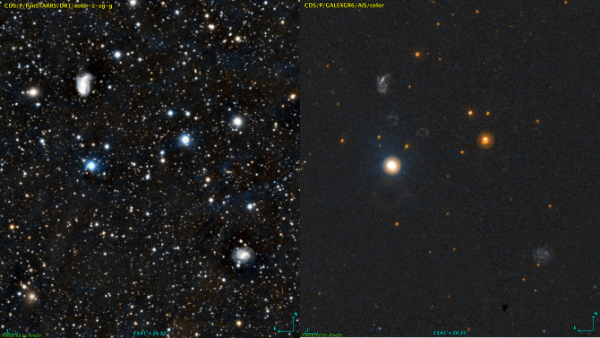
Pan-STARRS1 Surveys (PanSTARRS1) image on the left and GALEX UV image on the right of the area near NGC 6926. NGC 6929 is very faint in the UV but the other two galaxies are clearly visible. NGC 6926 and NGC 6929 are quite close together so high power will work in bringing them out. You can get UGC 11585 in the same field by using a medium power. For those that like collecting lists then NGC 6926 is part of the Herschel 3 list.
The northern arm of NGC 6926 appears to have several knots in it, although I expect that visually these will be beyond all but the largest telescopes in amateur hands. Perhaps not surprisingly it does not appear in any of the standard guides.
There is a nice amateur image at Astro-Cooperation, but in general as you can imagine this is a very overlooked galaxy. NGC 6929 appears to have another galaxy involved in its halo, although I think this will be too faint for anybody.
Owen Brazell - Galaxy Section Director
-
July 2016 - Galaxy of the Month
NGC 6906 in Aquila
This interactive image of the galaxies around NGC 6906 was provided by the Sloan Digital Sky Survey using Aladin Sky Atlas. We have a widefield finder chart should help you locate these galaxies, and a close-up chart for the image above.
Summer is never the best time for galaxies but if you do get a clear moonless night in the semi dark then this month’s galaxy is NGC 6906 in Aquila.
First discovered in 1863 by Albert Marth using William Lassells 48” speculum mirror telescope in Malta this galaxy makes a nice pair with the un-related galaxy NGC 6901 (also discovered by Marth). Interestingly both galaxies are marked as part of a pair in NED but I think this is erroneous.
NGC 6906 itself is actually part of a sparse group of galaxies as listed in the Lyon Galaxy Group catalogue (LGG). Listed as number 435 in this catalogue the group consists of 3 galaxies, NGC 6906 along with UGC 11551 and UGC 11555. Both of the latter two are actually across the border in the constellation of Delphinius. The group is perhaps 1.6 degrees across on the sky. Interestingly all the galaxies are spirals. The distance is to NGC 6906 is perhaps 60 Mpc, so probably similar to the other two galaxies in the group.
NGC 6901 is perhaps at a distance of 69 Mpc, so 9 Mpc further away than NGC 6906. NGC 6901 is also incorrectly labelled as IC 5000 due to a bad set of co-ordinates published by Marth and Bigourdan rediscovering it and thinking it was a new galaxy. It is also listed as IC 1316 in SIMBAD but this is now recognised as an error and the designation has been deleted from NED. SIMBAD also lists NGC 6901 as being part of a group of galaxies but I have been unable to determine what other galaxies might be involved. NGC 6906 has also had an IC number assigned to it in IC 5006 but this is really a double star.
Both NGC 6901 and NGC 6906 are spiral galaxies with NGC 6901 being much further away. There is also a much fainter edge on spiral in the same field but at mag 16 it only has a LEDA number and will probably require a very large telescope to spot visually. NGC 6901 was host to SN 2004da which was discovered by the UK amateur Tom Boles.
Owen Brazell - Galaxy Section Director
