Galaxy of the Month in Andromeda
-
NGC 797 in Andromeda
November 2025 - Galaxy of the Month

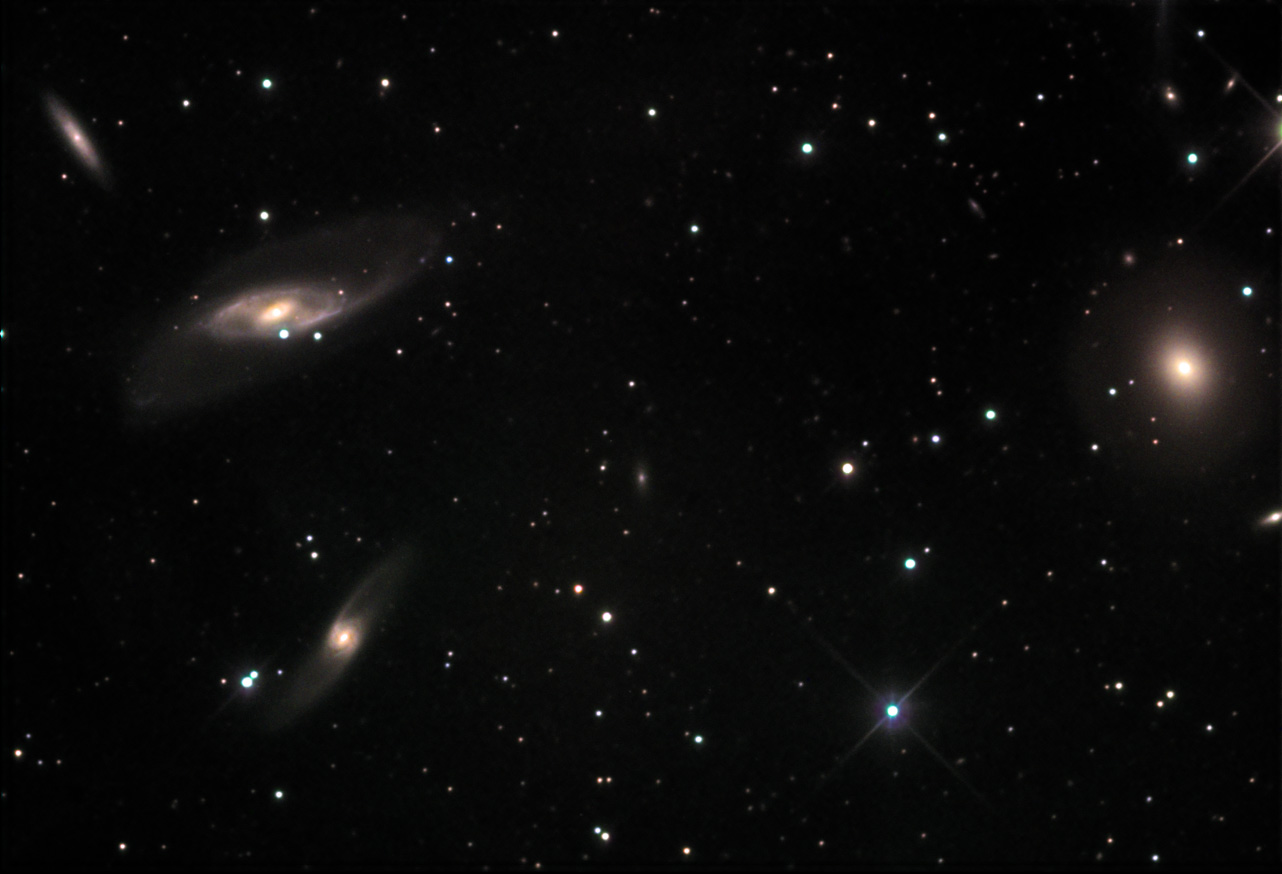
This interactive image of the galaxies NGC 797 and NGC 801 in Andromeda was provided by the Pan-STARRS1 Surveys using Aladin Sky Atlas. We also have a finder chart should help you locate this galaxy, as will this link for NGC 797 on the Stellarium Web planetarium. For this month challenge I have gone with the galaxy pair in Andromeda, NGC 797 and NGC 801.
NGC 797 was discovered by William Herschel in 1786. He missed the nearby edge on spiral NGC 801 which was discovered nearly 100 years later by Lewis Swift in 1885. There is some confusion over the identification of the object found by Swift but as this is the only nearby object it gets the nod.
NGC 797 is a barred spiral galaxy lying about 113 Mpc away. NGC 797 and NGC 801 form a physical pair with the distance between them being about 150 kpc.
In his Catalogue of Selected Compact Galaxies and of Post-Eruptive Galaxies Fritz Zwicky found a compact companion on the edge of one of NGC 797’s spiral arms and thought they were associated. There are some question marks over their connection and it maybe that they are purely a line of sight coincidence. The spiral arm in the direction of the compact galaxy does however show some signs of interaction so perhaps they are a pair.
NASA/IPAC Extragalactic Database (NED) as well as SIMBAD suggest there is a galaxy pair here but I am not sure if they are referring to the NGC 797/801 pair or the NGC 797/LEDA 212899 pair. The NGC 797/LEDA pair is also listed as number VV 478 in the Vorontsov-Velyaminov catalogue of interacting systems where he suggests it is a system of the M51 type. LEDA 212899 is also known as NGC 797b but there is not much else published on it.
A type Ia supernova was discovered in NGC 797 in 2025 (SN 2025pel)
NGC 801 is an edge on spiral galaxy with a suspected AGN of the LINER type. It is very much fainter than NGC 797 which is probably why Herschel missed it, even Swift thought it was faint with a 16” refractor. It is classified as an Sc type system seen almost edge on and there are obvious dark lanes in images, similar to those seen in NGC 891.
Both of these galaxies are quite close together and should fit in the same medium power field of view. Perhaps as expected given their faintness they are not in any of the common deep sky lists. The small companion to NGC 797 is listed as 16th magnitude so it may be in the range for large amateur telescopes. The Night Sky Observer's Guide (NSOG) Vol. 1 suggests that NGC 797 is faintly visible in 14” telescopes but more is seen with 16/18” telescopes. No mention is made in the NSOG of NGC 801 or the companion to NGC 797. Steve Gottlieb in his notes suggests that NGC 797 is moderately bright in 17.5” but NGC 801 is faint but again does not note the companion to NGC 797.
Owen Brazell - Galaxy Section Director
-
Abell 347 in Andromeda
November 2021 - Galaxy of the Month

This interactive image of the Abell 347 was provided by the Pan-STARRS1 Surveys using Aladin Sky Atlas. We also have a finder chart should help you locate these galaxies, as will this link for Abell 347 on the Stellarium Web planetarium. Near to the well-known edge on galaxy NGC 891 lies the small group of galaxies known as Abell 347. The cluster is relatively poor in Abell terms but contains 7 galaxies: NGC 906, NGC 909, NGC 910, NGC 911, NGC 912, NGC 914 and NGC 923.
The cluster is part of the Perseus-Pisces Supercluster, which also includes the clusters Abell 262 and Abell 426. The Perseus-Pisces super cluster is thought to be the most massive object within 300 million light-years. More information on the filament can be found at The Atlas of the Universe.
NGC 898 and NGC 910 were discovered by William Herschel in 1786. NGC 906, NGC 909, NGC 911 and NGC 914 were found by Stephan in 1878, and Dreyer found NGC 923 in 1874. NGC 898 is sometimes included as part of the cluster but appears to lie outside the core region. There was some thought that the active galaxy 3C66A was part of the cluster but it is now thought to lie well behind in another cluster.
Abell 347 probably lies at a distance of about 240 million light-years, and is classified as a richness class 0 and a distance class 1 in the Abell classification scheme. Here richness goes from 0 (least rich) to 5 (most rich) in terms of galaxy numbers. It has a putative Rood-Shastry class of I.
The Brightest Cluster Galaxy (BCG) is probably the large elliptical NGC 910. It has also been classified as a cD galaxy. However most of the brighter galaxies in Abell 347 appear to be spirals which suggests that this is a young group and the expected mergers have not yet taken place. Perhaps surprisingly there does not seem to have been much research done on this cluster.
Although some sources list over 57 galaxies in the cluster the Webb Deep-Sky Society Observer's Handbook (WSDSOH) Volume 5 lists 20 that may be visible in medium large instruments under good skies, There is a nice diagram as well as observing reports on the clusters in the Perseus-Pisces filament at Adventures in Deep Space.
Observationally the group is fairly compact and most of the main galaxies, with the exception of NGC 898 and NGC 914, will fit in a single medium power (270x) field using a modern hyperwide eyepiece. My suggestion, given the faintness of these galaxies, is to use the highest power you can to get the contrast up. My observations under poor skies using a 55cm showed most of the main galaxies, but I did not pick up any of the MCG galaxies in the field.
There is an article on the Skyhound website on observing this group. Unfortunately most images of the cluster are usually framed to fit in NGC 891 so the area of interest is rather small. I suspect this group has been overlooked because its proximity to NGC 891.
My apologies for the brevity of the material in this piece but I have been suffering from Covid whilst writing it.
Owen Brazell - Galaxy Section Director
-
September 2015 - Galaxy of the Month
NGC 48 Group in Andromeda
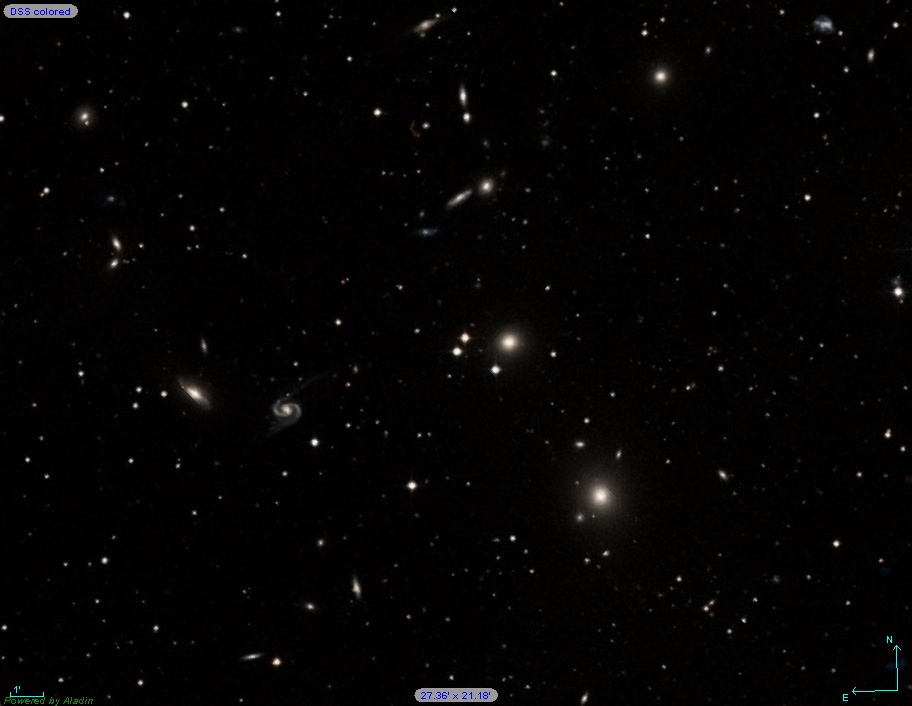
This interactive image of the NGC 48 group was provided by the Digitised Sky Survey using Aladin Sky Atlas. We've also provided a finder chart for the group too.
Browsing through the Clusters section of the Webb Society Deep-Sky Observer's Handbook (WSDSOH) Vol 5 I came across the description of the cluster of galaxies around NGC 48. Apart from their appearance in the WSDSOH the group does not appear to be in any of the other standard references and appears to have been neglected.
The galaxies appear to be a true physical group catalogued as WBL 005. The group consists of the three NGC galaxies NGC 48, 49 and 51 which were first discovered by Lewis Swift in 1885 using a 16” refractor and three IC galaxies IC 1534, 1535 and 1536, all discovered by Barnard in 1888 using a 12” refractor.
The clusters appears to be two parallel triplets with the NGC group and the IC group. Steve Gottlieb does have notes for all the galaxies in the group with a 17.5” telescope but describes them as fairly faint. NGC 51 would appear to be the brightest of the group. This may not be surprising as they have photographic magnitudes of around 14 for the NGC group and around 15 for the IC group.
The group lies on the border of the constellations of Andromeda and Cassiopeia and would appear to consist of two spirals and 4 lenticular S0 galaxies which is slightly interesting unless they are part of a much larger coarse grouping. There is a problem with the distance of NGC 48 as the redshift measurements are wildly discordant. However as it appears to be part of the group with the other 5 it must be at the 63 Mpc distance rather than 43 Mpc which some of the redshifts indicate. The galaxies may be an isolated group that is part of the western end of the Perseus supercluster.
They do however appear to be almost as ignored by the professional community as the amateur as apart from basic data there is really not a lot of information about them. NGC 51 may be a mild form of AGN known as a LINER. There are almost certainly gravitational interactions going on within the group which may be distorting the galaxies and causing some starburst behaviour. IC 1535 was home to SN 2000cz discovered by Mark Armstrong in the UK. IC 1536 is also classified as a Markarian starburst galaxy which is rather odd given is morphology of E/S0.
The will make both an interesting visual as well as imaging challenge as I could find no images apart from the DSS on the net.
Owen Brazell - Galaxy Section Director
Mike Wood made an observation of NGC 48 and its companions through his 20" reflector. If you have any observations please let us know.
-
October 2013 - Galaxy of the Month
Abell 262 Galaxy Cluster in Andromeda

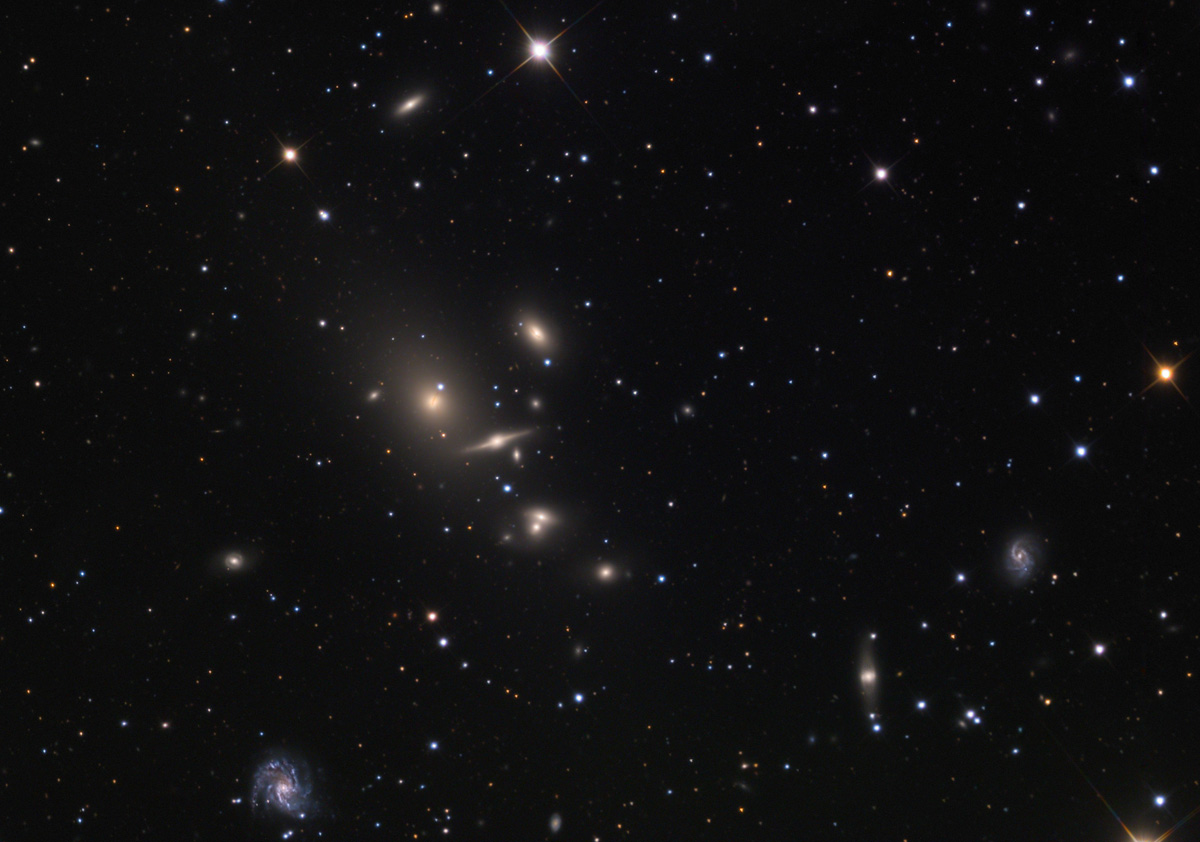
Image Courtesy of Adam Block/Mount Lemmon SkyCenter/University of Arizona. For more images from Adam Block please visit the Mount Lemmon SkyCenter website. You can click on image for a high resolution version, or download a copy of our Megastar© finder charts for Abell 2621 and Abell 262.
Abell 262 is part of the Perseus-Pisces chain of superclusters. This filament is one of the largest known structures in the Universe and extends from the Perseus clusters (Abell 426) through to the NGC 507 and NGC 363 groups in northern Pisces. Even at its current distance of 200 million light years this still spans 40 degrees of sky.
Abell 262 is unusual in that like the Hercules cluster the majority of its bright galaxies are spirals. The central galaxy, NGC 708, is a giant cD galaxy however.
The four galaxies in this area were first discovered by William Herschel and the remainder were found by John Herschel or by Lord Rosse and his assistants and d’Arrest.
The group contains 40—100 galaxies and is classified as an irregular cluster. There have been some suggestions that the cluster has two centres, one around NGC 708 and the other around NGC 785. I think this is highly unlikely given the separation of the two galaxies.
Like most large clusters of galaxies Abell 262 is permeated by a hot intracluster gas that radiates at X-Ray wavelengths because of its high temperature of approximately one million degrees Kelvin. Interestingly however in AGC there appears to be a tunnel blown in this gas from the jets from the super massive black hole in NGC 708.
One of the challenges when observing galaxy clusters is the presence of background galaxies and indeed when studying Abell 262 in the near infrared with 2MASS astronomers found that there as another cluster of galaxies in the background that showed the layered structure of the universe. The background cluster lay at a distance of almost 1 billion light years.
The group is well covered in the Webb Society Deep-Sky Observer's Handbook (DSOH) Vol.5 and has garnered increased interest recently as larger telescopes come into the hands of amateurs. Recent observations using a 56cm telescope in not such great skies by myself showed the central core of the cluster looking like a Y. The central field also showed several more galaxies and then scanning the field revealed a large number more. Unfortunately that observing session was cut short by illness. The central core galaxies should be in the range of 30cm and perhaps less.
As with most galaxy clusters it is best to be prepared with a finder chart when hunting for the galaxies here or you will miss some of the brighter ones, especially in the case of a cluster like Abell 262 that is so spread out. The supplied charts show both the extent of the cluster and the core galaxies.
Detailed observing notes can be found at the Adventures in Deep Space and Andreas Domenico's Visual Deep-Sky Observing websites. The grouping around NGC 708 is sometimes known as the Fath. I am not sure where that names comes from or to what it refers.
Owen Brazell - Galaxy Section Director
-
December 2012 - Galaxy of the Month
NGC 891 in Andromeda
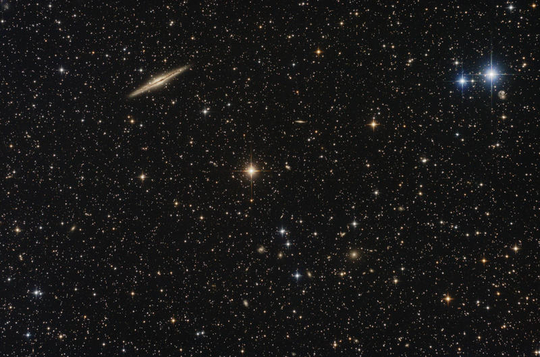
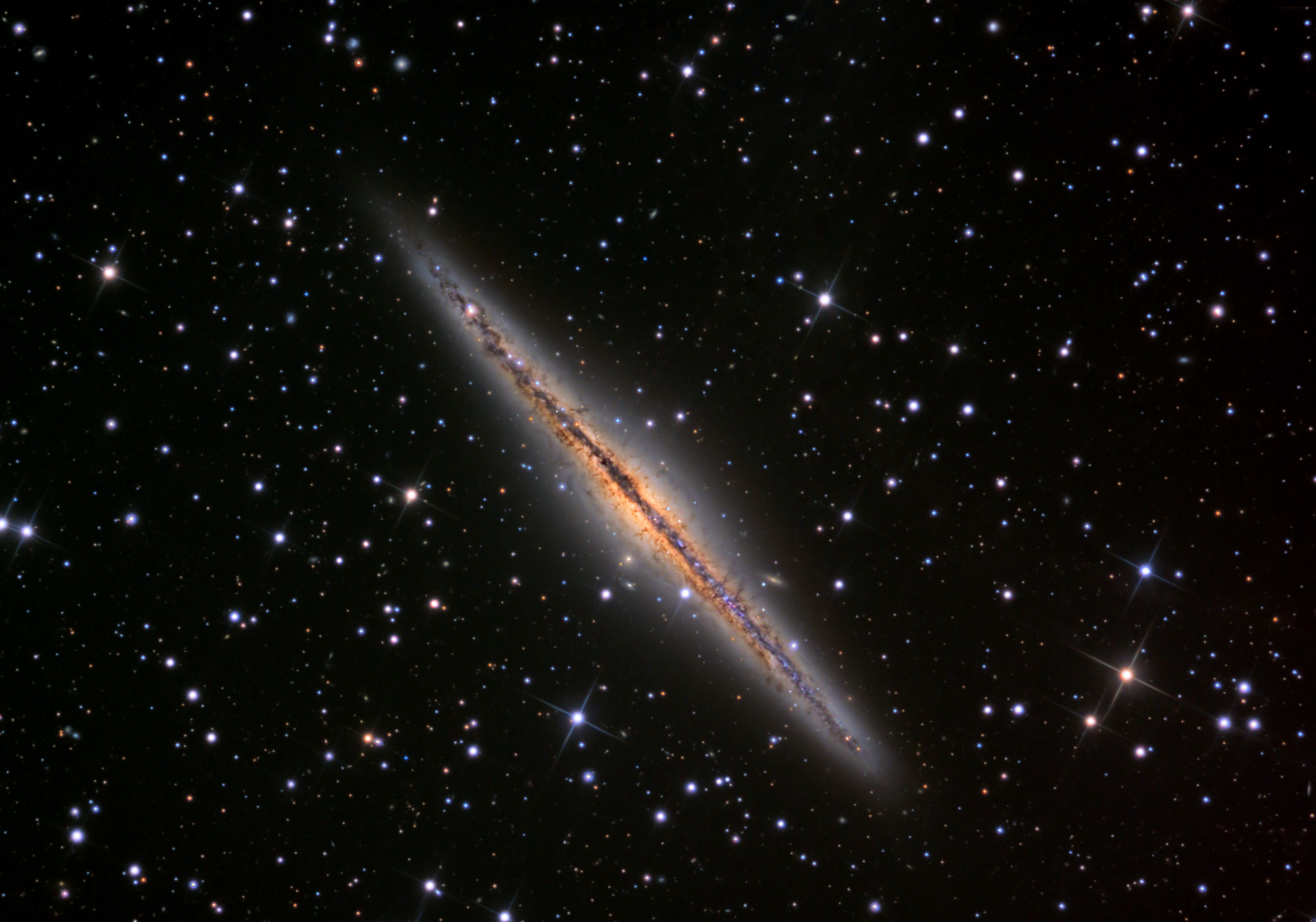
Image Courtesy of Michael Fulbright, North Carolina, USA. For more images from Michael please visit his website. Click on image for a high resolution version and you can download a Megastar© chart of the AGC 347 region.
This month’s galaxy of the month is two challenges in one.
NGC 891 is one of the finest edge on spirals in the sky. Its discovery was erroneously attributed to Caroline Herschel but it was in fact discovered by her brother William in 1784 where he described it as
Bright, large and very much extended
.NGC 891 is about 10 Mpc away and about 100,000 light years across and is part of a group of galaxies that also includes NGC 1023. Although it was first thought to resemble our Milky Way recent observations with the Hubble Space telescope have shown the existence of filaments of dust colloquially known as dust bunnies.
These filaments extend hundreds of lights years above and below the plane of the galaxy. The origin of these is unclear but they may have been thrown up out of the galactic plane by supernova explosions or intense star formation activity. There are some excellent Hubble images of these features.
Observations in the Infra-red suggest that the galaxy may have a bar and its classification should perhaps be SBb. NGC 891 is in many ways similar to our galaxy in that it shows remnants of tidal star streams from the disrupted dwarf galaxies that it has merged with. Robert Gendler provides a view of the galaxy seen through an 8 metre scope.
NGC 891 is also a TV star having appeared in the start of the TV program the Outer Limits and has had its name used in at least two music tracks.
The NGC 1023 group consists of the galaxies NGC 891, 925, 1023, 1058 and 1239 along with other much smaller dwarf galaxies. Observationally I find NGC 891 can be a challenge and the ease of seeing it depends very much on the transparency of the sky. I often use it as a test for the transparency.
On good nights it is an ethereal ghost floating in a nice star field. As always what size telescope you need to see NGC 891 depends on the clarity of the skies and from high dry sites smaller telescopes will show NGC 891. Its size lends it to using a medium power eyepiece when viewing. Higher powers will show some of the detail in the dust lane and the nucleus peeping through.
Close together on the sky being about ¾ of a degree away from NGC 891, although unrelated, is the galaxy cluster AGC 347 with the main galaxy NGC 910. This is at the much greater distance of perhaps 70 Mpc – roughly 7 times further away than 891.
The cluster contains 7 galaxies included in the NGC, although only four are brighter than 14th magnitude. Most of the galaxies where discovered by Stephan at Marseille using an 80cm silver on glass reflector but two of the brightest (910 and 898) were discovered by William Herschel. There are perhaps 32 galaxies in this group scattered over an area perhaps 56’ across. The Abell classification is 0 1 II-III.
George Whiston reporting in WSDSOH Volume 5 found 7 galaxies with a 16". I would be interested to know how many observers with larger telescopes can find. Due to the nature of this group medium to high power should be used as it will help bring out the contrast between galaxies and sky and most of these galaxies are quite small.
Owen Brazell - Galaxy Section Director
-
November 2012 - Galaxy of the Month
NGC 80 Group in Andromeda
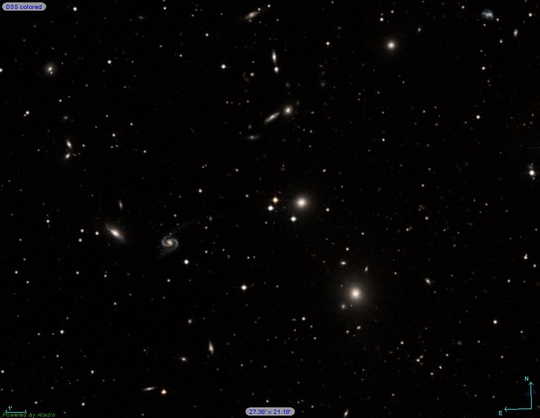
Image Courtesy of DSS - Digitized Sky Surveys at the Space Telescope Science Institute. Click on image for a high resolution version. We have a Megastar© finder chart of the NGC 80 region.
Although by accident rather than design a number of the groups of galaxies mentioned in recent galaxy of the month pieces have been part of the great Perseus-Pisces super cluster. The group discussed here surrounding the galaxy NGC 80 are also part of the western end this super cluster but unlike most of the others appear not have attracted the attention of imagers. Unusually then the colour image here was taken from the DSS.
The NGC 80 group is interesting as it contains a number of S0 or lenticular galaxies and these, much as expected, contain old stars. Of the 13 main galaxies in the group 9 appear to be Lenticular which is an unusually high fraction. Lenticular galaxies are normally thought to have been formed by interactions and ram pressure stripping in large clusters. The NGC 80 group is not however a large cluster, it does however appear bright in X-Rays which usually indicates there is a lot of hot gas.
The composition of the group may not be as fixed as was first thought however as the galaxies associated with the massive elliptical NGC 83 appear to lie in front of the main group and may form a subgroup that is merging with the main cluster associated with NGC 80. There is also evidence of interaction between galaxies in terms of enhanced star formation associated with both NGC 83 and IC 1548. It is unusual to find new star formation in an elliptical galaxy, especially in the centre.
The group had a mixed discovery history with NGC 80 itself being discovered by John Herschel but most of the other galaxies in the group being found by either Ralph Copeland using the 72" at Birr or by Bigourdan in Paris with a 12" refractor.
Unfortunately this means the group will not be easy to see and will be a challenge for medium to large telescopes. The main galaxies should be visible in perhaps 22-30 cm but to see the rest of the group is likely to require 40-50 cm aperture from dark skies. The IC galaxies in the group were discovered by Javelle with a 30" refractor and will possibly test very large telescopes. The attached finder chart from Megastar 5 gives the location and identity of the galaxies. There are perhaps 14 large galaxies in this group.
The galaxy group is part of the Astronomical League’s Galaxy Group and cluster program. It does feature in the Webb Society Deep-Sky Observer's Handbook (WSDSOH) Volume 5 which includes observations and drawings with both 40 and 76 cm telescopes. There are a few observations noted in the NSOG Volume 1.
As a challenge to the imagers it would be interesting to get a decent image of this group. Courtney Seligman has an interesting Celestial Atlas with information and images of the galaxies in this group.
Owen Brazell - Galaxy Section Director
-
October 2012 - Galaxy of the Month
NGC 891 in Andromeda
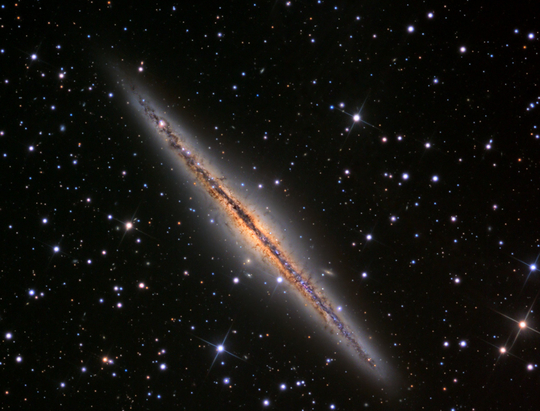
Image Courtesy of Adam Block / Mount Lemmon SkyCenter / University of Arizona. Click on the image above for a high resolution version.
NGC 891 is one of the finest edge on spirals in the sky. Its discovery was erroneously attributed to Caroline Herschel but it was in fact discovered by her brother William in 1784 where he described it as
Bright, large and very much extended
.Resource on the history of the objects discovered by Caroline are available online.
NGC 891 is about 10 Mpc away and about 100,000 light years across and is part of a group of galaxies that also includes NGC 1023. Although it was first thought to resemble our Milky Way recent observations with the Hubble Space telescope have shown the existence of filaments of dust colloquially known as dust bunnies.
These filaments extend hundreds of lights years above and below the plane of the galaxy. The origin of these is unclear but they may have been thrown up out of the galactic plane by supernova explosions or intense star formation activity. Hubble has some excellent images of these features.
Observations in the Infra-red suggest that the galaxy may have a bar and its classification should perhaps be SBb. The galaxy was chosen as the first light target for both the LBT and the Discovery Channel Telescope. NGC 891 is in many ways similar to our galaxy in that it shows remnants of tidal star streams from the disrupted dwarf galaxies that it has merged with. Robert Gendler provides a view of the galaxy seen through an 8 metre scope.
NGC 891 has also appeared in the start of the TV program the Outer Limits and has had its name taken in at least two music tracks.
The NGC 1023 group consists of the galaxies NGC 891, 925, 1023, 1058 and 1239 along with other much smaller dwarf galaxies. Observationally I find NGC 891 to be a challenge and the ease of seeing it depends very much on the transparency of the sky. I often use it as a test for the transparency.
On good nights it is an ethereal ghost floating in a nice star field. NGC 891 can be seen with small telescopes from very dark skies. Its size lends it to using a medium power eyepiece when viewing. Higher powers will show some of the detail in the dust lane and the nucleus peeping through.
About ¾ of a degree away, although unrelated, is the galaxy cluster AGC 347 with the main galaxy NGC 910.
Owen Brazell - Galaxy Section Director
-
December 2011 - Galaxy of the Month
Hickson 10 (NGC536)

Image Credit - Gary White and Verlenne Monroe/Adam Block/NOAO/AURA/NSF (click on image for a larger version), and for more information try the National Optical Astronomy Observatory (NOAO).
Galaxies in general can be nothing but featureless smudges through a small telescope. What enlivens galaxy observing is however trying to see features in these smudges and companions to them. My choice of galaxy of the month is the compact group Hickson 10.
Hickson 10 is one of the brighter members of the Hickson catalogue of compact galaxy groups but even so is still a challenge. This grouping consists of the galaxies NGC 529, 531, 536 and 542.
The main galaxy of the group NGC 536 was discovered in 1784 by William Herschel but he missed the other members which is a testament to their faintness. John Herschel found NGC 529 in 1827 and Mitchell working with the 72" at Birr found the remaining members of the group. NGC 536 is a fine spiral galaxy with a bright core. NGC 529 and 531 appear to be lenticular galaxies. This is slightly odd as normally these galaxies are found in large clusters where the ram pressure from the intra cluster gas has stripped the gas and dust from what started out as a spiral. Hickson 10 does not appear to be part of a larger group so maybe there are other ways of forming this type of galaxy.
There is also the challenge with Hickson groups in that they are not massive enough to survive for long periods, astronomically speaking, and therefore it is surprising that we see them at all. It is possible that these groups continually dissipate and then reform out of rich loose clusters of galaxies. There are certainly a large number of galaxies in the general area of Hickson 10, although their spatial relationship is not known.
Interestingly deep images show a shell of material around NGC 536 which is not actually centred on the galaxy. Perhaps a challenge for our imaging members to see if they can pull anything out. The location of the group near a bright 6th magnitude star will make observing them a challenge and the use of high power to keep the star out of the field may well be beneficial. Steven Gottlieb’s observations and a chart of the group can be found on his website. Other useful resources including a downloadable Atlas and an excellent Observing Guide. I suspect that the two brighter members of the group may be seen with a relatively small telescope but a much larger one will be needed to pull out the two fainter members of the group.
Owen Brazell - Galaxy Section Director