-
February 2026 - Double Star of the Month
About 10 degrees east of beta Aurigae lies a coarse cluster of mostly naked eye stars all bearing the label ψ (psi). The Cambridge Double Star Atlas (2nd edition) shows that ψ2, ψ5 and ψ7 are all double but they do not appear in the catalogue, presumably because they are all too wide. Nevertheless, 56 Aur = ψ5 Aur (06 46 44.34 +44 34 37.3), is worth looking at because it has a fine colour contrast.

A finder chart for the double star 56 Aur in Auriga created with Cartes du Ciel. It was found by William Herschel in 1782 when the position angle (PA) and separation were 17 degrees and 53". and he noted colours of white and pale red. By 2022 the values of PA and separation were 44 degrees and 28" due mostly to a proper motion, largely in declination, of the A star. In 1970 I found the colours to be yellow-orange and blue with a 21-cm mirror.
Pi Puppis (07 17 08.56 -37 05 51.0) is a wide, unequal double star found by James Dunlop at Parramatta in New South Wales. It is about 8 degrees south of the blue supergiant eta CMa (V = 2.5). The primary is a very bright (V = 2.9) K4 giant whilst there is a V = 7.9 companion at 213 degrees and 69" with this separation slowly decreasing with time.

A finder chart for the double star pi Puppis in Puppis created with Cartes du Ciel. Gaia DR3 gives distances of 560 and 970 light-years respectively for A and B but the parallax measured for has a 20% error and this is because the Hipparcos mission in the early 1990s found that A itself was a double star with a V = 6.9 companion 0".7 distant. Since discovery this star has moved just 3 degrees but it does not appear in DR3.
Pi Puppis lies in a cluster called Collinder 135 which has six members brighter than magnitude 6. It might have had a common origin with a nearby cluster UBC 7. The centres of the clusters are currently 24 pc apart but the stellar motions indicate they would have been closer in the past.
Bob Argyle - Double Star Section Director
-
February 2021 - Double Star of the Month
In December 1968 I was observing with friends in the back garden of a house in Newcastle-upon-Tyne using a 12-inch reflector. We looked at a number of double stars that night, including phi2 Cancri = STF 1223 (08 26 47.08 +26 56 07.8) and 24 Cancri = STF 1224 (08 26 39.82 +24 32 03.7). These two pairs form a kind of wide double-double and can be found in northern Cancer.
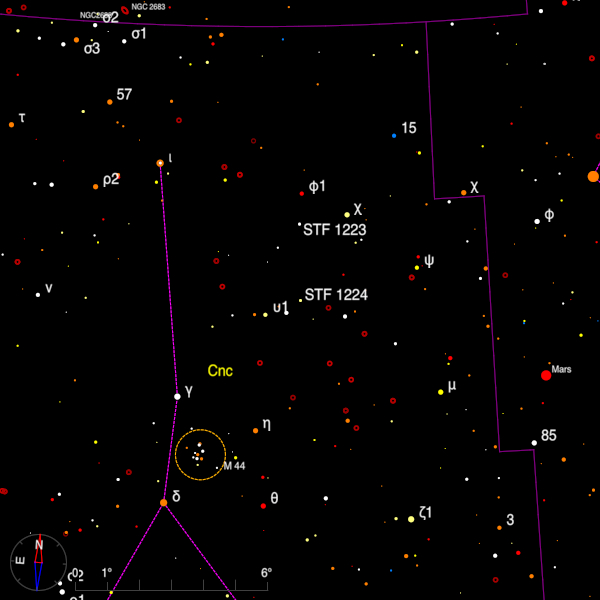
A finder chart for the double stars STF 1223 and STF 1224 in Cancer created with Cartes du Ciel. Starting with the beautiful pair iota Cancri, move about 4 degrees SE to find phi2. This is a pair of magnitude 6.9 and 7.5 stars separated by 5".7 and currently at PA 53 degrees. With the 12-inch I noted that the stars appeared white and lilac at a power of x208. Gaia indicates that these stars are at the same distance from us (347 light-years).
STF 1224 is the brighter of the two pairs with the components having V = 5.2 and 6.2. The separation is 5".2 and the position angle 219 degrees. I recorded both stars as being blue-white. Robert Aitken found that the B component was a very close binary of short period. The BC pair revolves in just 21.8 years and the separation stays close to 0".15 throughout the cycle. The Gaia EDR3 catalogue gives a parallax for the A component of 14.429 mas giving a distance of 226 light-years.
The magnitude 2.5 star pi Puppis (07 17 08.56 -37 05 50.9) lies in a rich area of the Miky Way which is part of the Vela-Puppis star forming region. It is surrounded by a number of naked-eye stars and the open cluster Collinder 135.
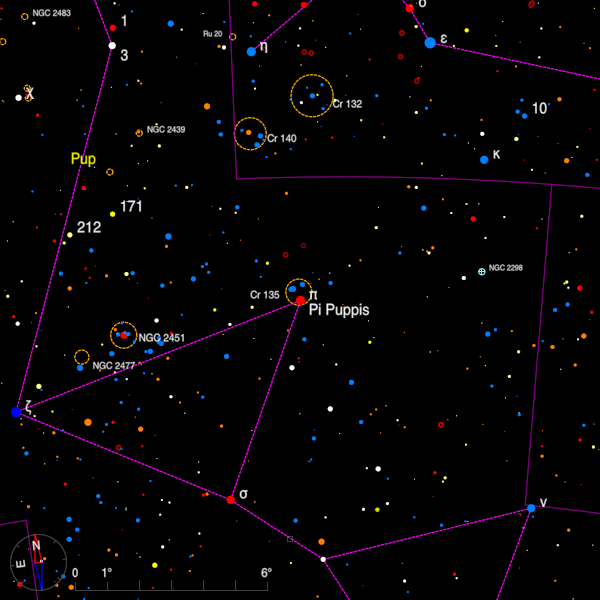
A finder chart for the double star pi Puppis created with Cartes du Ciel. Pi, which is distinctly red, is a close, very unequal double star which was discovered by Hipparcos in 1991 but whose nature does not appear to have been confirmed since. Along with a magnitude 7.9 star some 67" distant in PA 213 degrees it also forms the pair DUN 43.
To the north of pi are the bright stars upsilon 1 (V = 4.7) and upsilon 2 Puppis (V = 5.1) which are 4 arc minutes apart. Both these bright stars are variables. Upsilon 1 is also known as NV Puppis whilst upsilon 2 is NW Puppis. A V = 8.8 star lies at 119" and 215 degrees from B whilst William Jacob, observing from India, discovered a fainter companion (V = 9.1) to C at 3".1 and 209 degrees; this pair is now known as JC 10. There is another open cluster nearby called UBC7 and its possibly binary relation with Collinder 135 has been discussed.
Bob Argyle - Double Star Section Director


-
Deep-Sky Objects and Observations
