-
May 2026 - Double Star of the Month
Draw a line between iota and alpha Draconis. Take the midpoint and then move south-west by 1 degree. This will bring you to a field containing two F. G. W. Struve doubles, some 20 arc-minutes apart.
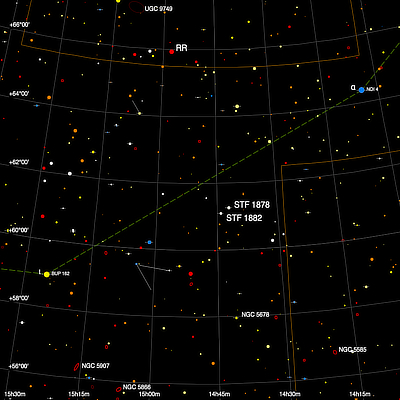
A finder chart for the double stars STF 1882 and STF 1878 in Draco created with Cartes du Ciel. The brighter of the two and also the most western is STF 1882 (14 44 03.55 +61 05 53.7) which consists of stars with visual magnitudes 6.9 and 9.2 currently separated by 11".3 in position angle (PA) 0 degrees. Gaia DR3 indicates that the stars are at similar distances but the the errors on the parallaxes are several times larger than is normal for stars of this brightness which might indicate that there is further structure in the system. The Washington Double Star Catalog also lists a magnitude 10.5 at 37 degrees and 7".2.
The other pair is STF 1878 (14 42 03.25 +61 35 42.9) which is very similar to STF 1882 in terms of the component brightnesses. Here we have magnitudes 6.3 and 9.2 at 313 degrees and 4".0 with the stars closing with decreasing PA since discovery. In this case the components have almost identical parallaxes and small errors indicating that they form a physical system. A is DL Dra, a delta Scuti variable.
Zeta (ζ) Lupi (15 12 17.0 -52 05 57.7), also DUN 176, is a spectacular pair. Zeta is the most southerly of the bright naked-eye stars in Lupus lying about three degrees north of the border with Circinus.
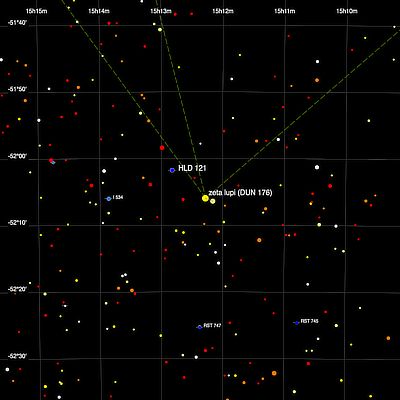
A finder chart for the double stars zeta Lupi (DUN 176) and HLD 121 in Lupus created with Cartes du Ciel. It is a K giant of visual magnitude 3.5 and is accompanied by a F8 dwarf of magnitude 6.7 which is 72" away in PA 249 degrees. The stars lies 114 light-years away using the Gaia DR3 parallax for the fainter component. Although the primary has a similar parallax it is not the same as B within the observed errors which may be due to the brightness of the star or it may have an as-yet undisclosed duplicity. The almost identical proper motions would seem to mark this out as a physical pair. The primary is a KO giant and its companion an F8V which led Ross Gould using 175-mm at x100 to report colours of deep yellow and dull brown-yellow.
Closely north and east is the pair HLD 121 which is now closing from the 3" separation which was measured at discovery in 1882. In 2016 the stars were 2".2 apart in PA 214 degrees.
Bob Argyle - Double Star Section Director
-
June 2022 - Double Star of the Month
Gamma Herculis (16 21 55.24 +19 09 10.9) appears in William Herschel's first double star catalogue as H V 19. Gamma is easily found as it sits just 3 degrees SW of the most south-westerly star, beta, in the Keystone of Hercules.
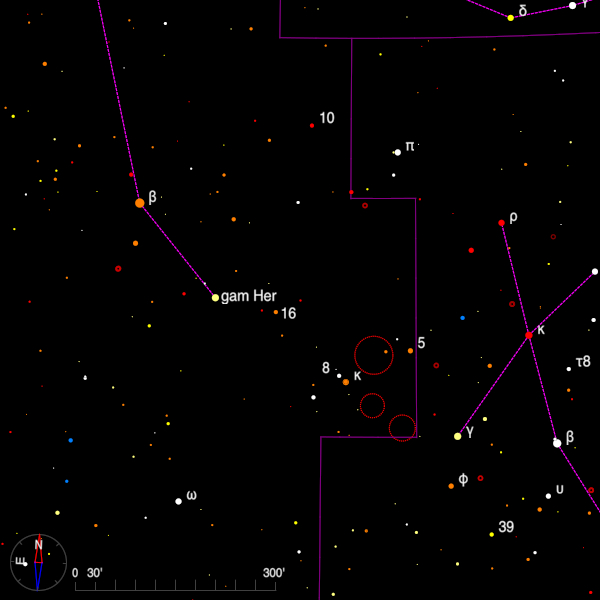
A finder chart for the double star gamma Herculis in Hercules created with Cartes du Ciel. It is a late-A giant star of magnitude 3.8 and in 1780 Herschel found a magnitude 10 companion at 251 degrees and 41".8. By 2013 the position angle had reduced to 226 degrees and the separation was 43".3. This change is due entirely to the difference in proper motions. The Gaia satellite finds the primary star is 193 light-years away whilst the companion is more than 1,770 light-years distant. An additional optical companion, of V = 13.3, can be found at 298 degrees and 82" from B.
The Washington Double Star Catalog (WDS) states that A is a spectroscopic binary, but it does not appear in the Ninth Catalogue of Spectroscopic Binaries (SB9), compiled by the late Dr. Dmitri Pourbaix. Additionally an infra-red survey has revealed an object 8" from A which has a K magnitude of 8, and thus a V magnitude of perhaps 10-11. Whether it is connected to A is not known.
Eta Lupi (16 00 07.33 -38 23 48.1) is a hot, early B-type star of magnitude 3.4 which lies in Lupus, 16 degrees due south of delta Sco, the middle of the three bright stars in the Scorpion's head. Eta is part of the Upper Centaurus - Lupus association and thus has a similar distance (460 light-years) and proper motion to a group of stars in the neighbourhood.
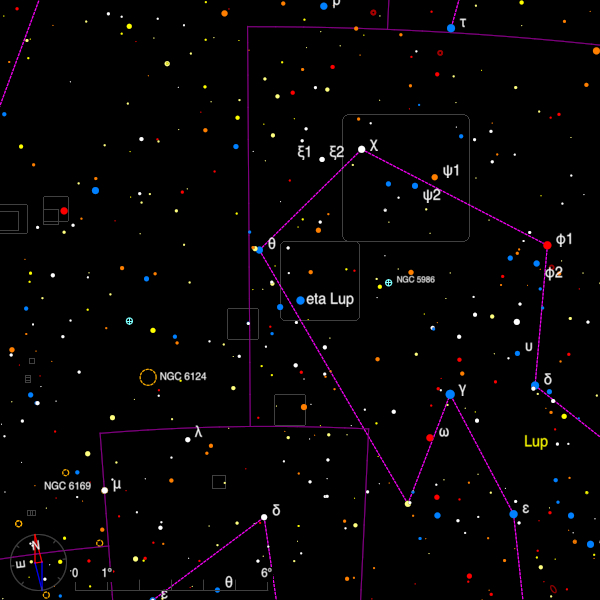
A finder chart for the double star eta Lupi in Lupus created with Cartes du Ciel. The WDS shows three companions, two of which have similar parallaxes to eta, and all of which appear white in the eyepiece. The B component is magnitude 7.5 at a distance of 14" and position angle 19 degrees, a relative position which has changed little since the pair were first noted by Rumker from Parramatta. C is magnitude 9.4 at 115" and PA 248 degrees. This star was also noted by Rumker who appears to have estimated a distance of 1 arc-minute but this may be in error (possibly a misprint for 2 arc-minutes?) as the star moves through space together with the brighter components. The star listed in the WDS as ANT 2 AD (the designation refers to Rainer Anton who measured the previously uncatalogued component D in 2007) does not appear to belong to the association and is almost four times more distant. It can be found at 293 degrees and 136".
Searching the Gaia EDR3 catalogue within a radius of 200 arc-seconds from eta shows a magnitude 14 star which also moves with, and is equally distant from us, as A, B and C, and which can be found at 290 degrees and 118".
Bob Argyle - Double Star Section Director


-
Deep-Sky Objects and Observations
