The Webb Deep-Sky Society

An international society of amateur and professional astronomers specialising in the observation of double stars and 'deep sky' objects founded in 1967. Membership is open to anyone who shares the interests of the Society.

  • About Us
  • Membership
  • Deep-Sky News
  • Galaxies
  • Nebulae and Clusters
  • Double Stars
  • Publications
  • The DSO
  • January 2021 - Double Star of the Month
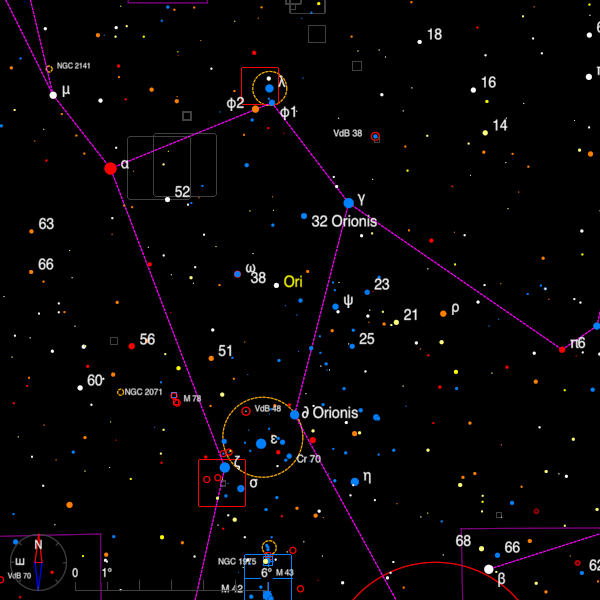
    Image of a finder chart for the double stars 32 Ori and delta Ori in Orion
    A finder chart for the double stars 32 Ori and delta Ori in Orion created with Cartes du Ciel.

    32 Orionis (05 30 47.06 +05 56 53.3) is easily found. It follows, and is slightly south of, Bellatrix (gamma Ori) by about 2 degrees. It was picked up by William Herschel on Jan 20, 1782 and he noted that the stars were Considerably unequal and The distance or black division between the two stars with 278 is about ¼ diameter of L(arge star)…. Herschel noted that the position angle was 232 degrees 10'. During the following century, measurements of 32 Ori showed the stars closing down to a distance of 0".3 before slowly increasing again to the current distance of 1".3.

    Thomas Lewis in his 1906 volume on the Struve stars thought the motion was explained by the proper motions of the two stars whilst van den Bosin 1962 also thought that the stars were not associated. The USNO Orbit catalogue gives a period of 614 years and predicts that the stars will widen until about 2100 before closing again. Gaia EDR3, unfortunately, does not help since it contains only an observation of the brighter component. The stars have V magnitudes of 4.4 and 5.8 and should be nicely seen in 10-cm aperture.

    Six degrees due south of 32 Ori, and just a little below the celestial equator is Mintaka, or delta Orionis (05 32 00.40 -00 17 56.7, V = 2.4), the most westerly of the three Belt stars.

    For the small telescope, the magnitude 6.8 companion (actually component C) located 52" away in PA0 degrees is an easy object to see. This star is itself a spectroscopic binary but it seems to be unassociated with its much brighter neighbour. Gaia EDR3 gives the distance of C as 1245 light-years and whilst the position of the A component is in the catalogue, there is no information on either parallax or proper motion. Hipparcos in 1997, however, found a distance of around 690 light-years, so it seems almost certain the stars are unassociated.

    The bright star is a close triple system. In 1978, Wulff Heintz using the 24-inch Sproul refractor, found a close visual companion at a distance of 0".2 which has a visual magnitude of 3.8; a preliminary orbit gives a period of 346 years. These two stars are very bright and hot, late O-type giant stars. In addition A is also an Algol-type eclipsing system. In 1877, Sherburne Burnham found a magnitude 14 companion (B) at 229 degrees and 33".

    Bob Argyle - Double Star Section Director

  • About the Webb Society

    • Back top of this page
    • Go to our home page
    • About us
    • News
    • Our Annual Meeting
    • Galaxy Section
    • Nebulae and Clusters Section
    • Double Star Section
    • Join the Webb Deep-Sky Society
    • Join our Mailing Group
    • Links to members' websites
    • Contact Us
  • Deep-Sky Objects and Observations

    • Observations home page
    • Object of the Season
    • Double Star Circulars
    • Double Star of the Month archive
    • Double Star of the Month RSSRSS feed icon
    • Galaxy of the Month archive
    • Galaxy of the Month RSSRSS feed icon
    • Picture of the Month archive
    • Picture of the Month RSSRSS feed icon
    • Nebula and Cluster of the Month archive
  • The Deep-Sky Observer

    • DSO digital subscriber login
    • Webb Society Journal archive
  • Publications

    • Handbooks, Guides and Atlases
    • Alvin Huey's Observer's Guides
    • Willman-Bell Publications
    • Free Observing Guide Downloads
  • Featured Articles

    • Where to get reliable NGC/IC data
    • Rediscovering the Bedford Catalogue
    • An Averted Vision Scale
  • Useful Links

    • Astronomy links
    • Astronomy Sketch of the Day website
    • FAS Events Diary

If you have any comments or problems with this page or any other Webb Deep-Sky webpage then please contact the Website Administrator

The Webb Society is registered under The Charities Act 1960 - Registered Charity No. 288384 © 2025 Webb Society except where stated.

The information contained in this website is for general information purposes only. The information is provided by The Webb Deep-Sky Society and while we endeavour to keep the information up to date and correct, we make no representations or warranties of any kind, express or implied, about the completeness, accuracy, reliability, suitability or availability with respect to the website or the information, products, services, or related graphics contained on the website for any purpose. Any reliance you place on such information is therefore strictly at your own risk. In no event will we be liable for any loss or damage including without limitation, indirect or consequential loss or damage, or any loss or damage whatsoever arising from loss of data or profits arising out of, or in connection with, the use of this website. Through this website you are able to link to other websites which are not under the control of The Webb Deep-Sky Society. We have no control over the nature, content and availability of those sites. The inclusion of any links does not necessarily imply a recommendation or endorse the views expressed within them. Every effort is made to keep the website up and running smoothly. However, The Webb Deep-Sky Society takes no responsibility for, and will not be liable for, the website being temporarily unavailable due to technical issues beyond our control.