-
May 2021 - Double Star of the Month
1 Boötis (13 40 40.50 +19 57 20.4) is a star just about visible to the naked eye on a good night. It can be found about 4 degrees WNW of eta Boötis. It is not an easy double star for the small aperture and I have not actually observed it, even thought the primary is a naked-eye object.
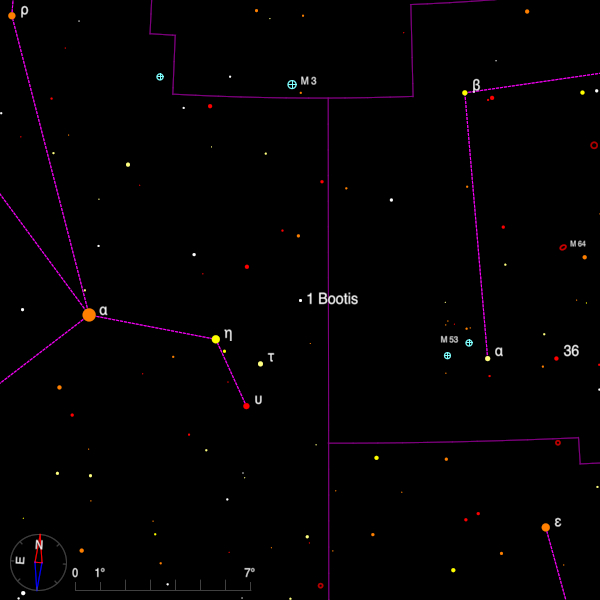
A finder chart for the double star 1 Boötis in Boötes created with Cartes du Ciel. The Washington Double Star Catalog (WDS) gives the magnitudes as 5.8 and 9.6 with the current position angle and separation being 133 degrees and 4.4 arc-seconds. A 15-cm aperture should give a good view of the stars, the primary being white - its spectral class is A1V. There is a faint field star, magnnitude 12.2, 88 arc-seconds away whilst the 7.4 magnitude star at 208 arc-seconds has a similar parallax and proper motion as the stars of the binary. According to Gaia EDR3 the three lie at a distance of 310 light-years.
For the first time in this series, (as far as I know, and deliberately at least!) a binary star is going to be included a second time. This is because it is an exceptional object, about which much has been learned recently so it seems a good time to take another look at alpha Centauri (14 39 36.50 -60 50 02.3).
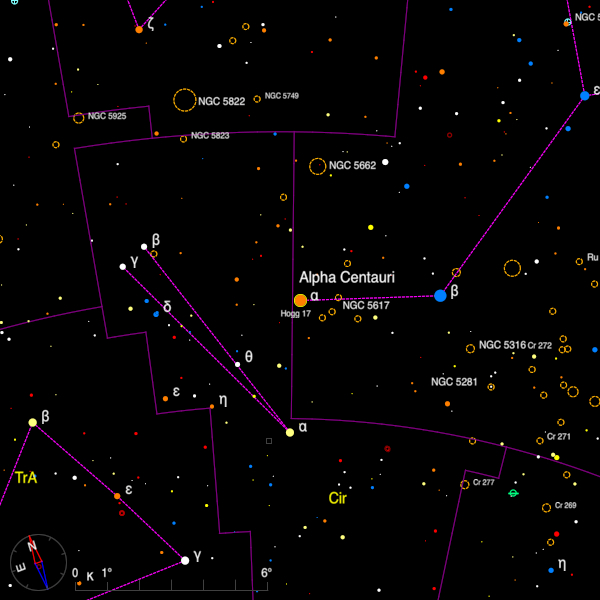
A finder chart for the double star alpha Centauri in Centaurus created with Cartes du Ciel. In May 2007, alpha Cen was at PA 235 degrees and 8".4. This month it can be found at 354 degrees and 6".35, although it is now widening, but only as far as 10".4 in 2020, and then it closes to 1".7 in 2038. Extensive direct imaging has been done of both the stars in the bright binary and the physically connected Proxima Centauri.
To date there definitely seems to be one planet orbiting Proxima and recent observations suggest there is a second one. Both bright components have been suspected of having planetary companions and a recent paper purports to show a candidate close to the A component.
The latest data from the Gaia mission - data release EDR3 - includes a measurement of Proxima Centauri. The satellite finds the star to be 4.2465 light-years away with a quoted error of 0.0003 light-years. The main stars are far too bright to have been considered for data reduction at present though it is hoped that this might be done towards the end of the present mission.
Alpha Centauri is always a 'goto' object for the observer fortunate enough to be south of latitude +20 degrees or so. I have seen the stars in the 67-cm refractor at Johannesburg, and they appear like car headlights - dazzlingly bright.
Bob Argyle - Double Star Section Director
-
Double Star of the Month - May 2007
In this series of short articles, a double star in both the northern and southern hemispheres will be highlighted for observation with small telescopes, with new objects being selected for each month.
xi Boo (14 51 23.3 +19 06 02) was discovered by Herschel the elder on 1780, Apr 9 with the note "Double L. (large star) pale r. or nearly r. S. (small star) garnet, or deeper r. than the other" (my brackets). With a parallax of 0".149 it is a nearby system and so the large apparent orbit means that for most of the 151 year orbit the pair is well within range of the small telescope. It is also a beautiful pair - the colours are yellow and orange, but unequally bright, the apparent V magnitudes being 4.76 and 6.95. The stars are presently closing slowly and in mid-2007 there are to be found at PA 311 degrees and separation 6".2. Closest approach occurs in 2066 when the stars are barely 2" apart. The WDS lists 1351 measurements of this pair and only 432 for alpha Centauri - a measure of how much the southern hemisphere is missing its double star observers.
alpha Centauri (14 39 40.9 -60 50 07) is the nearest binary star to the Sun and the most spectacular visual system in the sky. Discovered by Father Richaud from Pondicherry in 1689 whilst observing a comet ("je remarquai que le pied le plus oriental & le plus brillant etoit un double etoile aussi bien que le pied de la Croissade - I noted that the brightest star at the easternmost foot (of Centaurus) was a double star as good as that at the foot of the Cross" i.e. alpha Crucis.
In 1838 Henderson first measured the parallax at about 1 arc second but it was left to Bessel to publish the parallax of 61 Cygni first. A modern value obtained by the Hipparcos satellite (0".74212) is equivalent to 4.395 light years with a formal error of 0.008 light years. The stars are yellowish and orange-yellow reflecting the spectral types of G2V and K1V and the orbital period is 80 years. Because the system is so close the apparent separation of the orbit varies from 1.7 to 21.7 arc seconds so that they can be seen by small telescopes throughout the orbital cycle. At present the stars are closing (235 degrees and 8".67 for 2007.5). In 1915, Robert Innes found a third star of V=11 some 150 arc minutes away which shares the proper motion of alpha but which has a slightly larger parallax. The star became known as Proxima Centauri and is our nearest stellar neighbour. In 2006, a search was made in the infra-red around alpha Cen B using adaptive optics on one of the VLT telescopes. The modelled mass for this star is about 0.027 solar mass less than that derived from the orbit and it was thought that this might be explained by the presence of a sub-stellar object circling B. In all 252 faint background stars were found within 15" of alpha Cen B but nothing co-moving and therefore nothing physically connected to B itself.
Bob Argyle - Double Star Section Director
-
Deep-Sky Objects and Observations
