-
November 2022 - Double Star of the Month
In the corresponding column for this month in 2021, I mentioned a number of pairs close to the bright, close binary phi Andromedae. As promised this piece will include the pairs MAD 1 (01 00 35.58 +47 19 14.6) and STT 21 (01 03 01.54 +47 22 34.1).
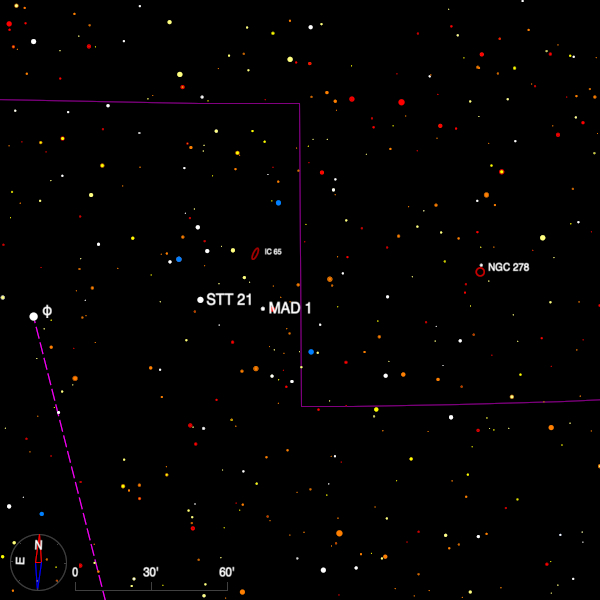
A finder chart for the double stars MAD 1 and STT 21 in Andromeda created with Cartes du Ciel. STT 21 is about 1.5 degrees west of phi And and is now considerably easier to observe than in the 1840s when the separation was 0".6 The current orbit of 450 year period was published by W. D. Heintz in 1966 and predicts a position of 176 degrees and 1".2 for late 2022. The apparent orbit is one of high eccentricity and inclination and the apparent motion appears to be almost linear. The magnitudes are 6.8 and 8.1 and the pair should be resolved in 15-cm aperture.
Johann Madler (1794 - 1874) succeeded F. G. W. Struve as Director of Dorpat Observatory where the main instrument was Fraunhofer's 9.3-inch refractor with which Struve had carried out his great survey of double stars. MAD 1 can be found half a degree west of STT 21. It is a long period binary with main components of magnitudes 7.7 and 9.1. When first observed the separation was 1" but the stars have been closing slowly and at the present time are 0".74 apart in PA 356 degrees, if the 2127 year orbit currently in the catalogue is accurate.
HJ 5437 (00 00 34.35 -53 05 51.8) sits in southern Phoenix 20 arc-minutes to the south-east of the red giant pi Phe (V = 5.1).
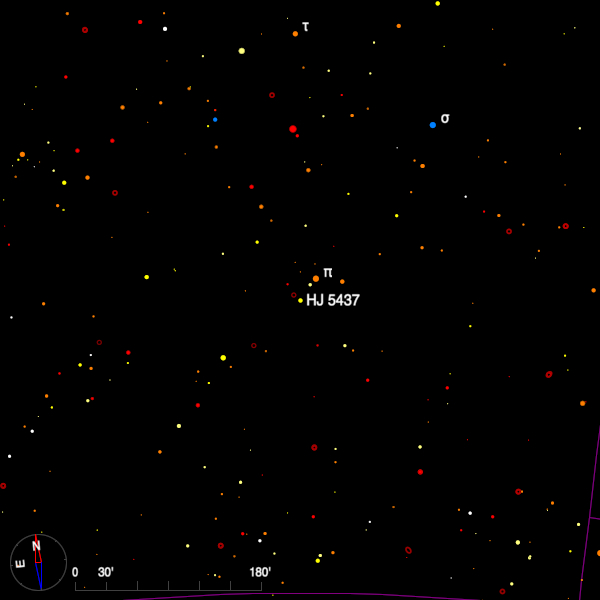
A finder chart for the double star HJ 5437 in Phoenix created with Cartes du Ciel. It is not labelled in the second edition of the Cambridge Double Star Atlas, and was found by John Herschel in 1836 at 340 degrees and 2".5 since then has been slowily closing. In 2019 the stars were at 340 degrees and 1".4 and as the magnitudes are respectively 6.9 and 9.9 this is a rather difficult pair which probably needs at least 20-cm.
Although the observed motion only amounts to 44 degrees, a premature orbit with a period of 904 years is listed in the online USNO 6th orbit catalogue. Incidentally the USNO double star website is back on-line and can be found at crf.usno.navy.mil. The WDS catalogue is available again but the latest update appears to have been about 2 months ago.
Bob Argyle - Double Star Section Director
-
Double Star of the Month - March 2012
In this series of short articles, a double star in both the northern and southern hemispheres will be highlighted for observation with small telescopes, with new objects being selected for each month.
STT 215 (10 16 16.05 +17 44 24.6) is one of Otto Struve's discoveries at Pulkova and is a slow moving binary. In 1844 the stars were just 0".47 apart in position angle 256°. Since then, slow retrograde motion has brought them to 177° and 1".5, sufficiently wide to be well-seen in a small telescope although the relative faintness of the two stars does require a night of good seeing and transparency to get a good view - it is not the easiest of pairs to measure with the Cambridge 8-inch OG. Surprisingly, the star is not in the Dover edition of Webb's `Celestial Objects' but it is described in Hartung and Haas. The current orbit projects a period of 670 years with the separation continuing to increase slowly. Hipparcos puts this star at a distance of 375 light years and the WDS gives the spectral type of the primary as A9IV.
I11 (09 15 14.64 -45 33 19.8) is in Vela, currently prominent from southern latitudes, and which is full of interesting double stars. It is located about 2 degrees south following λ Vel and was one of Robert Innes' first discoveries with a borrowed 6-inch refractor from Sydney in the last decade of the 19th century. Set in a fine field Hartung found both stars to be yellow, although the spectral type of the primary is B8V. This is undoubtedly a binary, albeit of very long period. Having closed slightly since discovery with increasing position angle, it was found at 290° and 0".8 in 1997 when last measured. It is a very distant system, only just giving a significant parallax form the observations made by Hipparcos which place it at a distance of almost 1900 light years.
Bob Argyle - Double Star Section Director
-
Deep-Sky Objects and Observations
