Double Star of the Month in Vela
-
March 2024 - Double Star of the Month
In a sparse area of sky south of Ursa Major a faint triangle of naked-eye stars can be seen. They straddle the border between Lynx and Leo Minor. The north-eastern of these stars is 38 Lyncis (09 18 50.64 +36 48 09.3), a beautiful pair whose components are magnitudes 3.9 and 6.1 and whose position angle has reduced just 15 degrees in the 200 years since the pair was first measured. The separation is 2".6 so a moderate magnification needs to be used to separate the stars adequately.
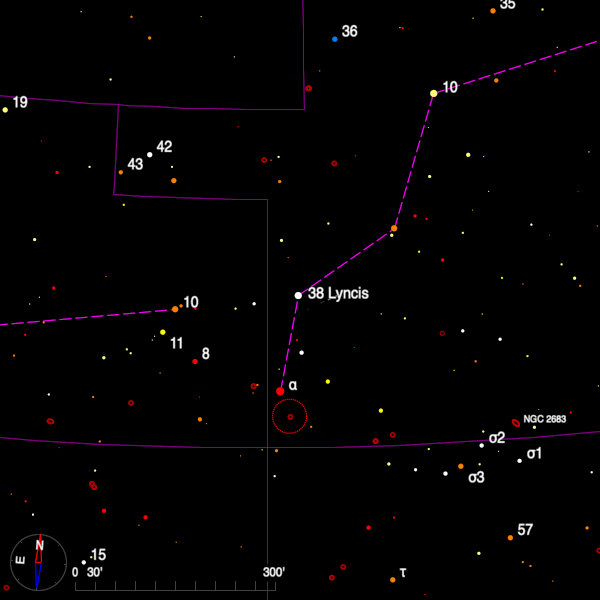
A finder chart for the double star 38 Lyncis in Lynx created with Cartes du Ciel. An orbit with a period of 2782.8335 years, published in 2019, needs to be regarded with some scepticism but the stars are certainly physical, as shown by the parallaxes which the Gaia satellite has provided. Speckle interferometry reveals that B is a very close pair with two observations only and a measured separation of 0".1 to 0".2, and the Washington Double Star catalog (WDS) indicates that the A component is a 2 day eclipsing binary, found by the TESS satellite.
There are optical companions (C,D) at 79" and 173" respectively, both of magnitude 12.5, and a fainter component E (magnitude 14.7) which is 101" away, but which has the same large parallax and proper motion as the bright stars thus elevating the whole system to quintuple status.
DUN 81 (09 54 17.66 -45 17 00.6) can be found in northern Vela. It is a bright and easy pair with components of magnitudes 5.8 and 8.2. When found in 1826 the PA was 239 degrees and separation 4".0. It is nearer to 5".6 today with no apparent change in position angle.
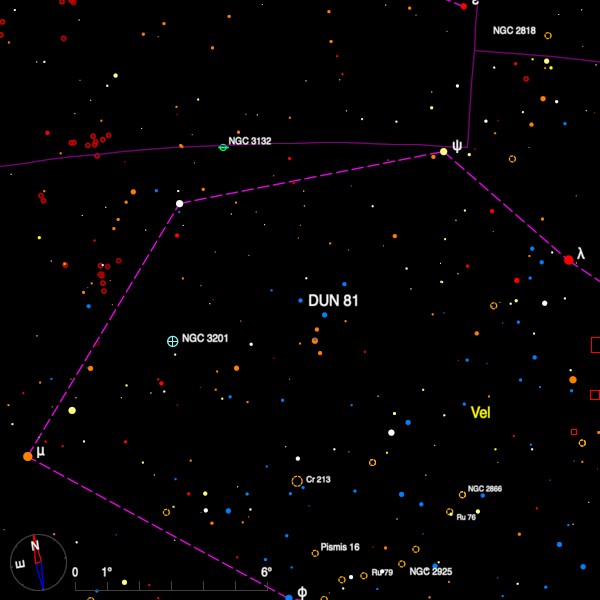
A finder chart for the double star DUN 81 in Vela created with Cartes du Ciel. These are distant stars but the parallax of each star suggests that they are related. The Gaia Data Release 3 (Gaia DR3) catalogue gives 1124 ± 6 and 1136 ± 16 light-years respectively for A and B, with similar proper motions. The primary is a B5 dwarf according to Simbad and whilst no spectral type can be found for B, its almost zero (B-V) colour suggests a hot, young star.
Using a 200" search radius on the Gaia DR3 catalogue shows a number of stars around magnitude 20 at about the same distance as the bright pair although admittedly the errors in the parallaxes are large it may suggest that there is a loose cluster here.
Bob Argyle - Double Star Section Director
-
March 2023 - Double Star of the Month
At the extreme eastern edge of Ursa Major, where it projects slightly into Leo Minor, there is a triangle of three naked-eye stars - 42 and 43 Lyn and a brighter but unlabelled star of Vmag 4.8 which turns out to be HD 82741. About a degree south of 42 Lyn is STF 1374 (09 41 21.88 +38 57 01.9) which is a long period visual binary.
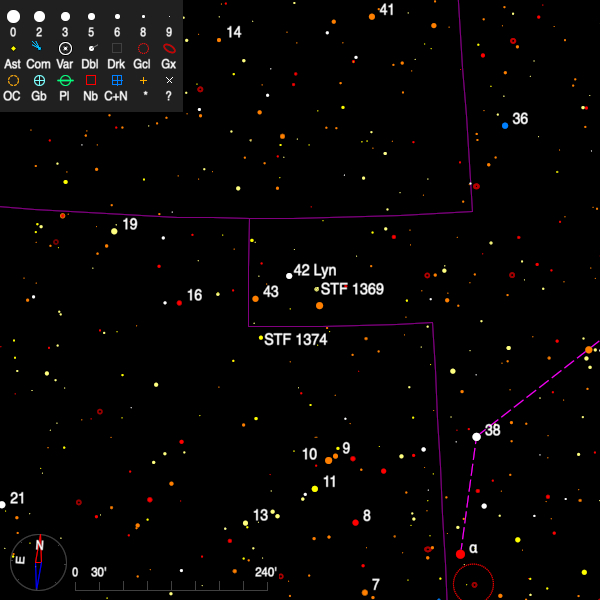
A finder chart for the double star STF 1374 in Leo Minor created with Cartes du Ciel. Since being measured by F. G. W. Struve (275 degrees, 3".3) the pair has closed slightly with increasing angle and is now to be found at 312 degrees, 2".8. This motion is apparently sufficient to allow the calculation of an orbit with a period of 1815 years.
This is a relatively unequal pair with magnitudes of 7.3 and 8.7 given in the Washington Double Star (WDS) catalogue. In the neighbourhood is STF1369 (7.0, 8.0, 150 degrees, 25".1) which is just north of HD 82741. Another star of magnitude 8.4 lies 116" distant and the A component is the close pair COU 2084 with a period of 50 years and a current separation of 0".1.
SEE 115 (09 37 12.65 -53 40 06.6) lies in southern Vela near the border with Carina. It sits neatly at the centroid of the isosceles triangle formed by φ, L and κ Vel.
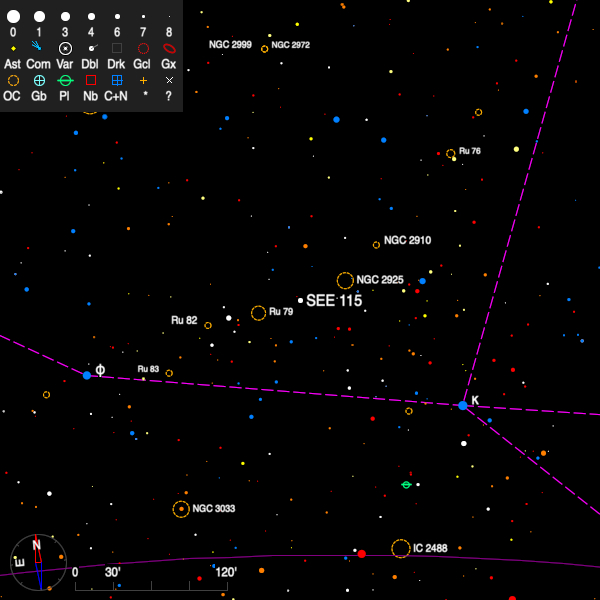
A finder chart for the double star SEE 115 in Vela created with Cartes du Ciel. It was discovered by T. J. J. See, but in the 125 years which has elapsed since then the position angle has only increased by 8 degrees whist the separation remains at 0".7. This is a good test for a 20-cm aperture as the stars are magnitudes 6.1 and 6.3.
Although it has an entry in Gaia DR3, there is no information on either parallax or proper motion even though a relatively wide pair such as this might be expected to have been resolved satisfactorily by this stage of the satellite mission.
Just half a degree WNW is the open cluster NGC 2925 some 10'x10' in size and discovered by Sir John Herschel.
Bob Argyle - Double Star Section Director
-
March 2019 - Double Star of the Month
During his work at Pulkovo using the 15-inch refractor to survey for new pairs, Otto Struve came across 256 wide pairs (with separations between 32" and 2', and by no means all new discoveries) which he collected an published in an Appendix catalogue. Many are rather faint and uninspiring but several are worth seeking out. One such is STTA 123 (13 27 04.7 +64 44 07.6) in Draco, found about 4 degrees preceding Thuban (alpha Dra).
The stars are given as yellowish and blue together with the description
striking object
in the Dover edition of Celestial Objects for Common Telescopes, Volume 2. Although Sissy Haas calls both stars solid blue, Simbad gives the spectral types of both stars as F0.Even though they are separated by 69" at position angle (PA) 145 degrees, the stars are identically distant within the errors in the parallax as determined recently by Gaia DR2 and the mean distance is 225.87 light-years with an error of 0.01 light-year. The WDS lists an additional faint companion of magnitude 12 at 95 degrees and 39".
Three and a half degrees east of the 1.8 magnitude gamma Velorum, and the same distance south of the Vela Supernova Remnant is A Velorum, although on the Cambridge Double Star Atlas (2nd edition) it appears only as HJ 4104 (08 29 04.76 -47 55 44.2).
This is a bright triple, the closer pair (AB) are magnitudes 5.5 and 7.2 and they were separated by 3".5 at PA 244 when I measured them in 2008; both quantities are slowly increasing with time. At 19" and 39 degrees (2008) is a magnitude 9.2 star.
In 1951, W. S. Finsen, using his eyepiece interferometer on the 26.5-inch refractor at Johannesburg found that the primary was double at a distance of 0".1. Recent measures have shown that this a binary of high inclination and the projected period is 340 years. If the orbit is correct the apparent separation reaches only 0".25 before falling back again.
Whilst the easily resolvable components appear to be early B stars, Ernst Hartung found the AB pair to be pale yellow. More recently, and also from Australia, Ross Gould, using 175-mm, notes only that the primary is pale yellow but confirms that the triple is embedded in an interesting field.
All three components appear to be equally distant - 1600 light years away, according to Gaia DR2.
Bob Argyle - Double Star Section Director
-
March 2018 - Double Star of the Month
Tucked away is an obscure part of Ursa Major is the red dwarf binary STF 1321 (09 14 22.79 +52 41 11.8). Containing stars of magnitudes 7.8 and 7.9 it sits about half a degree west of the centroid of a triangle of stars formed by 15, 18 and θ UMa.
Although discovered by Struve almost 200 years ago the orbital motion has amounted to only 50 degrees or so and the projected period is 975 years. Both stars are a distinct yellow colour and currently separated by 16".8 in position angle 99 degrees.
This is one of the nearest stellar systems to the Sun. Hipparcos measured both stars and came up with a distance of 19 ± 0.6 light years for the A component but most recently an interim measurement from Gaia gives a distance for the B star of 20.52 ± 0.05 light years.
The Hipparcos parallax error is exceptionally large and implies there may be underlying structure. Both stars have been suspected of being spectroscopic binaries but this was disproved, at least at the 0.1 km per second level by Morbey and Griffin. Further searches for faint companions have so far revealed nothing. It will be interesting to see what Gaia finds for the A star - the fact that the parallax has not yet been published may be revealing in itself.
The pair move across the sky at more than 2.5 arc-seconds per year and is fast approaching two faint companions found by Ball (mag. 11.9) and Espin (mag. 14.5).
BSO 18 in Vela (08 42 25.41 -53 06 50.5) contains two stars bright enough to be in the HR catalogue, the primary HR 3467 of magnitude 4.8 and HR 3466 of magnitude 5.6, 76 arc-seconds distance in position angle 311 degrees, so this is a fine pair of white stars for the binocular user.
It is easy to find as it is 25 arc-minutes south following the bright star o Velorum (mag. 3.6) which is itself embedded in the galactic cluster IC 2391, so the whole area is a spectacular telescopic view.
B in turn has a magnitude 9.9 star (D) at 266 degrees and 60 arc-seconds. The bright components of BSO 18 share the proper motion of the cluster and are both at a distance of about 500 light years.
In 1929 W. H. van den Bos found a close companion to the B component some 2.5 magnitudes fainter and 0.5 arc-seconds away. Since then the distance has increased only slightly and the position angle has increased by 40 degrees to 153 degrees. This pair (B 1625 BC) was last measured in 1991 and poses a challenge for 30cm.
Bob Argyle - Double Star Section Director
-
April 2017 - Double Star of the Month
Iota Leo (11 23 55.37 +10 31 46.9) is a naked-eye star which sits below the hind legs of Leo. It is a relatively easy double star to resolve given 15-cm of aperture and it seems to have been missed by William Herschel during his double star surveys around 1780.
The current orbit, which has a period of 186 years predicts a separation of 1".05 for 1780 but the pair is a very unequal one: the visual magnitudes are 4.06 and 6.71 making it somewhat easier than zeta Her which Herschel did discover. At the present time, the stars are separated by 2".1 and they are now almost back in the configuration in which they would have appeared to F. G. W. Struve in 1827.
From the UK iota Leo is relatively low and I have never found them particularly easy to measure. The stars will continue to widen until 2060 when they are 2".7 apart and then closing to 0".63 in 2128.
Admiral Smyth found the colours to be pale yellow and light blue. T. W. Webb noted white and tawny in 1870, whilst Hartung found yellow and whitish.
Pz 3 Velorum (10 31 57.33 -45 04 00.1) consists of two luminous B-type giants which lie over 600 light years away. Pz 3 lies at the end of a 5 degree arc of third, fourth and fifth magnitude stars starting with bright binary star mu Vel.
The arc also contains t Vel (HJ 4330 5.2, 8.6, 163º, 40") the primary of which is a recently discovered close pair, separation 0".4) whilst about 6 arcminutes east is HJ 4332 (mags 7.1, 9.8, 162º, 28").
Both components of Pz 3 were observed by Hipparcos and the resulting parallaxes show agreement although the scatter in each case is large.
With such a distant system, relative motion, if any, is very small and the current position angle and separation are 219º and 13".7 are little different from the first measures in 1826.
Gould notes that the components of the double star itself are white.
Bob Argyle - Double Star Section Director
-
March 2014 - Double Star of the Month
24 CBe (12 35 07.76 +18 22 37.4) sits at the north edge of the great Coma cluster of galaxies about 3 degrees following M88, but it is in a poor naked-eye star field so that locating it is not straightforward. One way would be to find beta CVn (V = 4.3) and move 23 degrees south. The effort is worth it - this is a very pretty, bright and easy pair for the small telescope. The contrasting colours have been noted by many observers. Webb thought the stars yellow and very blue, Smyth found orange and emerald and Sissy Haas made them citrus orange and fainter royal blue. The pair also serves another purpose - as a scale and orientation calibrator. At present the position angle is 270 degrees and the separation 20" (actually 270.3 and 20.14 for 2015.0). Many observing guides list the pair as optical but the evidence is not very persuasive. The Hipparcos satellite gives the parallaxes as 7.24 +/- 2.74 milliarcseconds (mas) for A and 19.29 +/- 14.58 mas for B. The proper motions are small but very similar. A is a K2 giant and B is a metallic-lined A9 dwarf which is also a spectroscopic binary.
x Vel = DUN 95 (10 39 18.39 -55 36 11.8) is in a rich area of the southern Milky Way just 5 degrees north of the Eta Carina Nebula, NGC 3372. This pair was found by John Dunlop at Paramatta in 1826 and is a glorious sight in small telescope. The stars (V = 4.38 and 6.06), according to Ross Gould using a 35-cm reflector, are yellow and deep-yellow and the low power field contains two small asterisms. Andrew James, on the other hand, is an experienced Australian observer with a very extensive website devoted to double stars and especially those of Dunlop. He reports that Russell in 1873 made the colours straw-yellow and greenish blue and around 1980 members of the AS of New South Wales reported orange and pale blue. Given the spectral type of B is B8V, the reported deep yellow is rather unexpected. There has been little motion between the two components over the last two centuries. In 2000 the position angle was 105° and the separation 51".7. The primary is an early G-type supergiant which is also a semi-regular pulsating star. Hipparcos puts the primary at a distance of 840 light years. In 1834 John Herschel found a faint companion to B, V = 11.9, some 15" away in position angle 178°. The distance has widened to 20" today.
Bob Argyle - Double Star Section Director
-
Double Star of the Month - March 2013
In this series of short articles, a double star in both the northern and southern hemispheres will be highlighted for observation with small telescopes, with new objects being selected for each month.
6 Leo (09 31 57.58 +09 42 56.8) can be found about 2 degrees preceding omicron Leo, and is in the same low power field as omega Leo - a splendid binary (see the column for March 2008). Not unsurprisingly it was first catalogued by Sir William Herschel on 1781 Feb 21 when he noted that the `Large' star was red and the `Small' star `dusky'. It then seems to have appeared in everyone else's catalogue (SHJ 107, STTA 101).The primary is a K giant star and has visual magnitude 5.22. It is accompanied at 75° and 37".5 by a magnitude 9.3 star whose relative position has changed little over 200 years. T. W. Webb noted colours of deep orange and green with his 3.7-inch Tulley refractor and again, in 1882, presumably with the 9.3-inch where he notes pale orange and blue. Hipparcos places the primary star at just over 500 light years away.
J Velorum (10 20 54.81 -56 02 35.6) is near the southern border of Vela with Carina and is located almost on the galactic equator. It is 2 degrees north of the Smile nebula (NGC 3199), a cloud of gas some 75 light years in diameter and 12000 light years distant formed by the interaction of a hot Wolf-Rayet stellar wind and the surrounding interstellar medium. On sweep 435 with his 18-inch reflector at Feldhausen, Herschel described it as `A very large and very remarkable nebula, which is brighter to the S.f. part, and dies off to the N.p., having a curved form and forked tail. In the head of it is a double star. The nebula is pretty bright, very large, figure irregular, 8' long 4' broad'. The double star mentioned is HJ 4302 (10.9, 12.1, 116°, 22".7). Whilst J Velorum was first observed as a double by Rumker (it is RMK13) he missed the brighter but closer B component and recorded only A and C. It was John Herschel who noted the star as triple and referred to it as T Velorum. AB has mags of 4.5 and 7.2 which are currently at 102° and 7".1. C, which is V= 9.2, is 36" away in PA 191° and the distance is slowly widening. Andrew James calls it a spectacular triple. The colours are blue, white and yellow.
Bob Argyle - Double Star Section Director
-
Double Star of the Month - March 2012
In this series of short articles, a double star in both the northern and southern hemispheres will be highlighted for observation with small telescopes, with new objects being selected for each month.
STT 215 (10 16 16.05 +17 44 24.6) is one of Otto Struve's discoveries at Pulkova and is a slow moving binary. In 1844 the stars were just 0".47 apart in position angle 256°. Since then, slow retrograde motion has brought them to 177° and 1".5, sufficiently wide to be well-seen in a small telescope although the relative faintness of the two stars does require a night of good seeing and transparency to get a good view - it is not the easiest of pairs to measure with the Cambridge 8-inch OG. Surprisingly, the star is not in the Dover edition of Webb's `Celestial Objects' but it is described in Hartung and Haas. The current orbit projects a period of 670 years with the separation continuing to increase slowly. Hipparcos puts this star at a distance of 375 light years and the WDS gives the spectral type of the primary as A9IV.
I11 (09 15 14.64 -45 33 19.8) is in Vela, currently prominent from southern latitudes, and which is full of interesting double stars. It is located about 2 degrees south following λ Vel and was one of Robert Innes' first discoveries with a borrowed 6-inch refractor from Sydney in the last decade of the 19th century. Set in a fine field Hartung found both stars to be yellow, although the spectral type of the primary is B8V. This is undoubtedly a binary, albeit of very long period. Having closed slightly since discovery with increasing position angle, it was found at 290° and 0".8 in 1997 when last measured. It is a very distant system, only just giving a significant parallax form the observations made by Hipparcos which place it at a distance of almost 1900 light years.
Bob Argyle - Double Star Section Director
-
Double Star of the Month - March 2011
In this series of short articles, a double star in both the northern and southern hemispheres will be highlighted for observation with small telescopes, with new objects being selected for each month.
STF1333 (09 18 25.97 +35 21 51.3) appears with a brief description in Chambers revision of Smyth's Celestial Cycle but not in the original publication. Both stars appear `very white' in this tome but a more recent observation by Sissy Haas calls them `pure lemon yellow' but she also notes that they are in a very low power field with the orange star alpha Lyncis and also close to the bright, unequal pair 38 Lyn. The primary is spectral type A8V and the secondary probably similar although the WDS gives no spectral type. Discovered by William Herschel in 1782, Struve measured it in 1827 and found 40° and 1".5. The pair has slowly widened to 1".9 with little change of angle, so it is likely to be a long period binary but the relatively slow movement makes it a fine test for a small telescope with the components of magnitude 6.6 and 6.7. The distance according to Hipparcos is 308 light years.
Mu Velorum (10 46 50.36 -49 25 12.8) is a magnitude 2.8 yellow giant located in a relatively blank area of sky to the naked eye some 11° north of the eta Carina nebula. In 1880, Russell, in Sydney, found it to be double with the companion some 2.7 magnitudes fainter located at PA 55° and a separation of 2".8. The pair turned out to be binary and by 1949 it had closed to 0".2. The currently accepted period is 138 years so the system is now almost at the point in its orbit where it was discovered. The relatively large difference in magnitude makes this star a southern equivalent of zeta Herculis although the separation range is much greater thanks to an eccentricity of 0.84. It will be near widest separation for many years and thus easily accessible to small telescopes on nights of steady seeing. Hartung notes that both stars are yellow, the companion being a G2 dwarf and therefore almost identical to the Sun. A is also a spectroscopic binary.
Bob Argyle - Double Star Section Director
-
Double Star of the Month - March 2010
In this series of short articles, a double star in both the northern and southern hemispheres will be highlighted for observation with small telescopes, with new objects being selected for each month.
The subjects of this month's column have several things in common. Both are binaries with unequal components, both contain F stars and in each case both contain a variable component according to the 1989 paper by Baize and Petit.
sigma2 UMa = STF1306 (091023.53 +670803.3) lies in NW UMa not far from the galaxies M81 and M82. The apparent orbit of this 1140 year system shows that at closest approach the stars were about 1"1 apart in PA 153 degrees as happened in 1912. With the magnitudes of 4.87 and 8.85 this would have been a difficult object. Since then the pair has continued to widen and the current position is 350 degrees and 4.15 arc sec. Widest separation occurs around 2520 when the pair are 11.3 arc sec apart. Suspicion of variability of B was voiced by Webb who noted that both Sadler and Dembowski had recorded this, the latter giving the range of B as 8.0 to 10.0. Smyth gives colours of flushed white and sapphire blue whilst Webb noted greenish and orange. The distance to this system is 66 light years.
psi Velorum = Copeland 1 (093041.97 -402800.2) lies on the Vela/ Antlia border. A close and occasionally very difficult binary of short (33.95 years) period it escaped the attention of John Herschel (it was only 0".3 in 1835/6) and was discovered by Ralph Copeland, later Astronomer Royal for Scotland, in the early1880s whilst separated by 1". One of the brightest systems in the sky, with components of magnitudes 3.91 and 5.12, psi is now widening and offers a
chance, in the next few years, for those with small to medium apertures to see it divided. The ephemeris is as follows:
- 2010.0 101.3 0.85
- 2012.0 110.1 1.00
- 2014.0 117.0 1.08
- 2016.0 123.2 1.11
- 2018.0 129.4 1.08
The stars are both subgiants of spectral type F0 and F3 respectively and the distance to this system is 61 light years.
Bob Argyle - Double Star Section Director
-
Double Star of the Month - March 2008
In this series of short articles, a double star in both the northern and southern hemispheres will be highlighted for observation with small telescopes, with new objects being selected for each month.
The two stars this month are both relatively difficult pairs to see. They have periods of over 100 years but the apparent separations vary quite widely throughout the complete orbit.
omega Leo (09 28 27.4 +09 03 24) William Herschel found this pair in 1782 and catalogued it as number 26 in his first class of double stars. He gave it a position angle of 110.9 degrees and estimated the separation at 1". By the time that F. G. W. Struve observed the star in 1825 the star had advanced 43 degrees in angle with unchanged distance. By 1838 Struve could only elongate it and the modern orbit of 118.227 years by van Dessel predicts a separation of 0".71. In 2008 the star is almost back to its discovery position so here is a chance to see it as Herschel would have done. The magnitudes are 5.69 and 7.28 which add considerably to the difficulty of measuring it, and the revised Hipparcos parallax is 30.12 mas with an uncertainly of 0.71 mas.
delta Vel (08 44 44.2 -54 42 31) When Robert Innes lived in Sydney at the end of the 19th century, he used a small refractor in a search for new double stars. One of the first was delta Velorum, a mag 1.9 star which turned out to have a 5th magnitude companion at a distance of about 2" and a PA at about 170 degrees. In fact, delta Argus (as it was then) was first found by Solon Bailey in Arequipa, Peru in 1894 using the 13-inch Harvard refractor but Innes was first into print and thus gained priority. The star closed slowly until the early 1950's after which there were no observations until Hipparcos in 1991 with exception of one observation in 1978 which it is now believed is of the Innes companion but at first was thought to be a 3rd component. The Hipparcos observations showed the pair at 0".7 and widening, having been close in the 1980's. An orbit by Andreas Alzner with the benefit of a speckle measure made in 1999 showed the companion swinging around the end of its long apparent ellipse and heading back for its discovery position. The period is 142 years and in 2008 it will be at 319 degrees and 0".66, a difficult object for a 30-cm telescope. It is also now known to be the brightest eclipsing binary in the sky, a 45.16 day period with a primary dip of about 0.4 mags having been found by Sebastian Otero in 1997. A faint John Herschel pair at a distance of 69 arc seconds shares the proper motion of delta so this is a quintuple system some 25 parsecs from us.
Bob Argyle - Double Star Section Director
-
Double Star of the Month - March 2007
In this series of short articles, a double star in both the northern and southern hemispheres will be highlighted for observation with small telescopes, with new objects being selected for each month.
The constellation of Cancer is a sprawling area of sky with few naked eye stars to betray its presence. The main object of note is the open cluster M44, well seen to the naked eye. Zeta Cnc (8 12 12.7 +17 38 53) was noted as a 6 arc second double by Flamsteed in 1680 and a century later William Herschel divided the brighter of the two stars. It turned out to be a binary with a period of about 60 years and attracted the attention of many 19th century observers because of it's relative ease of measurement (the distance varies from 0.6 to 1.0 arc second - it is currently nearest widest separation). Measurements of the third star with respect to star A indicated a long period of revolution - today this is thought to be over 1000 years but more intriguingly, the motion was not smooth. The apparent path appeared sinusoidal and repeated every 18 years. It was thought, correctly, that this was due to an unseen companion (D) rotating around C. It was not until 2000 that the 4th star was first detected - in the infra-red and at a distance of about 0.2 arc second. The three visible stars are F and G spectral type so appear slightly yellowish, and present a beautiful sight in a 10-cm telescope or bigger.
Vela straddles the southern Milky Way between Puppis and Centaurus and is a rich hunting ground for the deep-sky observer. The brightest star is gamma Velorum (8 09 32.0 -47 20 12). James Dunlop found it was double so it has the catalogue number Dun 65. With magnitudes of 1.8 and 4.3, and a separation of 43 arc seconds, this is one of the most spectacular and easy doubles in the sky. Both stars are very hot and luminous and appear white in the telescope; gamma A or more correctly gamma 2 is the brightest known Wolf-Rayet star. Hipparcos puts the system at a distance of 257 parsecs with an uncertainty of about 15%. This corresponds to a true luminosity of 10,000 sun power (assuming no absorption of the light by interstellar material along the way). In reality gamma 2 is a massive spectroscopic binary, the companion an O7 star with revolves around the common centre of gravity in 78 days. Two further stars of magnitudes 7.3 and 9.5 respectively can be seen at distances of 63 and 94 arc seconds.
Bob Argyle - Double Star Section Director
