Double Star of the Month in Phoenix
-
November 2022 - Double Star of the Month
In the corresponding column for this month in 2021, I mentioned a number of pairs close to the bright, close binary phi Andromedae. As promised this piece will include the pairs MAD 1 (01 00 35.58 +47 19 14.6) and STT 21 (01 03 01.54 +47 22 34.1).
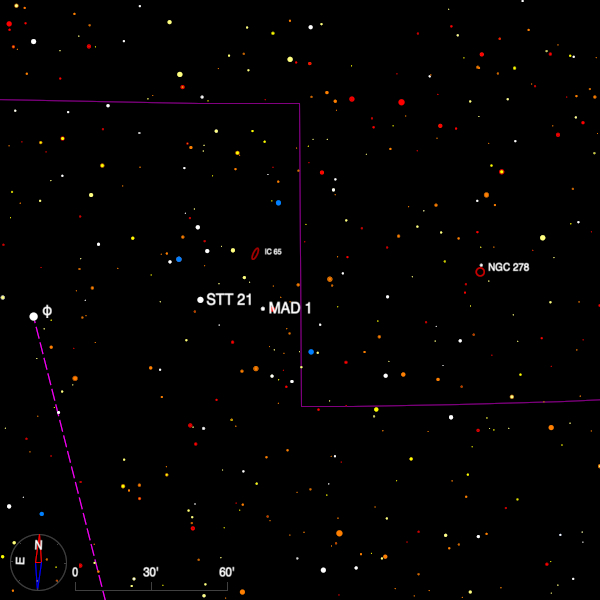
A finder chart for the double stars MAD 1 and STT 21 in Andromeda created with Cartes du Ciel. STT 21 is about 1.5 degrees west of phi And and is now considerably easier to observe than in the 1840s when the separation was 0".6 The current orbit of 450 year period was published by W. D. Heintz in 1966 and predicts a position of 176 degrees and 1".2 for late 2022. The apparent orbit is one of high eccentricity and inclination and the apparent motion appears to be almost linear. The magnitudes are 6.8 and 8.1 and the pair should be resolved in 15-cm aperture.
Johann Madler (1794 - 1874) succeeded F. G. W. Struve as Director of Dorpat Observatory where the main instrument was Fraunhofer's 9.3-inch refractor with which Struve had carried out his great survey of double stars. MAD 1 can be found half a degree west of STT 21. It is a long period binary with main components of magnitudes 7.7 and 9.1. When first observed the separation was 1" but the stars have been closing slowly and at the present time are 0".74 apart in PA 356 degrees, if the 2127 year orbit currently in the catalogue is accurate.
HJ 5437 (00 00 34.35 -53 05 51.8) sits in southern Phoenix 20 arc-minutes to the south-east of the red giant pi Phe (V = 5.1).
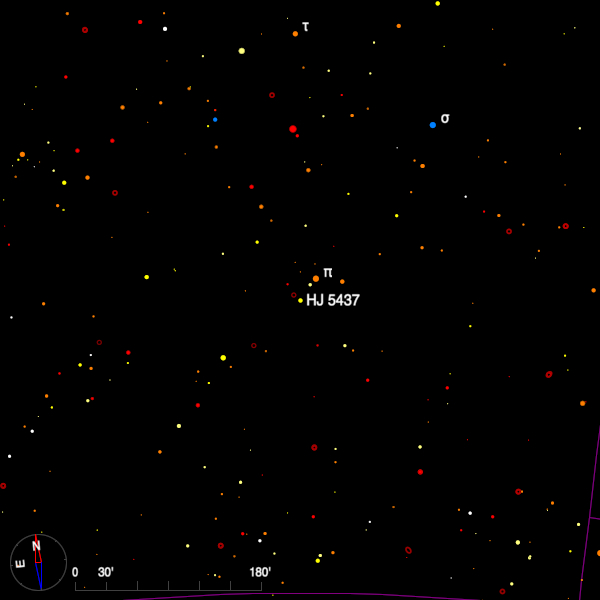
A finder chart for the double star HJ 5437 in Phoenix created with Cartes du Ciel. It is not labelled in the second edition of the Cambridge Double Star Atlas, and was found by John Herschel in 1836 at 340 degrees and 2".5 since then has been slowily closing. In 2019 the stars were at 340 degrees and 1".4 and as the magnitudes are respectively 6.9 and 9.9 this is a rather difficult pair which probably needs at least 20-cm.
Although the observed motion only amounts to 44 degrees, a premature orbit with a period of 904 years is listed in the online USNO 6th orbit catalogue. Incidentally the USNO double star website is back on-line and can be found at crf.usno.navy.mil. The WDS catalogue is available again but the latest update appears to have been about 2 months ago.
Bob Argyle - Double Star Section Director
-
Double Star of the Month - November 2010
In this series of short articles, a double star in both the northern and southern hemispheres will be highlighted for observation with small telescopes, with new objects being selected for each month.
Psi Cas (01 25 55.90 +68 07 48.8) is a pretty triple star found about 8 degrees due north of delta Cas the second left-hand-most star in the 'W'. AC (mags 4.7, 9.2) was found by William Herschel in 1783 and has closed up considerably since then. In 2007 the position was 128° and 20".3, a change which is due entirely to the proper motion of A. Both stars are double again and with a small telescope CD is quite difficult since the components are magnitude 9.4 and 10.0. Burnham found a 14th magnitude companion (B) to A which was last measured in 1970 at separation 2".4 and must be considered beyond the range of most amateur instruments. Chambers gives colours of orange tint, blue and reddish for A, C and D. In 1850 Webb found A orange and C blue.
Beta Phe (01 06 05.11 -46 43 06.6) is a bright visual binary which has been under-observed since it was discovered by R. P. Sellors in 1891 with an 11-inch refractor. It widened to about 1".4 in the mid C20 but then started to close again and was measured occasionally as it closed up with a measure in 1999 giving 258.8°, 0".29. This was the last observation until 2008 and during that time the star passed unobserved through 140 degrees of position angle and more crucially, periastron passage. In 2002 Andreas Alzner calculated the first orbit but more recent measures by Rainer Anton (see JDSO) indicate that a further revision is necessary. This is now in progress. The star is now widening and at the time of writing is around 0".40 so that it should be seen as double in 25-cm on a good night. Steady air is essential since the stars are very bright - magnitudes 4.0 and 4.2. When looking for this pair, take time to look for Slr 2 some 30 arc minutes to the east. It is somewhat wider and fainter but it is doubtless also a long period binary
Bob Argyle - Double Star Section Director
-
Double Star of the Month - February 2008
In this series of short articles, a double star in both the northern and southern hemispheres will be highlighted for observation with small telescopes, with new objects being selected for each month.
This month the two binary systems in question both have late-type giant stars as primaries.
In 1882, using the 12-inch refractor on Mount Hamilton, Burnham found that eta Gem (06 15 52.70 +22 30 24.6) was double and it eventually became number 1008 in his catalogue. In several cases where he discovered very faint and close companions, Burnham tended to underestimate the brightness of the companion. When, for instance, he found alpha UMa to be double (BU 1077) he gave the magnitudes as 2.0 and 11.1 whilst the modern values for A and B, as found by Hipparcos are 1.95 and 4.87. In the case of eta Gem, he estimated A and B to be 3.0 and 8.8 - again Hipparcos notes that B is considerably less faint than Burnham's estimate and gives V equivalent magnitudes of 3.3 and 6.0 with the companion at a distance of 1".1. Since then the position angle has reduced by about 40 degrees and the separation has increased to 1".5. Even in 1961, Hartung was able to see it with 10.5-cm aperture and these days it is somewhat wider than that. The primary, spectral type M3.5I-II is orange but no colour estimate of B is noted.
In the 1880s, astronomers at Sydney Observatory were busy looking at the double stars, including re-observation of those of John Herschel using an 11.4-inch refractor. Under the directorship of H. C. Russell, R. P. Sellors was one of the observers. The WDS shows 24 pairs under his name, the first and brightest of which is beta Phoenicis - a bright, close binary. The second brightest pair is SLR 8, located in Vela at (08 32 04.97 -53 12 43.1). Consisting of stars of magnitudes 6.13 and 7.08 this pair was separated by 0".4 in 1892, widened to about 1" in 1925 and is now closing again. An aperture of 15-cm should show it but there have been no measures since 1991 - an indication of how the southern pairs continue to be neglected. The colours are orange-yellow and whitish, reflecting the spectral types of KOIII and A3. This system is 227 parsces distant according to the revised Hipparcos parallax.
Bob Argyle - Double Star Section Director
-
Double Star of the Month - November 2007
In this series of short articles, a double star in both the northern and southern hemispheres will be highlighted for observation with small telescopes, with new objects being selected for each month.
The two pairs featured this month are both at rather high declinations and hence can be seen for some time either side of this month. Both are unequally bright but easy objects in small telescopes.
Eta Cas = STF 60 (00 49 05.10 +57 48 59.6) Found by William Herschel in August 1779, this beautiful contrasting pair of GO and M0 dwarf stars has been measured on more than one thousand occasions since, and as early as 1906 Thomas Lewis had said that ``in all probability the period does not exceed 233 years". He was wrong - the retrograde motion to date amounts to 250 degrees in 225 years - close on a degree a year - and as the pair is still widening it seems likely that the 480 year period found by Strand in 1969 is much closer to the mark. For 2008.0 the orbit predicts 320.6 degrees and 13.13 arc seconds. The V magnitudes of the stars are 3.52 and 7.36 and at a distance of 5.95 parsecs it is one of the nearest visual binaries to the Sun. The proper motion is 1.22 arc seconds per year and the WDS lists 7 faint field stars within 700 arc seconds, whose distances are changing rapidly as this system speeds past them. Webb and Smyth found the companion purple whilst Sissy Haas notes almond brown.
Zeta Phe - Rmk 2 AC (01 08 23.06 -55 14 45.0) is pair of late B dwarf stars which appear white to observers. Since 1835 the pair has widened from 4 to 6.8 arc seconds whilst the position angle is little changed. The distance would have increased substantially more if the pair were an optical one but at a distance of 85 parsecs this will be a very long period system. For the serious double star observer, there is interest in the faint, close companion to A discovered by Robert Rossiter at Bloemfontein in Dec 1931, and numbered 1205 in the Rst catalogue. This is a binary of about 350 years period as it appears to be moving at about 1 degree a year with the separation fixed at 0.6 arc seconds. The magnitudes of A and B are 4.02 and 6.80 so the pair should be visible in a 30-cm telescope on a good night. It turns out that A is also an Algol system with a period of 1.67 days.
Bob Argyle - Double Star Section Director
