Double Star of the Month in Draco
-
May 2026 - Double Star of the Month
Draw a line between iota and alpha Draconis. Take the midpoint and then move south-west by 1 degree. This will bring you to a field containing two F. G. W. Struve doubles, some 20 arc-minutes apart.
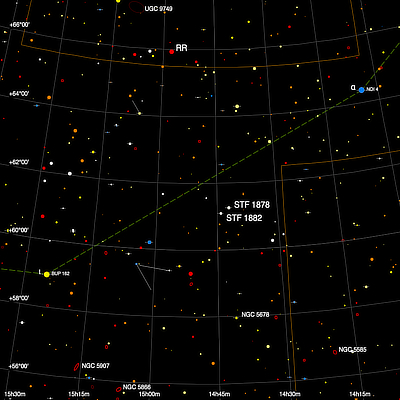
A finder chart for the double stars STF 1882 and STF 1878 in Draco created with Cartes du Ciel. The brighter of the two and also the most western is STF 1882 (14 44 03.55 +61 05 53.7) which consists of stars with visual magnitudes 6.9 and 9.2 currently separated by 11".3 in position angle (PA) 0 degrees. Gaia DR3 indicates that the stars are at similar distances but the the errors on the parallaxes are several times larger than is normal for stars of this brightness which might indicate that there is further structure in the system. The Washington Double Star Catalog also lists a magnitude 10.5 at 37 degrees and 7".2.
The other pair is STF 1878 (14 42 03.25 +61 35 42.9) which is very similar to STF 1882 in terms of the component brightnesses. Here we have magnitudes 6.3 and 9.2 at 313 degrees and 4".0 with the stars closing with decreasing PA since discovery. In this case the components have almost identical parallaxes and small errors indicating that they form a physical system. A is DL Dra, a delta Scuti variable.
Zeta (ζ) Lupi (15 12 17.0 -52 05 57.7), also DUN 176, is a spectacular pair. Zeta is the most southerly of the bright naked-eye stars in Lupus lying about three degrees north of the border with Circinus.
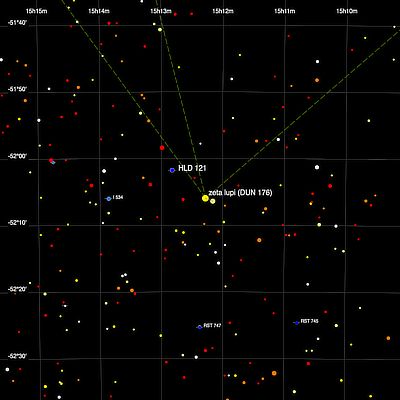
A finder chart for the double stars zeta Lupi (DUN 176) and HLD 121 in Lupus created with Cartes du Ciel. It is a K giant of visual magnitude 3.5 and is accompanied by a F8 dwarf of magnitude 6.7 which is 72" away in PA 249 degrees. The stars lies 114 light-years away using the Gaia DR3 parallax for the fainter component. Although the primary has a similar parallax it is not the same as B within the observed errors which may be due to the brightness of the star or it may have an as-yet undisclosed duplicity. The almost identical proper motions would seem to mark this out as a physical pair. The primary is a KO giant and its companion an F8V which led Ross Gould using 175-mm at x100 to report colours of deep yellow and dull brown-yellow.
Closely north and east is the pair HLD 121 which is now closing from the 3" separation which was measured at discovery in 1882. In 2016 the stars were 2".2 apart in PA 214 degrees.
Bob Argyle - Double Star Section Director
-
July 2024 - Double Star of the Month
The constellation of Draco is draped across 11 hours of Right Ascension and perhaps the most distinctive part of it are the four stars which form the head of the beast. The faintest of these, and the most north-westerly is nu Dra (17 32 16.04 +55 10 22.5). Even a small pair of binoculars will show that it is really two equally bright, white gems, both of visual magnitude 4.9. Discovered in 1690 (by Flamsteed) this beautiful pair is worth seeking out in any aperture.

A finder chart for the double star ν Draconis in Draco created with Cartes du Ciel. The separation is slowly decreasing with time but at the time of writing is still a generous 62". Gaia EDR3 indicates that the stars are essentially at the same distance (98 light-years) and have very similar proper motions. This object forms one of the calibrating standard pairs which I use to convert the settings of the micrometer on the 8-inch Cooke telescope at Cambridge to position angles in degrees and separation in arc-seconds on the sky.
Meanwhile, the stars of Ara sit south of Scorpius and the brighter members resemble a `butterfly' shape. Beta and gamma Ara, at the head of the butterfly, sit a degree apart and have distinctly different hues, thus creating a fine view in binoculars. Beta is red and gamma is blue whilst 4 degrees due south is 3.6 magnitude delta Ara (17 31 05.96 -60 41 01.8).
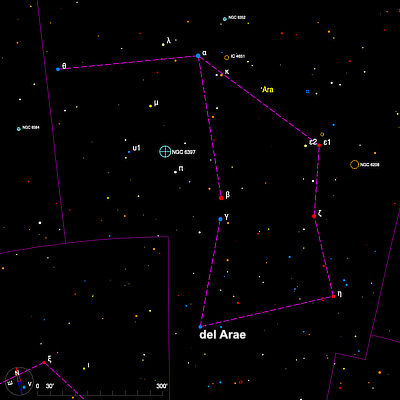
A finder chart for the double star δ Arae in Ara created with Cartes du Ciel. John Herschel noted a distant and faint companion (V = 11) some 40" away and entered the pair as number 4951 in his catalogue. The companion should be visible in 10 or 15-cm and is now somewhat better placed having eased out to a distance of 50".4 in 2016. In 2010 a project involving deep infra-red imaging of stars which may have sub-stellar companions revealed 3 images within 12" whose K magnitudes were between 12 and 14.
Bob Argyle - Double Star Section Director
-
June 2024 - Double Star of the Month
STF 1984 (15 51 10.09 +52 54 25) lies in south-eastern Draco almost on the border with Boötes in a rather featureless part of the sky, which may be why I have no record of observing this pair during my early visual survey.
I did make a measure with the 8-inch Cambridge Cooke telescope giving 279 degrees, 6".4 in late 2009. An aperture of 10-cm should show the two stars which form this system - the magnitudes are 6.9 and 8.9.
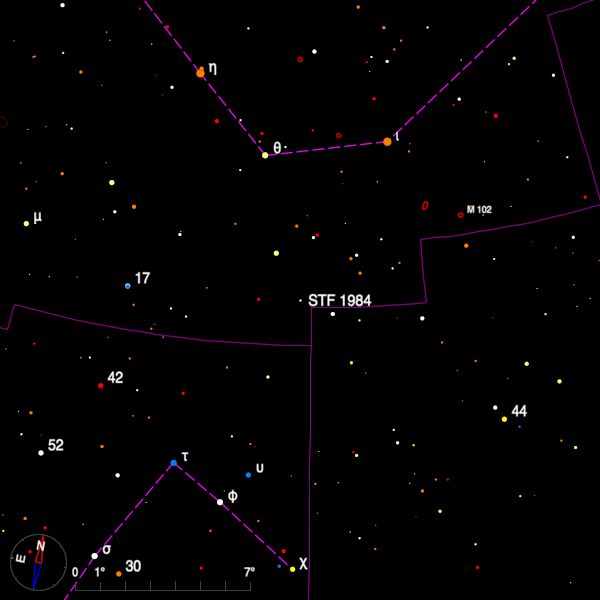
A finder chart for the double star STF 1984 in Draco created with Cartes du Ciel. Although Gaia DR3 places the stars at similar distances (around 370 light-years), the formal errors on the parallaxes are significantly smaller than the parallax difference between the components, so whether the stars form a binary system is open to some doubt.
In May 1874 S. W. Burnham was observing stars in Scorpius with his 6-inch Alvan Clark refractor and more specifically he was looking for HJ 4756 - a close pair discovered by John Herschel some 40 years earlier. He found a pair which vaguely resembled the HJ pair but its position did not correspond very well to the catalogue position so Burnham called the pair BU 228. He later realized that this was indeed the Herschel pair HJ 4756 (15 19 40.37 -24 16 11.9).

A finder chart for the double star HJ 4756 in Libra created with Cartes du Ciel. The stars are magnitudes 7.9 and 8.3 and are currently slowing closing in a 500-year orbit. The current position is 229 degrees and 0".65 so a 25-cm telescope will be needed and more importantly, if observing from Europe, a night of high quality.
Some 30 seconds of RA directly preceding is BU 227, an easier pair which drew from Burnham the comment that
It is singular that he (Herschel) should have missed the other pair
i.e. this one. The stars have magnitudes 7.5 and 8.6 and are currently 2 arc-seconds apart in PA 160 degrees, so should be divisible in 10—15 cm. The stars can be found 3 degrees ENE of sigma Lib.Bob Argyle - Double Star Section Director
-
June 2023 - Double Star of the Month
HU 149 (15 24 35.30 +54 12 46.1) is from the catalogue of William J. Hussey, a well-known observer and discoverer of visual double stars who worked in the USA and who was a leading instigator of the Lamont-Hussey Observatory which was set up in Bloemfontein, South Africa and equipped with a 27-inch refractor with which R. A. Rossiter spent a lifetime on his own catalogue of discoveries.
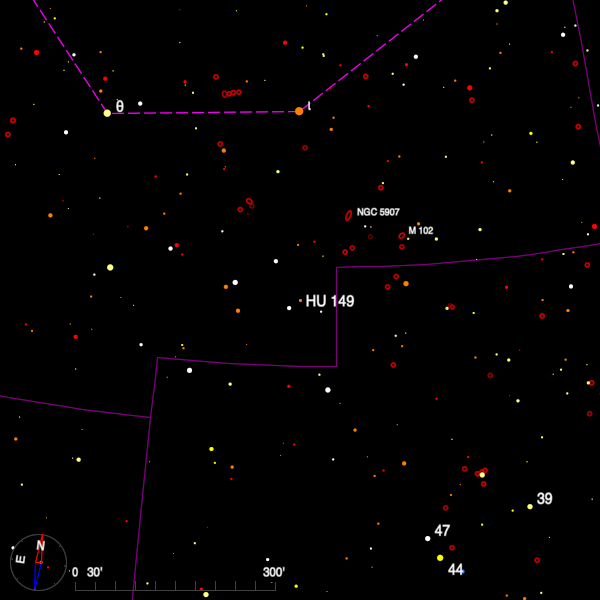
A finder chart for the double star HU 149 in Draco created with Cartes du Ciel. Many of the Hussey pairs tend to be close and difficult and HU 149 was only 0".2 apart when found in 1900, but it has since widened and according to the 770 year orbit of Zirm (2015), the stars should now be about 0".65 apart. A recent measurement by Andreas Alzner with a 32-cm Cassegrain confirms that the separation is close to 0".7. The pair has just passed one of the maximum separations in the apparent orbit and will now close to 0".1 by the 2180s. The stars are almost equally bright at V = 7.5 and 7.6 respectively.
The name Jerome de Lalande appears in the Washington Double Star catalog (WDS) although just 4 pairs appear under his discovery prefix (LAL) - numbers 53, 123, 192 and 193. All are worth looking out for and this month I have chosen LAL 123 (15 33 09.52 -24 29 15.9) which sits roughly half-way between the three bright stars in the head of the Scorpion and sigma Librae.
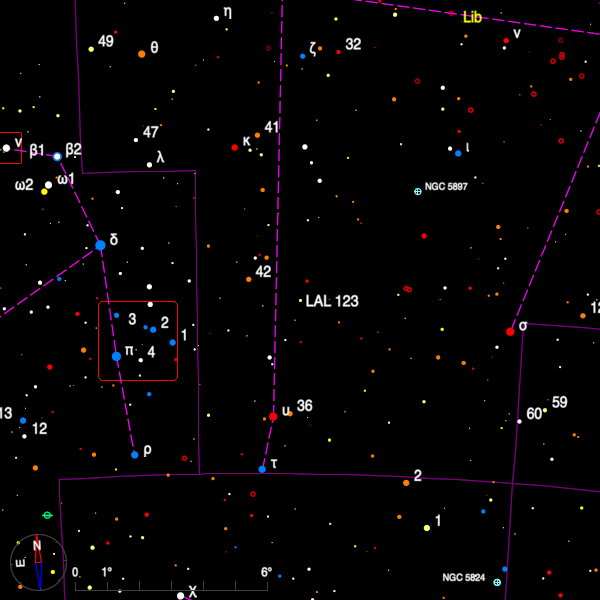
A finder chart for the double star LAL 123 in Libra created with Cartes du Ciel. The stars are magnitudes 6.9 and 7.0 and were 9".3 apart in 2016 at PA 302 degrees. This is an easy object for 10-cm but the possessors of larger telescopes may like to examine the B star more closely. This was found to be double by T.J.J. See and has turned out to be a binary of 61 year period. The pair passes widest separation the next few years and at the moment the stars are just 0".33 apart - calling for at least 40-cm to resolve - and they have visual magnitudes of 7.0 and 8.2.
The A component is an even closer pair and was found by speckle interferometry. CHR 232, at 0".1 and a period of 16.47 years, is beyond all but the largest apertures especially as there is almost a two magnitude difference in the brightness of the components.
Bob Argyle - Double Star Section Director
-
June 2020 - Double Star of the Month
In this column for July 2013, I included the difficult pair 26 Dra. One of Burnham's discoveries at the time of writing it was closing and by mid-2020 it will be widening (186 degrees, 0".5) but will still probably require 30-cm and a good night as the stars are almost 3 magnitudes apart.
Attention this month turns to STF2218 (17 40 18.07 +63 40 31.4) which is 2 degrees N of 26 Dra and slightly E. Discovered at Dorpat by F. G. W. Struve this pair has been closing slowly over two centuries but is still within range of 10-cm. The components are magnitudes 7.1 and 8.4 and at 2020.5 they can be found at 307 degrees and 1".4. The orbit is preliminary as the angular motion amounts to just 50 degrees and predicts a period of 2130 years.
R. T. A. Innes used a 7-inch refractor at the Cape Observatory around 1900 to survey the sky for new double stars and to take up work again which he was doing as an amateur astronomer in Australia about 5 years before.
One of his discoveries was I 333 (15 39 55.12 -78 01 38.1), a relatively bright and easy pair with magnitudes 6.9 and 7.5 and 0".8 apart when he happened upon them. He was not the discoverer though. This was Solon Bailey who found the pair from Arequipa in Peru in July 1897 but the observation did not get published until 1908 so Innes got the credit.
When Willem van den Bos made a pair of mean measures from Johannesburg around 1930 the stars were just 0".3 apart and clearly in rapid motion. The WDS Observations Catalogue then reports no further observations until 1990, a stretch of almost 60 years. By then they stars were almost back to where they were discovered and it seems that here is a binary with a period of about 150 years.
I 333 was brought to my attention by Andrew James who had noted the probable binary nature of the pair and at my request Rainer Anton secured a measure in Namibia in mid-2019. His result was 323 degrees 0".85.
Like iota Octantis in April this pair is close to the South Pole but should repay observation with 15 or 20-cm.
Bob Argyle - Double Star Section Director
-
July 2019 - Double Star of the Month
STF 2398 (18 42 46.69 +59 37 49.4) is a pair of M dwarfs whose large proper motion has been known for well over a century. It was inevitable that the stars would be shown to be close to the Sun, and such indeed has proved the case.
Gaia DR2 puts the primary star at 11.487 light-years whilst B comes out at 11.490 light-years, with formal errors of 0.002 and 0.004 light-years respectively. The large proper motion of 2.3 arc-seconds per annum means that two fainter and unassociated field stars (C = mag. 12.2 at 158 degs, 215", 2000) and D (13.5 at 110 degs, 100", 2008) are being rapidly left behind.
The current orbital period is 408 years and in mid-2020 the companion can be found at 182 degrees, 10".9. This pair needs 20-cm to see well, but the writer has yet to measure it with the Cambridge 8-inch as the red field illumination tends to swamp the stars; 30-cm might show the colours of orange-red. it can be found 1 degree west and slightly north of omicron Dra, itself a colourful pair worth seeking out (4.8, 8.2, 317 degs, 38") which Burnham calls orange and blue and Haas finds yellow peach and clear grey.
Just 3 degrees north of Antares and a little proceeding is the naked-eye star rho Ophiuchi (16 25 35.03 -23 26 47.0). This beautiful pair, whose components are magnitudes 5.1 and 5.7, is currently 3".0 apart in PA 334 degrees and has been slowly closing since discovery by Herschel with the position angle decreasing by 30 degrees over the same interval.
Whether it is binary is not yet fully established, as the measures of distance by Gaia as given in the DR2 catalogue show that the parallaxes just overlap within the quoted errors but the proper motion of B is significantly larger than that of A.
The stars are 467 light-years away putting it about 40 light-years beyond the rho Ophiuchi dark cloud which lies 1 degree to the south.
Rho has a number of faint companions - C is 7.3 at 0 degrees, 149" and D is 6.8 at 252 degrees, 156"; both distances are slowly reducing. S. W. Burnham divided D into stars of 6.8 and 8.4 which are currently 0".28 apart in a binary orbit which takes 675 years.
Bob Argyle - Double Star Section Director
-
March 2019 - Double Star of the Month
During his work at Pulkovo using the 15-inch refractor to survey for new pairs, Otto Struve came across 256 wide pairs (with separations between 32" and 2', and by no means all new discoveries) which he collected an published in an Appendix catalogue. Many are rather faint and uninspiring but several are worth seeking out. One such is STTA 123 (13 27 04.7 +64 44 07.6) in Draco, found about 4 degrees preceding Thuban (alpha Dra).
The stars are given as yellowish and blue together with the description
striking object
in the Dover edition of Celestial Objects for Common Telescopes, Volume 2. Although Sissy Haas calls both stars solid blue, Simbad gives the spectral types of both stars as F0.Even though they are separated by 69" at position angle (PA) 145 degrees, the stars are identically distant within the errors in the parallax as determined recently by Gaia DR2 and the mean distance is 225.87 light-years with an error of 0.01 light-year. The WDS lists an additional faint companion of magnitude 12 at 95 degrees and 39".
Three and a half degrees east of the 1.8 magnitude gamma Velorum, and the same distance south of the Vela Supernova Remnant is A Velorum, although on the Cambridge Double Star Atlas (2nd edition) it appears only as HJ 4104 (08 29 04.76 -47 55 44.2).
This is a bright triple, the closer pair (AB) are magnitudes 5.5 and 7.2 and they were separated by 3".5 at PA 244 when I measured them in 2008; both quantities are slowly increasing with time. At 19" and 39 degrees (2008) is a magnitude 9.2 star.
In 1951, W. S. Finsen, using his eyepiece interferometer on the 26.5-inch refractor at Johannesburg found that the primary was double at a distance of 0".1. Recent measures have shown that this a binary of high inclination and the projected period is 340 years. If the orbit is correct the apparent separation reaches only 0".25 before falling back again.
Whilst the easily resolvable components appear to be early B stars, Ernst Hartung found the AB pair to be pale yellow. More recently, and also from Australia, Ross Gould, using 175-mm, notes only that the primary is pale yellow but confirms that the triple is embedded in an interesting field.
All three components appear to be equally distant - 1600 light years away, according to Gaia DR2.
Bob Argyle - Double Star Section Director
-
July 2016 - Double Star of the Month
39 Dra (17 57 12.56 -30 22 24.80) can be found about 4 degrees following and slightly north of xi Dra in the 'head' of Draco. It is also known as b Dra.
The binocular user will see a pair of mag 5.1 and 8.0 stars separated by about 89". Any aperture larger than 6-cm will show the companion to A which William Herschel found in 1780 and allocated to his class 1 i.e. between 0 and 2". Since that time the pair has widened with increasing position angle and in 1993 was found at by the writer at 351° and 3".9. The AB stars are magnitudes 5.1 and 8.1 so it requires good seeing to see B clearly.
This is a quintuple system since all 3 bright stars are physically connected and both A and B are spectroscopic binaries. Surprisingly, although the motion in AB amounts to just 25 degrees in 230 years, a highly speculative orbit with a period of 3962 years appears in the USNO Sixth Orbit Catalogue.
In October 2011, John Nanson found
the primary was a distinct yellow watered down by a weak touch of white, I could see a slight tinge of blue in "B" and "C" was just weakly white
. There is much more information on this system on the Starsplitters website.PZ 6 (17 59 05.28 -30 15 10.8) is a beautiful pair which lies about 1.5 degrees due west of gamma Sagittarii. In the 1st edition of the Cambridge Double Star Atlas it is given as PZ 4 but is corrected to PZ 6 in the second edition.
An observation of this pair on the evening of 5 September 2013 using the Johannesburg refractor showed the colours of the stars to be deep yellow and lilac.
The WDS gives spectral types M1Ib and G8II so this is a rare pairing of a supergiant and a giant. There is little motion between the two stars and the primary star sits a little over 1,000 light years away but with an uncertainty in the distance of 30%.
The stars are magnitudes 5.4 and 6.0, and the current separation of 5".7 appears to indicate that the stars have been slowly closing since the first measure in 1826. A 13.2 mag star at 25" was measured by the writer in September 2013.
By moving the telescope another 1.5 degrees further west, and crossing the border from Sagittarius into Scorpio, the observer will come across PZ 5 - another bright wide pair easily resolvable in a small aperture. The stars are mags 6.7 and 8.2 and both white - the spectral types are A3 and B9. Note, however, that PZ 5 is not labelled in CDSA 2 whilst it is in the first edition. The position in 2013 as determined by the writer was 104° and 5".7. On the same night a mag 11 companion was also noted at a distance of 49".
Bob Argyle - Double Star Section Director
-
June 2016 - Double Star of the Month
16/17 Dra (16 36 13.72 +52 55 27.8) is a 90" binocular pair to be found about 15 degrees preceding the head of Draco and the stars are of magnitude 5.4 and 5.5. William Herschel noted that A itself was a rather unequal but easy pair 4" apart, and he included it is his 1782 catalogue as H I 4. He reported that
It is the star to which a line drawn from nu through mu points, at nearly the same distance from mu as mu from nu
. The brighter star was recorded as white whilst the fainter was 'white inclining to red'. In mid-2015 the writer found the position angle 106 degs and the separation 2".9. The angular motion is but 8 degrees and the stars have closed up from 4" at discovery. All three components appear to be physically connected.COO 197 (16 25 17.59 - 49 08 52.2) is a rather faint pair (mags 8.1 and 8.2) in southern Norma, near the border with TrA, which appeared in the catalogues of stars compiled at Cordoba Observatory.
It was first measured as double by R. P. Sellors at Sydney in 1895 using the 11.5-inch refractor. It was found to be in slow direct orbital motion and in 1977 an orbit was calculated with a period of 311 years. In 2008 the writer observed it with the large refractor in Johannesburg and at that time the observed position angle and the calculated value differed by more than 20 degrees. Andreas Alzner then performed a re-calculation of the elements of apparent orbit and found that the period was much longer (1132 years). In mid-2016 the stars will be found at 93 degs and 2".3.
In recent years, observations of this system with high resolution techniques and large telescopes have revealed that it is quite a complex multiple star. Using the NACO infra-red camera on one of the 8.2-metre VLT telescopes in 2004, Chauvin and colleagues found that B was again double at a distance of 0".1. The image in the journal shows the two stars clearly separated, but nearby star A appeared single. However, in 2014 Andrei Tokovinin also resolved A into two unequally bright stars separated by 0".1. It appears likely that there is also a spectroscopic sub-system in either Aa or Ab but which of the stars it can be pinned to is not yet determined. A 12th mag star now at 77 degs and 20" is being left behind.
Bob Argyle - Double Star Section Director
-
June 2015 - Double Star of the Month
Two bright double stars, each with its own observational difficulties, feature this month.
In the constellation of Draco, eta Draconis (16 23 59.51 +61 30 50.7) is circumpolar for observers in the UK but as a classical refractor user I find it is easiest to observe when in the north-west in the early evening. The primary is a G8 giant (V = 2.8) which is 92 light years distant and as a relatively nearby object it has attracted the attention of the astronomers wishing to determine its diameter. The result is that it is a shade under 10 million miles in diameter or about 11 solar diameters. The mag. 8.2 companion was first noted by Otto Struve at Pulkova in 1843 and he found it at PA 150° and separation 4".4. Since then it has moved retrograde by 11 degrees and the separation has slightly increased. I measured the pair on 4 nights in 1994 but in recent years have not been able to see the companion. The primary is also recorded as being variable so here is a pair to keep an eye on.
epsilon Lupi (15 22 40.89 -44 41 22.5) first attracted the attention of James Dunlop from Paramatta as a fine unequal and wide pair (DUN 182 AC). The stars are magnitudes 3.6 and 9.1 and today are separated by more than 26", a considerable increase on Dunlop's figure of 19". When Ralph Copeland, who later became Astronomer Royal for Scotland, visited the Andes with a 6-inch refractor for site-testing purposes, he found the primary star was a close and unequal pair which has since turned out to be a binary of period 319 years. Star B, mag 5.1, ranges in distance from A between 1".2 (as in 1834) to 0".18 (in 2026); in 2015 the pair are separated by only 0".26 and needs a large aperture. More recently, in a survey of stars in the Sco-Cen-Lup-Cru association, Rizzuto and colleagues, using the Sydney University Stellar Interferometer (SUSI) found another star of magnitude 5.1 but closer in at a distance of 0".05. It is not clear whether this is the known spectroscopic binary component of A (which has a period of 4.55 days), but epsilon appears to be at least a massive triple system.
Bob Argyle - Double Star Section Director
-
Double Star of the Month - July 2013
In this series of short articles, a double star in both the northern and southern hemispheres will be highlighted for observation with small telescopes, with new objects being selected for each month.
S W Burnham discovered 26 Dra (17 34 59.58 +61 52 28.4) using the 18.5-inch refractor at Dearborn Observatory in 1879. It was soon apparent that this was a binary system because the large proper motion of the primary star (almost 0".6 per year) was clearly shared by the faint and close companion. Along with many of the other similar pairs he discovered, Burnham substantially underestimated the brightness of the companion, and gave the magnitude of the stars as 5.5 and 10.1 is his General Catalogue of 1906. The WDS gives 5.28 and 8.54 and I saw the comes perfectly well with the 8-inch Cooke refractor at Cambridge in summer 1999. At that time the separation was 1".6 but the pair is now closing quickly and it will take a larger aperture to see them in 2013 when the separation is 0".65. The large proper motion is a consequence of the proximity of this star system. The Hipparcos catalogue gives a revised parallax of 70.47 mas which corresponds to 46.3 light years with a quoted error of 0.24 light years. To find it, draw a line between beta and nu Draconis in the head of the Dragon and extend the line twice as far again.
See 342 (17 53 23.47 -34 53 42.5) is also a close pair requiring a reasonable aperture to resolve, but it does have the additional attraction of being embedded in the open galactic cluster M7, close to the tail of Scorpius. Since discovery in 1897, the pair has moved in retrograde fashion by 80 degrees whilst the separation has remained close to 0".4. A provisional orbit by Andreas Alzner puts the period at 700 years and its parallax places it at the distance of M7. A good chart for identifying See 342 is given in Burnham's Celestial Objects Volume 3, page 1712. It is #1 and is located at the SW corner of the cluster. Robert Burnham quotes magnitudes of 6.5 for each star whilst the WDS lists 5.85 and 7.89 which also seems too unequal. Recent measures by Tokovinin give a delta m of 0.3 to 0.4. The primary star is a K giant and a spectroscopic binary.
Bob Argyle - Double Star Section Director
-
Double Star of the Month - July 2010
In this series of short articles, a double star in both the northern and southern hemispheres will be highlighted for observation with small telescopes, with new objects being selected for each month.
Located close to the head of the Dragon, mu Dra (17 05 20.12 +54 28 12) is a long period binary system, first found by William Herschel in 1781. With a period of 672 years, the apparent separation of the two stars ranges from 2".0, which last occurred about 40 years ago, and 5".7. At the present time it is almost 2".4 apart at position angle 5°. With components of magnitudes 5.66 and 5.69 the star is easily visible to the naked-eye and is an excellent target for small telescopes so it is included in James Mullaney's One Hundred Showpiece Double and Multiple Star list, where he gives the colours as yellowish-white. Sissy Haas also notes the stars as goldish-white, but Smyth sees them only as white. There is evidence for a spectroscopic companion to B which may be bright and wide enough to be resolvable in the optical, and there is a mag 13.7 star at 12" may also be part of the group. The system lies at a distance of 90 light years.
Nu Scorpii (16 11 59.27 -19 06 53) is the southern equivalent of the Double-Double in Lyra, although the brighter pair is more difficult to divide than its northern equivalent, and as a consequence at least 150-mm is needed to see the four components clearly. The wide pair catalogued by Herschel as H V 6 consists of white stars of magnitude 4.2 and 6.0 separated by 41". In 1846 Mitchel, using an 11-inch refractor in Cincinnati, resolved the companion into two stars about 1".3 apart. Burnham then discovered that the primary was also double with his 6-inch Clark in 1873 when the separation was around 0".6. Since that time both pairs have slowly widened and the current values are 1°, 1".3 for A and 55°, 2".3 for B. This is a physical system of high multiplicity since A is double again at the sub-0".1 level and there is also a spectroscopic component of 5.5 day period. The writer has measured both bright pairs from the UK with 20-cm but it needs a night with very steady air to do this.
Bob Argyle - Double Star Section Director


