Double Star of the Month in Cetus
-
November 2024 - Double Star of the Month
George Knott was a Victorian amateur astronomer with an interest in double stars. Using a 7.3-inch Clark refractor which once belonged to W. R. Dawes at his observatory in Cuckfield, West Sussex, he made a number of discoveries, five of which can be found in the current Washington Double Star catalog.
The primary star of KNT 1 (01 02 18.34 +81 52 32.1) is the variable star U Cephei. It is an eclipsing binary with a period of 2.5 days and in mid-eclipse the star drops by almost three magnitudes. At maximum, it is V = 6.7 and has a faint companion of magnitude 11.8 some 14" distant in PA 63 degrees.

A finder chart for the double star KNT 1 in Cepheus created with Cartes du Ciel. Rather surprisingly both stars lie at the same distance (632 light-years) and have very similar proper motions. A slighter fainter, and definitely unconnected, third star can be found at PA 315 degrees (increasing) and 24" (decreasing).
Another pair of stars with a variable primary is HJ 3476 (02 00 26.77 -08 31 25.8). This is AR Cet which is probably a semi-regular variable. John Herschel swept them up from Feldhausen and noted
Large star very yellow
. The primary is an M3 giant and its catalogue magnitude is given as 5.7 with the companion 61" away in PA 202 degrees. Herschel noted magnitudes 6 and 10.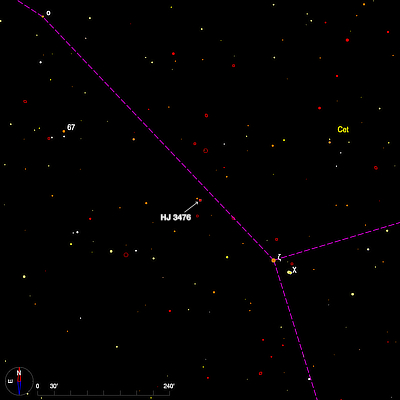
A finder chart for the double star HJ 3476 in Cetus created with Cartes du Ciel. The position angle has reduced 20 degrees since discovery but this is due to the proper motion of the primary star which is 536 light-years away whilst its faint companion lies 2160 light-years distant.
HJ 3476 lies about 3 degrees NE of zeta Cet which is also known as Baten Kaitos. This, too, is a very unequal and wide double with the components of 3.8 and 10.5 being divided by 106".
Bob Argyle - Double Star Section Director
-
November 2023 - Double Star of the Month
In the western reaches of Andromeda, about 10 degrees north of the faint naked-eye shape of Triangulum sits the glorious double star gamma Andromedae (see the entry for Dec 2006).
Move 3.5 degrees SSE and 59 And (02 10 52.83 +39 02 22.4) will appear in the field of view. This is a fine pair for the small telecope, the magnitude 6.0 and 6.8 components being currently separated by 16".6 and position angle 36 degrees.
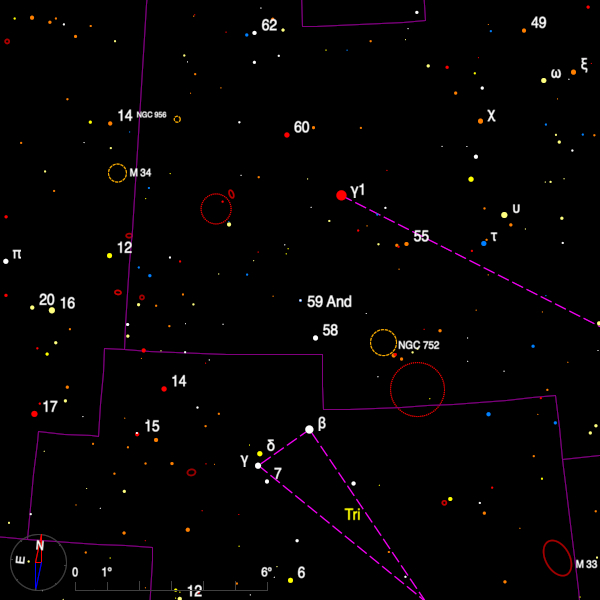
A finder chart for the double star 59 And (STF 222) in Andromeda created with Cartes du Ciel. Although it is usually known as STF 222, it was noted by William Herschel in July 1783. He noted the stars were reddish white and pale red and catalogued it as H 4 129. Herschel also noted a third star in view about 58 or 60 degrees south proceeding. In 1968 I noted a `superb' pair with colours of white and lilac. More recently Sissy Haas calls the colours of the stars pearl white and peach white.
Gaia puts both stars at the same distance within the observational errors - 438 light-years.
The United States Naval Observatory in Washington has a history of carrying out stellar astrometry which stretches back 150 years. During this long history they have occasionally noted new double stars which appear in the Washington Double Star catalog (WDS) under the catalogue name WNO.
The first entry in this list, WNO 1 (00 53 12.46 -24 46 37.0), was found in 1876 and is a rather unequal pair (6.6, 8.9) which has moved very little since the first measurement. It is currently at 7 degrees and 5".4.
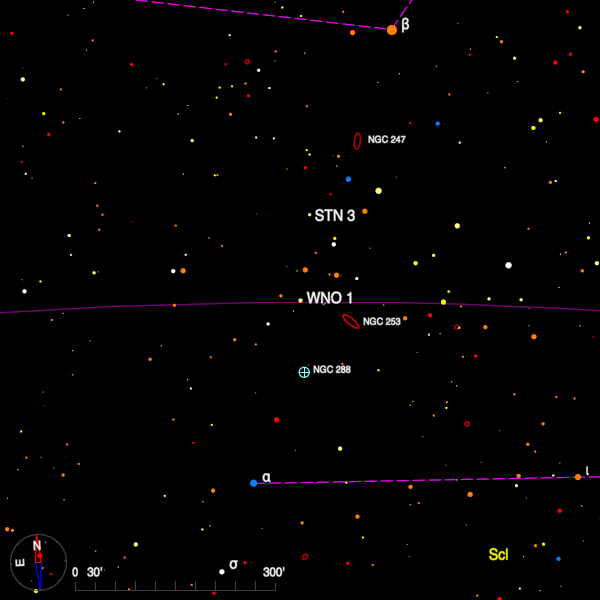
A finder chart for the double star WNO 1 in Cetus created with Cartes du Ciel. The pair lies in Cetus about 1.5 degrees ENE of the bright spiral galaxy NGC 253. About 2.5 degrees N of WNO 1 is STN 3, another pair worth looking at. It has been closing since discovery in 1877 - 7.6, 8.4, 240 degrees, 2".
Bob Argyle - Double Star Section Director
-
November 2021 - Double Star of the Month
On the border of Andromeda and Cassiopeia, about 15 degrees north-west of gamma And, is the naked-eye star phi And (01 09 30.12 +47 14 30.6). This has long been known as a close and difficult visual binary, having been discovered by Otto Struve at Pulkova in the 1840s.
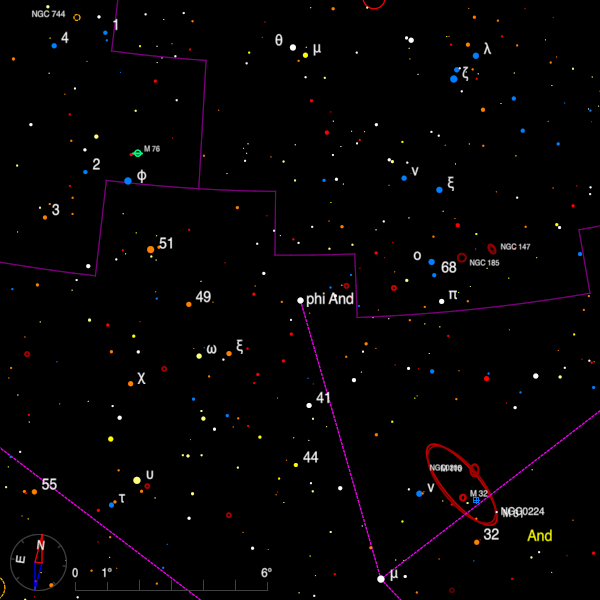
A finder chart for the double star phi And in Andromeda created with Cartes du Ciel. The orbital period is long, a recent estimate put it at 554 years, but at present it is slightly wider than 0".5 and is thus within range of 25-cm, although 20-cm might well show an elongation. The stars are not equally bright, the Washington Double Star Catalog (WDS) gives values of 4.6 and 5.6 for the magnitudes.
Within 2 degrees of phi there are three other double stars marked in the Cambridge Double Star Atlas, 2nd edition. Two of these (MAD 1 and STT 21) will be discussed in this column next year.
The other is BU 397 which lies 40' south-west of phi. The stars are magnitudes 7.5 and 10.3 at PA 142 degrees and separation 8".7. This pair was actually discovered by John Herschel, but S. W. Burnham noted that Herschel had made an error of 1 degree in declination. Burnham also added a fainter and more distant star - 12.9 at 72 degrees and 19".3.
66 Cet (02 12 47.54 -02 23 37.1) is a beautiful wide pair to be found 1.5 degrees WNW of Mira Ceti, the famous long period variable star. Mira reached maximum brightness in August 2021, so judging by previous light curves it is expected to be about V = 7.5 by mid-November.
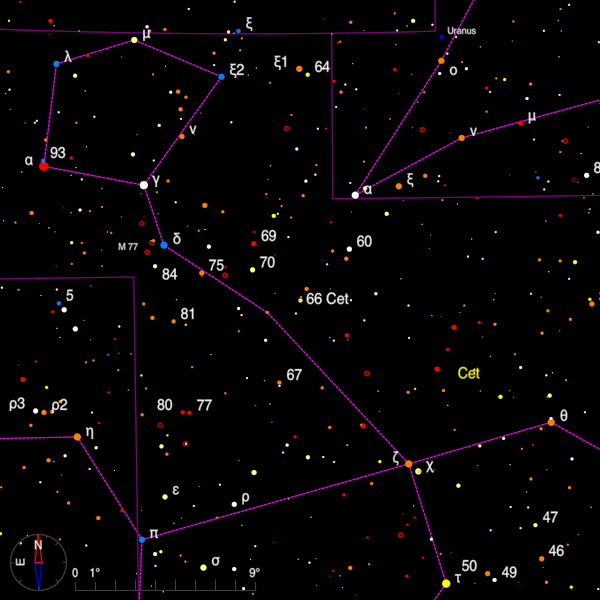
A finder chart for the double star 66 Cet in Cetus created with Cartes du Ciel. 66 Ceti has stars of spectral types F8V and G1V and visual magnitudes 5.7 and 7.7. The position angle of 235 degrees and separation of 16".8 has remained unchanged since 1783 when the pair was noted by William Herschel. This is almost certainly a physical pair, since in addition to very similar parallaxes the two stars have the same considerable proper motion.
In addition, the A component, which was known to be a spectroscopic binary, has recently been resolved by Dr. Andrei Tokovinin at Cerro Tololo using the 4 metre SOAR telescope, The period is 94 days and the angular separation is under 0".02.
A more distant star of V = 11.5 is optical. I found the primary stars to be yellowish and lilac with a 21-cm reflector.
Bob Argyle - Double Star Section Director
-
November 2019 - Double Star of the Month
STF 79 (01 00 03.56 +44 42 47.7) This is a beautiful, easy pair in Andromeda about 4.5 degrees north-east of M31. It was missed by William Herschel on his first two surveys for new double stars but swept up eventually in 1786 and is catalogued as H N 45.
Sissy Haas notes that the stars are pearly white and pale blue-violet. When I last observed it in 1968 I recorded it as 'bluish-white and bluish(?)' in a 21-cm reflector at x96. Strangely it has not been measured with the Cambridge telescope at all, although an easy object and with the stars of magnitudes 6.0 and 6.8, and the current position is 195 degrees and 7".9.
An image of the pair appears on the Asociacion Astronomica de Hubble website. The observer JCS noted that the stars appeared to be a delicate shade of sky-blue and there did not appear to be any contrast between them.
Both stars are spectroscopic binaries and probably form a quadruple system. DR2 places them 494 light years away.
H 2 58 (01 59 00.72 -22 55 11.2) is in Cetus, about 0.5 degree south-east of 56 Cet. It is one of William Herschel's discoveries. He noted that the stars were considerably unequal but the WDS gives 7.3 and 7.6 and Gaia gives a magnitude difference in the G band of just 0.17. Herschel also gave both colours as dusky white and the spectral types are A7 and G0 according to the WDS.
Found at 315 degrees and 5".0 in 1782, the stars had widened to 8".3 in 2015 with the PA decreasing to 302 degrees. More recently, the primary was found to be a W UMa ellipsoidal eclipsing binary system which is now known as AA Cet. The period of variation is 0.536 days and the magnitude range is 6.2 to 6.7. Both stars are given as F2 in the Catalogue of Eclipsing Variables by Avvakumova (2013).
Bob Argyle - Double Star Section Director
-
November 2018 - Double Star of the Month
As a by-product of his survey at Dorpat for new double stars F. G. W. Struve came across hundreds of pairs which were very wide, and obviously of not much significance. He consequently placed them in two appendix catalogues - now denoted by STFA and STFB in modern WDS parlance.
His son, Otto also compiled a catalogue of wide pairs which he happened across during his searches and which appear in the Washington Double Star Catalog (WDS) as STTA. Most of these pairs can be seen in binoculars but some of them are quite attractive and worth seeking out.
One such pair is STTA19, also known as S 398 (01 28 22.92 +07 57 40.9). It is 3.5 degrees East of the attractive bright pair zeta Psc. The WDS gives magnitudes of 6.3 and 8.0 and the K1 giant primary appears orange, although T. W. Webb calls it rosy, whilst the companion is 'bluish'. W.H. Smyth found yellow and pale blue.
Modern observations have shown that there is more to this system than meets the eye. Gaia DR2 indicates that the stars are at the same distance (391 light years) from us and moving through space with the same considerable proper motion of more than 0".1 per year. In addition the B star is a close pair which has moved about 30 degrees in Position Angle (PA) since discovery in 1999. The separation is currently about 0".4 whilst the components are mags 8.1 and 11.9.
Some of the more interesting and difficult visual binaries were found by the Clark brothers, Alvan and Alvan G., during the course of testing some of their objectives on stars.
In 1853 Alvan was assessing the performance of a 7.5-inch objective when he alighted on 95 Cet = AC2 (03 18 22.43 -00 55 49.0) and noted it had a faint and close companion. When William Rutter Dawes heard about this his interest was aroused. The following year Dawes met Clark during the latter's visit to England and bought the objective and telescope.
Dawes soon looked at 95 Cet and was able to measure the new companion which was at 73 degrees and 0".7. What made it hard to measure was the significant difference in magnitude.
After Dawes' observations, made on three nights, there were no further measures for 30 years according to Burnham. The American master relates how he spent many nights with various apertures only to find no trace of the companion and he succeeded only once, in 1888, in seeing the B star.
By 1900 even Aitken with the Lick 36-inch could not see the companion. It has long been suspected that the B star is variable, which would explain some of the negative results.
Modern observations show that the visual magnitude difference is between 2 and 3, but currently the stars are close to maximum separation (2019.0, 260 degs, 1".18) and this represents a good opportunity to divide the pair; it probably requires 20-cm and a night of fine seeing.
Bob Argyle - Double Star Section Director
-
December 2017 - Double Star of the Month
The two pairs selected for December are both wide, unequal double stars.
WEB 2 (03 42 42.73 +59 58 09.8) appears in the first edition of Celestial Objects for Common Telescopes. In it, Webb calls the primary star P III 97 and in examining Piazzi's Palermo Catalogue you will find that Piazzi did indeed record the primary star and also the secondary. He adds a note saying
another telescopic (star) follows to the north
, so this is, in fact, a discovery by Piazzi.Webb was almost certainly drawn towards this star because of his abiding interest in red stars. His notes say
orange with scarlet blaze and bl(ue).
for the colours of the components which is a good enough reason to observe this pair.The magnitudes are 5.7 and 8.9 and the current position of B is 33° and 54 arcseconds but there is no evidence that the stars are are in any other way connected. Espin added two fainter, closer stars in PA 33° and 98° and there is an 11.8 magnitude at 168 arcseconds along PA 162°.
WEB 2 is close to STF 385, STF 389, STF 396 and STF 400, 15 degrees due north of Mirfak (alpha Per).
H 3 80 (02 26 00.38 -15 20 28.0) is in Cetus in a fairly sparse area of sky about 12° south of Mira, 1.5 degrees preceding σ Ceti towards τ Ceti.
Herschel came across this pair on October 13th, 1782. He measured the distance as 11.2 arcseconds and the PA at 292°. There has been little change in either coordinate since then.
The stars are magnitudes 5.9 and 9.1 and the primary is a A star although William Herschel called it reddish white, whilst the companion appeared bluish-red to him.
The primary star (AB Ceti) is both a spectroscopic binary and a member of the Alpha2 CVn class of variables. These are main-sequence stars which display strong magnetic fields and whose spectra show abnormally strong lines of Si, Sr, Cr, and rare earths. They exhibit magnetic field and brightness changes and the amplitudes of the brightness changes are usually no greater than 0.1 magnitude in V.
Bob Argyle - Double Star Section Director
-
Double Star of the Month - November 2008
In this series of short articles, a double star in both the northern and southern hemispheres will be highlighted for observation with small telescopes, with new objects being selected for each month.
This month's pairs are just visible to the naked eye - each being V=5.6
65 Psc (00 49 53.1 +27 42 37.1) was found by William Herschel in 1783 and is one of the showcase pairs listed by Sissy Haas in her publication Double Stars for Small Telescopes. She finds the two stars to be citrus orange in colour with a 60-mm refractor; Webb found them yellowish and Smyth says both are pale yellow. This would accord with the spectral types which are given variously as gF0 and gF2 (Burnham) and F4III and F5III in Hartung. The system is 273 light-years away and since the first measure the position angle has decreased only 5 degrees with the separation increasing from 4".0 to 4".3. Clearly it is a binary of very long period as the proper motion of almost 0".1 per year for the primary would have separated the stars by 20" today if they were unrelated.
BU 395 in Cetus (00 37 19.79 -24 46 02.0) is one of the most interesting of Burnham's discoveries. Found using the 6-inch Clark in 1875, it has turned out to be a short period system. The period is 25.09 years and the orbital plane is highly inclined so that the separation varies from 0".17 in 2006 to 0".77 in 2015. At present (2009.0) the stars are separated by 0".37 affording those with 30-cm aperture the chance to test the resolving power of their telescope.
By 2010.0 the pair widens to 0".48. The star has also been observed as a double-lined spectroscopic binary with the spectral types given as G8V and G9V. Hipparcos places the system some 50 light-years away and the proper motion carries it about 1".5 annually almost exactly east-west across the line of sight.
Bob Argyle - Double Star Section Director


