Double Star of the Month in Canis Minor
-
February 2022 - Double Star of the Month
To the naked eye, Canis Minor is essentially two stars - Procyon and beta (or Gomeisa). In the field with Procyon is STF 1126 which has already been described in this column (Feb 2014). Starting at Gomeisa, move 1.5 degrees due south and slightly east and you will alight on eta CMi (07 28 02.1 +06 56 32), a magnitude 5.3 star. It is also known as BU 21, the low number indicating it was in the first list of discoveries, made with the famous 6-inch Clark refractor, which S W Burnham published in 1870.
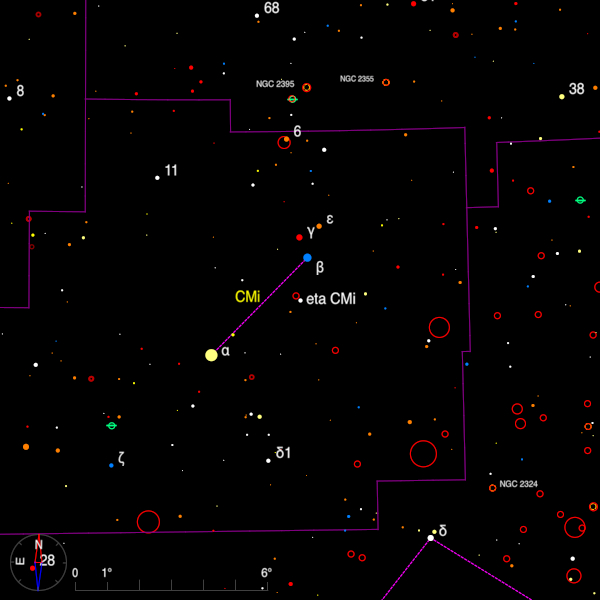
A finder chart for the double star eta Canis Minoris created with Cartes du Ciel. The Washington Double Star Catalog (WDS) gives the magnitude of B as 11.1 and the latest measures places it 4".3 from the bright primary. Gaia EDR3 tells us that the stars are at the same distance from us, within the errors of measurement i.e. 319 light-years, and that the proper motions are almost identical.
Two and a half degrees south of eta CMa (Aludra) is an equilateral triangle of 5th magnitude stars, the north-easterly of which is a fine triple for medium apertures and a difficult quadruple for 30-cm upwards.
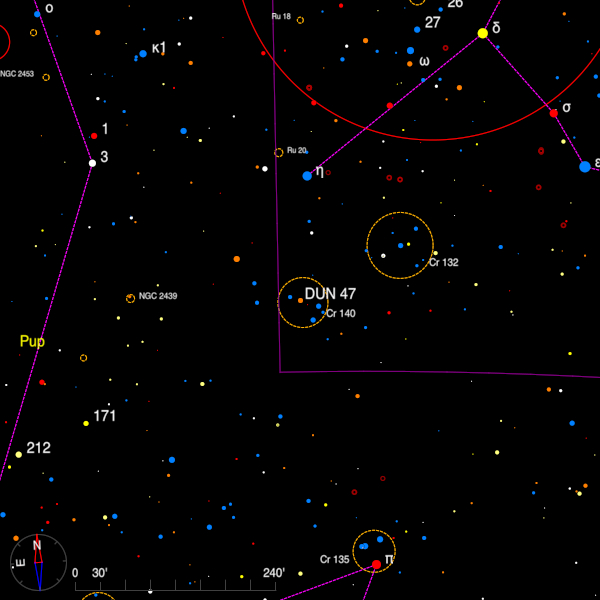
A finder chart for the double star double star DUN 47 created with Cartes du Ciel. The region was noted by James Dunlop at Paramatta when he saw a very wide and unequal pair of stars which he catalogued as DUN 47 (07 24 43.9 -31 48 32), and which is now given as AC in the WDS. These are 5.4 and 7.6 at 344 degrees and 97". A third star (B) was added by Bernhard Dawson observing with a 15-inch refractor at La Plata in Argentina. He noted a magnitude 9.7 just 2".2 from the primary and some years later Willem van den Bos added D, a magnitude 10.8 at 0".9 from C, a star which has not been measured since 1965.
Stars A and B have parallaxes close to 5.2 milli-arcseconds (630 light-years), whilst C and D are considerably more distant (mean parallax of 2.4 mas = 1360 light-years) and thus placing them at about the same distance as the nearby cluster Collinder 140. (This is a revised version - I'm grateful to John Greaves for pointing out an error in the original text).
Bob Argyle - Double Star Section Director
-
February 2014 - Double Star of the Month
STF 1126 (07 04 06.99 31 51.9) is easily to locate - it lies in the same low power field as Procyon, preceding the bright star. Since discovery by Herschel in 1781 the stars widened slightly but at the mid-point of the 19th century they slowly began to close. Motion is very slow and at present the companion can be found at 174° and 0".9. With magnitudes of 6.6 and 7.0 this is a relatively easy object for 20-cm although being fairly low in the sky it is not often seen to full advantage. Observations by the writer with the 20-cm at Cambridge were made in 1992, 2002 and 2012 and over that period the position angle increased by 10 degrees with no change in separation. Either A or B is a spectroscopic binary according to the WDS. A third star of magnitude 11.4 can be found at 251°, 43". The primary star is an AO giant, and the catalogue value for the parallax is given as 12.6 13.7 milliarcseconds.
STF1146 (07 47 56.71 -12 11 33.8) is also known as 5 Pup. It lies near the extreme northern border of Puppis about 3 degrees north following M46 and M47. During a winter evening of very good seeing in early January the writer made a rare foray around the stars of Puppis and saw this star well resolved with the 20-inch Thorrowgood OG. After discovery by F. G. W. Struve when separated by 3".3, the pair started to slowly close. In the 1960s Ernst Hartung noted that it was 'a fine object in a starry field and 75-mm shows it well. In recent years, however, it has been closing more quickly and now is separated by barely 1". This is a long period binary with a highly inclined orbit and the stars will reach a separation below 0".5 before widening again. Thomas Lewis gave the colours as yellowish and blue whilst Webb thought the fainter star to be ruddy in 1851. The primary star is a F5 dwarf, and this pair lies 93 light years away according to Hipparcos.
Bob Argyle - Double Star Section Director
