Double Star of the Month in Camelopardalis
-
December 2025 - Double Star of the Month
During the course of his long observing life, Thomas William Webb happened upon a number of wide double stars which were not included in the catalogues of the time. The Washington Double Star catalog (WDS) contains 10 pairs with the discoverer number WEB. One of these (WEB 2) lies in Camelopardalis at 03 42 42.73 +59 58 09.8.

A finder chart for the double star WEB 2 in Camelopardalis created with Cartes du Ciel. The primary star, which is a K4 giant, was catalogued by Piazzi in 1814 and is called P III 97. In fact, Piazzi did note the fainter companion to the north but did not measure it. Webb noted the companion star B on Mar 2, 1854. It is V = 8.5 whilst the primary is just above naked-eye visibility at V = 5.7. Both stars should be visible in a good pair of binoculars but a small telescope should show the distinct orange tinge of the primary and the bluish tinge of the secondary. Thomas Espin added three fainter companions. The components are currently at 36 degrees and 55". Both stars are 1790 light-years away.
Many of the bright pairs in the Dunlop catalogues are rather wide and any relative motion is in general very small. However a small number of pairs do show significant orbital motion including p Eri (Dun 5) and Dun 23 in Puppis. The latter binary can be found at 06 04 46.76 -48 27 30.2.
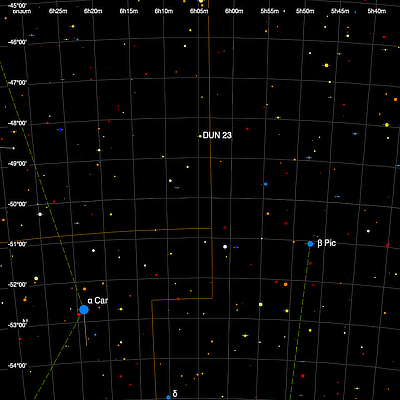
A finder chart for the double star DUN 23 in Puppis created with Cartes du Ciel. Since Dunlop found the pair in 1826 the companion has moved 160 degrees. A recent orbit gives a period of 553 years and the predicted position for the time of writing is 132 degrees and 2".5. With the star magnitudes of 7.3 and 7.7 this is a pair which should be well seen in 10-cm.
Radial velocity observations using the 2.5 metre reflector at CTIO in Chile by Andrei Tokovinin showed that A is a spectroscopic binary with a period of 2.51 days and the WDS notes that B may be a very close pair although the radial velocity showed very little variation. This system is 100 light-years distant.
Bob Argyle - Double Star Section Director
-
January 2018 - Double Star of the Month
7 Cam (04 57 17.2 +53 45 07.5) is a fairly unprepossessing system in the F G. W. Struve Dorpat catalogue and appears as number 610 in that list.
The stars are magnitudes 4.9 and 11.3 with the current position 242° and 26 arc-seconds, and there is no evidence that the stars are in anyway connected. It is 7 degrees north of Capella and about 4 degrees preceding, and is part of a group of 4th and 5th mag stars which also contain the splendid pairs 1 and 2 Cam.
In 1864, Baron Ercole Dembowski discovered that A was an unequal, close pair, the new component being magnitude 7.9 at 307° and 1".2. Since then the stars have closed in, but are now slowly widening, although by 2020 the separation will still only be 0".62 in PA 196°.
A recent orbit with a period of 2733 years has since been replaced in 2014 by a linear ephemeris by Drummond, although this has now, in turn, been updated by Hartkopf in 2017.
The two recent linear solutions give 315° 0".88 and 196° 0".62 respectively for epoch 2020 but it is difficult to understand why there is such confusion about the quadrant in which the companion is located as there is such a large difference in magnitude. Suffice to say it will take sustantial aperture to see Dembowksi's companion but visual observations will help to confirm which of the two predictions is right.
With Canis Major skimming along the southern horizon at present there is a brief window of opportunity to delve into its treasures.
Mu (μ) CMa (06 56 06.59 -14 02 34) is a pretty pair but rather close and unequal and tends to be more difficult than it really is due to its low altitude from the UK.
The stars are magnitudes 5.3 and 7.1 with a current separation of 3".1, showing a very slow closing since discovery almost 200 years ago. Struve gave colours of orange and reddish although the Washington Double Star Catalog (WDS) gives spectral types of G5III and A2.
By the way, don't forget to take a look at Sirius, just 3.5 degrees south-west of μ CMa - the companion is now fully 10 arc-seconds distant.
Bob Argyle - Double Star Section Director
-
December 2017 - Double Star of the Month
The two pairs selected for December are both wide, unequal double stars.
WEB 2 (03 42 42.73 +59 58 09.8) appears in the first edition of Celestial Objects for Common Telescopes. In it, Webb calls the primary star P III 97 and in examining Piazzi's Palermo Catalogue you will find that Piazzi did indeed record the primary star and also the secondary. He adds a note saying
another telescopic (star) follows to the north
, so this is, in fact, a discovery by Piazzi.Webb was almost certainly drawn towards this star because of his abiding interest in red stars. His notes say
orange with scarlet blaze and bl(ue).
for the colours of the components which is a good enough reason to observe this pair.The magnitudes are 5.7 and 8.9 and the current position of B is 33° and 54 arcseconds but there is no evidence that the stars are are in any other way connected. Espin added two fainter, closer stars in PA 33° and 98° and there is an 11.8 magnitude at 168 arcseconds along PA 162°.
WEB 2 is close to STF 385, STF 389, STF 396 and STF 400, 15 degrees due north of Mirfak (alpha Per).
H 3 80 (02 26 00.38 -15 20 28.0) is in Cetus in a fairly sparse area of sky about 12° south of Mira, 1.5 degrees preceding σ Ceti towards τ Ceti.
Herschel came across this pair on October 13th, 1782. He measured the distance as 11.2 arcseconds and the PA at 292°. There has been little change in either coordinate since then.
The stars are magnitudes 5.9 and 9.1 and the primary is a A star although William Herschel called it reddish white, whilst the companion appeared bluish-red to him.
The primary star (AB Ceti) is both a spectroscopic binary and a member of the Alpha2 CVn class of variables. These are main-sequence stars which display strong magnetic fields and whose spectra show abnormally strong lines of Si, Sr, Cr, and rare earths. They exhibit magnetic field and brightness changes and the amplitudes of the brightness changes are usually no greater than 0.1 magnitude in V.
Bob Argyle - Double Star Section Director
-
March 2016 - Double Star of the Month
STF 485/STF 484 (04 07 51.38 +62 19 45.4) are really just part of the open cluster NGC 1502 (H VII 47).
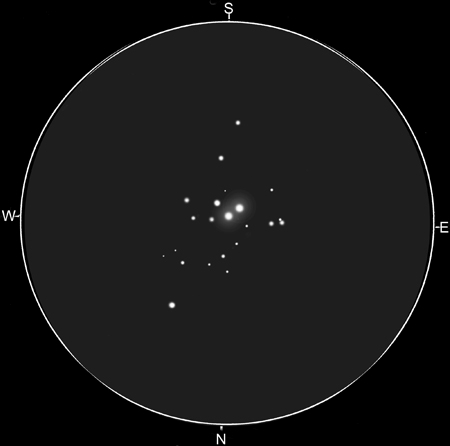
This sketch is reproduced courtesy of Matt Heijen who observed the area in December 2008 with his Orion Optics 30-cm telescope at x94 with a 52 arc minute field of view. For the small telescope user this is a pretty sight but its appears to be a real headache for the double star cataloguers and there is an extensive entry in the WDS catalogue notes trying to sort out which stars are which, and who discovered what.
The brightest pair is STF 485 AE which consists of stars of mags 6.91 and 6.94 separated by 17". There are a further 5 comites of magnitude 10 or brighter within 140" of star A. Two of these, mags 9.63 and 9.81, form STF 484 at 336° and 22".8 (visible on the drawing to the east of the cluster centre). Recently, Andrè Debackére measured a new component in one of the pairs in this group (see DSSC 24 on this website).
For the astrophysicist, the most interesting star is E. This turns out to be a multiple star consisting of a 2.69 day Algol system with a third star (but also a close binary) 0".1 distant circling the two every 54 years. The total mass in this system is more than 50 suns. The GCVS gives the name SZ Cam to the variable but ironically the distance derived from the dynamics of the 54-year system place the stars over 300 pc further than the accepted distance of 800 pcs to the cluster. There is little colour in this grouping as many of the components are hot early B stars.
15 Hya (08 51 34.44 -07 10 38.0) is an object which I have not yet observed but which in terms of separation and magnitude difference looks like a tempting target.
The star first entered the double star catalogues as H V 120 when William Herschel noted on 1782 Dec 28 that it appeared
Extremely unequal
with the brighter star white and the comes red whilst the separation was 43 arc seconds.The WDS gives magnitude 11.4 for the fainter star but relegates it to component C as in 1878 S. W. Burnham found that the primary was a close double (0".47) whose components he estimated had magnitudes 5.7 and 7.2. Since then the close pair has widened significantly and is now more than 1" apart so it should be visible in 15-cm in the UK; the seeing needs to be good as the declination counts against it.
Burnham adds a further faint star of mag 12.1 at 55". AB is clearly a long period binary and the position angle has decreased to 121 degrees in 2003 although there do not appear to have been any measures since then.
Bob Argyle - Double Star Section Director
We have had an observation submitted for STF 485. If you have observed this double star – or the cluster it is in – please let us know.
-
May 2015 - Double Star of the Month
STF 1694 (12 49 13.80 +83 24 46.3) is one of the most northerly of the bright double stars and lies in a rather sparse area of the sky. It is worth making the effort to find it as the planetary nebula IC 3568 lies 1.5 degrees south-west. Both stars are in the Hipparcos Catalogue and though the parallaxes seem significantly different (8.14 mas for A and 5.57 mas for B), the large error on that of B means that they are the same within the quoted uncertainties. However, B is a spectroscopic binary and this may well account for the Hipparcos satellite's problems with defining its distance accurately. The primary star (V = 5.3) is an A1 giant whilst the companion (V = 5.7) consists of a pair of A0 and A2 dwarfs. The current position angle and separation is 324° and 20".9, little changed from the epoch of discovery. The proper motion of RA of both stars is significant and similar so it would appear that this is a common-proper-motion pair. In 1944 Wallenquist found a third star of magnitude 11.5 at 223° and 73" but both these values are decreasing quite quickly. Sissy Haas calls the primary 32 Cam and notes that both stars are lucid-white.
4 Centauri (H N 51) is located at 13 53 12.54 -31 55 39.4. Also known as h Cen, this is one of the pairs found by William Herschel in his last concerted campaign of double star observation and was observed on 1787, Mar 15. It is in an arc of faint naked-eye stars some 5 degrees north-west of theta Centauri and is a splendid sight in a small aperture. The stars, magnitudes 4.7 and 8.5, were measured by the writer in 2013 and were found to be at 185 degrees and 14".8. Hartung notes that the colours are pale yellow and ashy, and that both stars are spectroscopic binaries. The primary star is a subgiant of spectral class B4 which Hipparcos puts at a distance of 637 light years.
Bob Argyle - Double Star Section Director
-
January 2014 - Double Star of the Month
The two stars to be highlighted this month are both systems of higher multiplicity although the closest visual components are at the limit of amateur instrumentation.
2 Cam (04 39 58.03 +53 28 23.7) is a Struve pair (No 566) which has somehow eluded me for more than 40 years. I first saw it in 2012 with the Cambridge 8-inch Cooke and the companion was quite well seen and measurable. Since it was first measured in 1828 at 312° and 1".5, the two stars have slowly closed and moved in a retrograde manner and last year I obtained 169.7° and 0".89. A preliminary orbit gives a period of 425 years for this unequal (5.6 and 7.5) pair of stars. In 1901, using the Yerkes 40-inch OG, Burnham noted that the primary was a close pair in itself with the new component (V = 7.4) being found at 317° and 0".2. This turned out to be a rapid binary and the currently accepted period is 26.89 years, whilst the separation of the stars never exceeds 0".3. Dembowski adds another pair in the field (D 4) and it can be found about 4 minutes preceding - mags 9.0, 10.3 and separation 5".8. Whilst in this area look at 1 Cam = STF 550, a fine bright pair.
eta Orionis (05 24 28.62 -02 23 49.7) This fine, bright pair of white stars is a good test for the 20-cm aperture. It was first resolved, when separated by 0".9, by W. R. Dawes who noted 'This close and beautiful object was discovered by me on Jan 15, 1848, with an aperture of only 4.25-in which I happened to be using on my 6.33-in refractor'. It is one of 13 pairs in the WDS under his discovery code. The current separation is around 1".8 and the stars have been slowly separating since discovery. Notwithstanding the fact that they are similarly hot, young and massive stars, the WDS notes that A and B form an optical system; the more distant mag 9.4 star at 114" is also believed to be unconnected with the bright stars. DA 5 was not known to Smyth but Webb notes colours of white and purplish (this may be the observation of Dawes) whilst others see only two white components. The A star is actually a massive triple system. Many years ago it was found to be an eclipsing spectroscopic binary of 7.88 days period with both stars possessing about 12 solar masses. More recently, speckle interferometer observations by H. A. McAlister and colleagues found a third companion with a period of 9.9 years, whose mass is about 1.5 solar.
Bob Argyle - Double Star Section Director
-
Double Star of the Month - January 2012
In this series of short articles, a double star in both the northern and southern hemispheres will be highlighted for observation with small telescopes, with new objects being selected for each month.
35 Cam (06 04 29.10 +51 34 24.2) was observed by Madler in 1843, and became number 128 in the Pulkovo Catalogue of Otto Struve, although it had been discovered by John Herschel in 1830. Later authorities including Aitken in the ADS added the word rejected because the separation was too wide for the pair to be a likely binary system. The rejected tag seems to have been removed in the current WDS but there is no evidence that the two bright stars are connected. The pair is a fine sight in a small telescope - the primary appears white and V = 6.4, whilst a V = 9.26 mag. bluish companion sits about 40 arc seconds away in PA 14°. For the user with say 30-cm there is the additional interest that the companion is a close pair - HU 559 which appears to be moving in retrograde binary motion - some 30 degrees since the discovery by Hussey in 1902. The WDS gives magnitudes of 9.6 and 10.6 and the current separation is 0".6 so this is as much of a test of the atmosphere as it is of the telescope.
The constellation of Columba lies to the south of Canis Major and a triple star worth seeking out is HJ 3858 (06 25 30.01 -35 03 50.5). It forms an isosceles triangle with kappa and delta Col and is exactly 5 degrees south of zeta CMa. This is both an easy binocular pair and a fine triple in the small telescope. The brightest stars have magnitudes 6.4 and 7.6 and are separated by 131" a distance which is slowly increasing. The primary star, of spectral type K3 appears deep yellow to Gould with 175-mm, whilst the companion appears white, reflecting its spectral type of A4. When John Herschel noted it on sweep 663 at Feldhausen, he described its three stars as 'Fine object. A star 6 mag precedes to the south'. The close pair (BC) is currently 3".8 apart and also slowly separating with little change in position angle, and the magnitude of C is 8.2.
Bob Argyle - Double Star Section Director
-
Double Star of the Month - January 2011
In this series of short articles, a double star in both the northern and southern hemispheres will be highlighted for observation with small telescopes, with new objects being selected for each month.
Rigel = beta Orionis (05 14 32.27 -08 12 05.9) is perhaps the most intrinsically luminous star in a double star system which can be seen in a small telescope. Whilst the measured luminosity of other bright stars such as Canopus have varied wildly over many years, the advent of the Hipparcos mission has been able to pin down the geometric distance to these objects much more accurately. The current trigonometric parallax for Rigel from Hipparcos is 3.78 milli-arcseconds with an uncertainty of about 10%. This translates to a luminosity of 48,000 times that of the Sun. The faint companion star whose estimated magnitude has also fluctuated over the years might be dominated by the light of the dazzling primary star 9 arc seconds distant but it is an equally interesting object in its own right. In 1871, Burnham, using his 6-inch Clark refractor, suspected an elongation of this star, and having then examined it with the 18.5-inch OG at Dearborn was convinced that there was a `real and measurable' elongation. Around 1900, Aitken, Hussey and Barnard using the 36-inch refractor at Lick all recorded separations in the 0.09 to 0.16 arc second range for BC. Occasional sightings have been reported since then, including as late as 2005 but no orbit exists and in fact the reality of the companion to B must still regard as unproven. Rigel B is known to be a spectroscopic binary but this cannot be BC. It needs a good night to see Rigel B clearly in the glare of the primary. The magnitude is near to 6.8 rather than the 10.4 first assigned to it by Burnham.
19 Cam (05 22 33.53 +79 13 52.1) is a mag 5.1 late F dwarf star some 68 light years distant. A companion star of mag. 9.2 was first noted, apparently by Piazzi, in the compilation of his Palermo catalogue and later catalogued by Struve as STF 634.This is a good example of an optical double. In 1825, South found star B at 346° and 37", by late 1926 it was at 62°, 9" and by 2008 it had reached 133°, 27". Both stars have significant proper motions (0.18 and 0.16 arc seconds per annum) but almost in opposite directions on the sky. This is an attractive pair for small telescopes although rather difficult to find being in a sparse area near the north celestial pole - the colours were given as light yellow and pale blue by Smyth.
Bob Argyle - Double Star Section Director
-
Double Star of the Month - February 2010
In this series of short articles, a double star in both the northern and southern hemispheres will be highlighted for observation with small telescopes, with new objects being selected for each month.
STF1127 (07 47 00.43 +64 03 07.3) is a coarse, relatively bright triple star in Camelopardalis about 90 arc minutes south of 51 Cam. The magnitudes are given in the WDS as 7.0, 8.5 and 9.7 about 0.5 mag fainter in each case than the corresponding figures in Celestial Objects for Common Telescopes. Webb notes the colours as very white, ash and orange but no other observers venture a colour estimate. The primary is A2V. Component B is 5".4 away in position angle 340 degrees almost unchanged since the early 19th century whilst C is 11".7 distant from A in PA 177. Between STF1127 and 51 Cam the neat pair STF1122 can be seen.
HJ 3928 (07 05 32.05 -34 46 40.1) The companion star was discovered in 1836 on sweep 809 of John Herschel's 20-foot reflector, along with two more distant, much fainter (10.8 and 13.5 mag) and probably unrelated stars. AB is a binary star with the position angle decreasing from 157 degrees at discovery to 145 degrees now and the separation closing from 4.0 to 2.7 arc seconds in the same interval. The magnitudes are 6.47 and 7.81 according to the WDS so the pair should be well seen in 100-mm. Star A is 175 light years away according to the revised Hipparcos catalogue.
Bob Argyle - Double Star Section Director


