Double Star of the Month in Sextans
-
April 2021 - Double Star of the Month
35 Sex (10 43 20.91 +04 44 51.6) lies south of the main body of the constellation of Leo and about 5 degrees SSE of the magnitude 3.9 star rho Leonis. It is a fine pair with the principal stars shining at magnitudes 6.2 and 7.1 and the current separation of 6".8 puts the pair within range of small apertures.
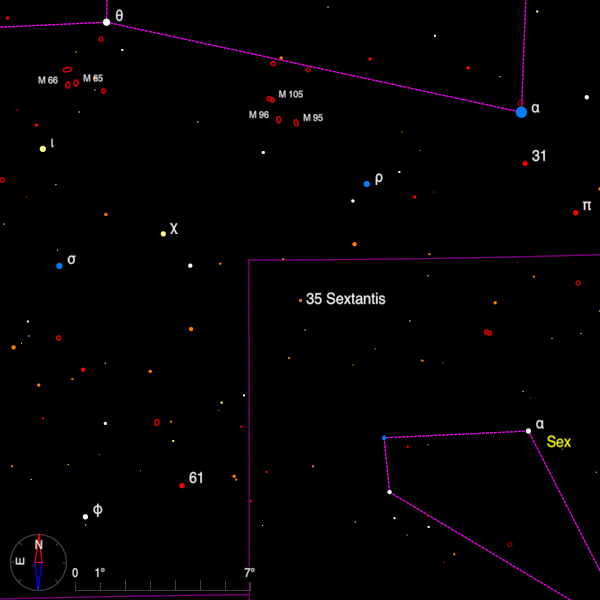
A finder chart for the double star 35 Sextantis in Sextans created with Cartes du Ciel. The angular motion in 2 centuries has amounted to about 2 degrees with the stars closing in very slowly. There seems to be no doubt that this is a binary pair - the Gaia EDR3 parallax data show that they are at 687 and 718 light-years respectively each with a formal error of about 22 light-years. Each star appears to be an early K giant which would imply that they should appear orange or deep yellow. Webb found colours of yellow and blue and later yellow and ruddy and noted that there was
Much difference as to colours
.Just over 5.5 arc-minutes away from AB in PA 210 degrees is a star of magnitude 8.1, which is the long period binary A 2769 - 8.4, 9.4, 207 degrees, 0".5.
Nestling within the bounds of the five main bright stars of Crux, CPO12 (12 28 16.88 -61 45 55.6) can be found 1.5 degrees N. of alpha Crucis (Acrux) and 20 arc-minutes east of the open cluster NGC 4349. The stars are V magnitudes 7.3 and 8.2 and with a current separation of 2".1 they can be easily seen in 75 to 100-mm aperture.
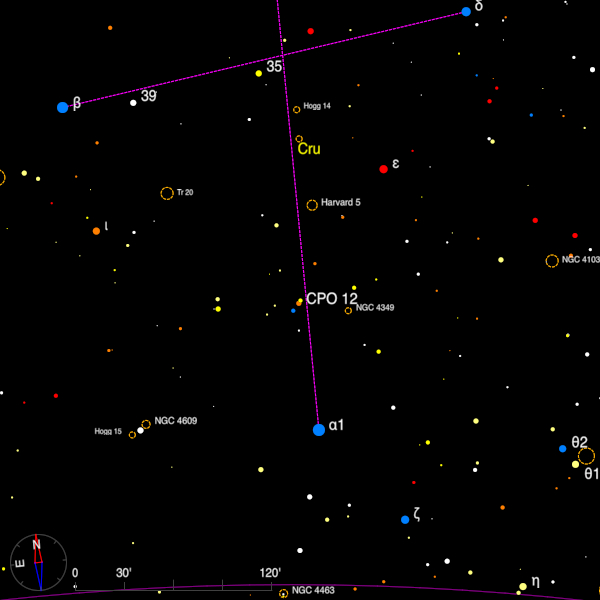
A finder chart for the double star CPO 12 in Crux created with Cartes du Ciel. Since the pair was discovered in 1880 the position angle has reduced from 271 degrees to 183 degrees and a preliminary orbit by Dr. Andrei Tokovinin suggests that the period is about 690 years. In 1939, Robert Rossiter, using the 27-inch refractor at Bloemfontein in South Africa, noted that the B star was a close double. The Washington Double Star Catalog (WDS) gives a magnitude of 8.8 for each component. This is also a binary system but the stars are about ten times closer than A-B. The period is 28 years and the stars are currently 0".18 apart. By 2030 they will have reached their maximum separation of 0".24. There is another, much fainter companion - a star of magnitude 13.7 at 331 degrees and 7".9.
Acrux, of course, is a magnificent pair - see the column for April 2007 for more details.
Bob Argyle - Double Star Section Director
-
March 2015 - Double Star of the Month
With Cancer now moving inexorably towards the western horizon, its stars are becoming more comfortably accessible to the classical refractor user and one of its finest doubles is 57 Cnc (08 54 14.70 +30 34 45.0).
According to Webb, it is a pair of crocus-yellow stars which are not quite equal in brightness (magnitudes 6.1 and 6.4). There has been little motion of any kind save a small increase in both position angle and separation with the result that the separation is now well over 1".
It is an ideal test for a 7.5-cm refractor. Webb was able to divide it at x144 on his 3.7-inch Tulley OG, and the writer found 1".55 with the Cambridge 8-inch in 2006.
The pair is almost certainly binary in nature as the proper motion of the system would have separated them a long time ago. A faint component can be found at 55" and PA 202° which appears fixed. The WDS gives its magnitude as 9.2.
57 Cnc is about 2.5 degrees north following the spectacular wide pair iota Cnc.
Gamma Sextantis, also called 8 Sextantis (09 53 30.47 -08 06 17.7) was discovered on 1852 Apr 7 by Alvan Clark with a 12-cm aperture. As it happens he observed the star at a suitable part of its orbit but this discovery is a good indication of the quality of Clark's telescopes.
He said, reporting his finds in Monthly Notices for 1857,
Notwthstanding the moderate meridional altitude of of 8 Sextantis at Dorpat (about 24°), it may reasonably be doubted whether its duplicity would have been left to be discovered with a 4 3/4-inch object-glass, however perfect, if no change had occurred in its appearance since Struve's scrutiny of that part of the heavens
.The separation of this close pair is never wider than 0".6. It reached maximum separation in its 77.8 year cycle in 2002 and is now closing again. By Spring 2015 it will be at 44°, 0".54 and the low declination means that it will be a significant test for 20-cm and its more likely that a good, steady air will be essential to resolve it, especially as there is a considerable difference in brightness between the components - A is 5.4 and B is 6.4. Hipparcos places the system at 278 light years distance and the primary is an A1 dwarf.
To find gamma Sextantis, locate alpha Hya and move 5 degrees east.
Bob Argyle - Double Star Section Director
