Double Star of the Month in Perseus
-
December 2020 - Double Star of the Month
About 5 degrees due south of alpha Persei (Mirfak) is the rather faint pair STF 391 (03 29 13.74 +45 02 57.5). The Washington Double Star (WDS) catalogue gives the magnitudes as 7.6 and 8.3 and the stars are currently 3".9, a value that has remained unchanged for 200 years or so.
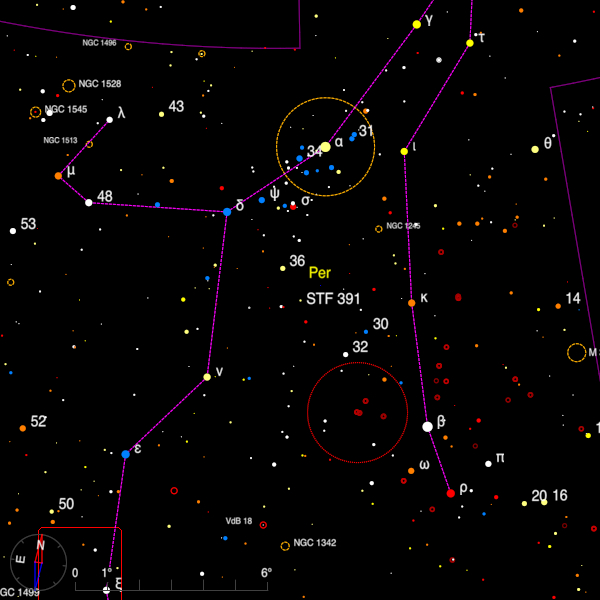
A finder chart for the double star STF 391 in Perseus created with Cartes du Ciel. The primary is a B1 dwarf and its companion a giant star of spectral type G8. The colours of the stars might therefore be expected to be white and yellow. Sissy Haas in her book 'Double stars for small telescopes' gives the colours as white and red, as observed in her 60-mm refractor. On the other hand, when I observed them with a 21-cm reflector some years ago, I noted that there was a superb contrast of yellow and blue. I have not yet observed the stars in the Cambridge 8-inch refractor but will try to do so at an early opportunity.
The Gaia satellite provides a distance of about 3,100 light-years for each component with an error of about 150 light-years in each case. Whilst in the area check out S 430 (03 38 18.53 +44 48 06.5), approximately 2 degrees east and slightly south, a fine pair - 7.2, 7.5, 96 degrees, 41".
In the far south-eastern and rather sparse corner of Hydrus near the border with Octans is HJ 3568 (03 07 32.13 -78 59 21.3). This is one of John Herschel's Cape discoveries. The primary is a naked-eye star (+5.7) whilst some 15" distant is a magnitude 7.7 companion. In addition, A is also a spectroscopic binary and a delta Scuti variable, known as BN Hyi.
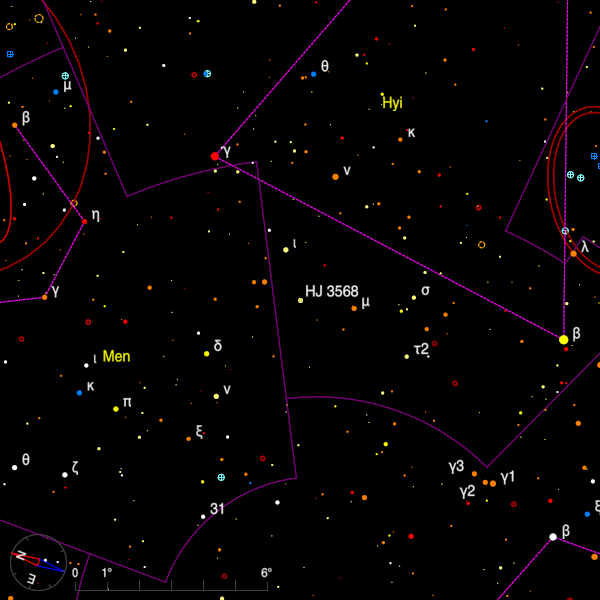
A finder chart for the double star HJ 3568 in Hydrus created with Cartes du Ciel. The stars are equally distant (263 light-years) according to Gaia DR2 and both are moving through space in the same direction and at similar velocity but there has been little change in the relative motion of the stars since the 1830s giving no clue as to the orbital period. Ernst Hartung notes that this is a
fine, unequal pair yellow and bluish-white
.Bob Argyle - Double Star Section Director
-
Double Star of the Month - November 2012
In this series of short articles, a double star in both the northern and southern hemispheres will be highlighted for observation with small telescopes, with new objects being selected for each month.
STF 162 (01 49 15.54 +47 53 49.0) sits in an obscure corner of Perseus about 6 degrees north and 2 degrees preceding gamma And. It is also about 1.5 degrees south following 51 And. It is a multiple star, four components of which can be seen in 7.5-cm. The closer pair, which consists of components of magnitudes 6.5 and 7.2, was found by Struve in 1828 when the separation was 2".2 and the position angle 227 degrees. At the current epoch these have both decreased to 1".9 and 298 degrees. A third star which remains fixed with respect to A can be found 20" away almost due south, and another at mag 10.1 is 139" distant. The WDS reveals that either A or B is itself an interferometric binary with a separation less than 0".2 and B is also a spectroscopic binary.
Epsilon Sculptoris (01 45 38.65 -25 03 08.8) is a fine pair located in the extreme north-east corner of Sculptor and which can be seen from the UK but which first caught the attention of John Herschel at Feldhausen when he noted 'large * w(hite) small star dull red' an gave the magnitudes as 6 and 10(modern values 5.4 and 8.5). Since then the companion has moved slowly retrograde from the discovery position of 72 degrees to its current value of 20 degrees. In 1969 de Freitas Mourao looked at the observations and decided that they could be fitted by a face-on circular orbit with a separation fixed at 4".65 and a period of almost 1200 years. In recent years, however, the companion has begun to stray ever further from the primary and the separation is now over 5". More observations are needed but the real orbit will not be obvious any time soon, and in fact the apparent motion to date looks more linear than curved. However, epsilon Scl is relatively nearby (92 light years) and the annual proper motion of 0".16 would take it almost 30" from B since discovery if the latter was optical. Hartung called it an easy, bright yellow pair whilst Gould with 175-mm called the primary pale yellow.
Bob Argyle - Double Star Section Director
-
Double Star of the Month - December 2008
In this series of short articles, a double star in both the northern and southern hemispheres will be highlighted for observation with small telescopes, with new objects being selected for each month.
zeta Per = STF 464 (03 54 07.92 +31 53 01.2) is a rare animal - a supergiant in a visual binary system. The star was thought to be a member of the Perseus OB2 association but the recently revised Hipparcos parallax puts it around 230 parsecs away, significantly closer than the association. The WDS notes 3 other companions two of which appear by dint of differing proper motions, to be optical but Kaler thinks that both B and E are physical stars. The early type of the primary (B1Ib) and star B (B8V) result in the system appearing white to the small telescope user but Smyth says `flushed white and small blue' whilst Webb says `green white and ash' and Haas has `banana-yellow and blue'. The position of B has changed little since it was measured by Struve in 1824 and is currently near 209 degrees and 12".9. The magnitudes of A and B are 2.85 and 9.16 making it not particularly easy for a small aperture. The WDS notes that A is a spectroscopic binary but no orbit appears to have been calculated for it and a paper in 2003 shows no variation in radial velocity. Both stars appear white to the writer.
f Eri = Dun 16 (03 48 35.82 -37 37 12.5) `Superb double star but ill defined' wrote John Herschel in 1847 commenting on his observations made 11 years earlier. Hartung gives both stars as pale yellow whilst the WDS spectral types of B9V and A1V seem at odds with this assessment. The stars are magnitudes 4.72 and 5.25 and the separation has increased from 7".0 in 1826 to 8".4 in 2002 with the angle increasing from 202 to 218 degrees in the same period. This system is some 185 light years distant and the proper motion is sufficiently large that over 200 years the stars would have separated by about 15 arc seconds if they were not binary in nature. `Showcase pair' says Sissie Haas in her book.
Bob Argyle - Double Star Section Director
-
Double Star of the Month - December 2007
In this series of short articles, a double star in both the northern and southern hemispheres will be highlighted for observation with small telescopes, with new objects being selected for each month.
Epsilon Per (03 57 51.2 +40 00 36) With the newly invigorated Comet Holmes causing a stir in observational circles, this month's northern double star is in Perseus where the comet has spent much of the last few months. Epsilon is located in the east of the constellation about 15 degrees following Algol. Coincidentally, its primary star - a hot B dwarf is also an eclipsing system in the Algol class. Almost due north, about 9 arc seconds distant is the companion, an A2 dwarf and so it might be expected that both stars would appear white in a small telescope. Hartung, however, notes star B to be slate gray whilst Smyth in 'Celestial Cycle' records that it is lilac. The latter also informs the reader that John Herschel suggested putting a piece of paper at the centre of the objective, (Smyth used a 2-inch stop on his 5.9-inch refractor), in order better to see the faint companion which is 6 magnitudes fainter than A. This is a relatively distant system - the revised Hipparcos catalogue, produced recently by Dr. Floor van Leeuwen gives a parallax of 5.12 +/- 0.22 mas corresponding to 630 light years.
Jc 8 (03 12 25.7 -44 25 11) In 1835 John Herschel found a close double star at this position and gave it his catalogue number 3556. He had trouble in making out that it was wedge-shaped and estimated the position as 230 degrees+/- and 1.5 arc seconds. In March 1856 Captain W. S. Jacob in Madras, whilst making measures of southern pairs with his 6.3-inch refractor made by Lerebours and Secretan, suspected the A component of being double in the S direction. This has turned out to be a rapid visual binary with a period of 45.2 years with the separation varying from 0.04 to 0.75 arc seconds. Currently the separation of AB is 0".70 and the pair is beginning to close again, whilst that of AB-C has widened to 3".7 making the whole group an attractive sight in a 20-cm telescope or bigger.
Bob Argyle - Double Star Section Director
