Double Star of the Month in Libra
-
June 2024 - Double Star of the Month
STF 1984 (15 51 10.09 +52 54 25) lies in south-eastern Draco almost on the border with Boötes in a rather featureless part of the sky, which may be why I have no record of observing this pair during my early visual survey.
I did make a measure with the 8-inch Cambridge Cooke telescope giving 279 degrees, 6".4 in late 2009. An aperture of 10-cm should show the two stars which form this system - the magnitudes are 6.9 and 8.9.
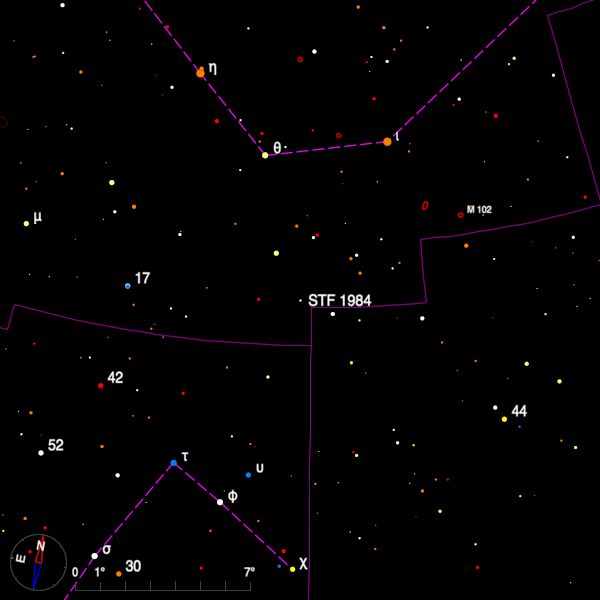
A finder chart for the double star STF 1984 in Draco created with Cartes du Ciel. Although Gaia DR3 places the stars at similar distances (around 370 light-years), the formal errors on the parallaxes are significantly smaller than the parallax difference between the components, so whether the stars form a binary system is open to some doubt.
In May 1874 S. W. Burnham was observing stars in Scorpius with his 6-inch Alvan Clark refractor and more specifically he was looking for HJ 4756 - a close pair discovered by John Herschel some 40 years earlier. He found a pair which vaguely resembled the HJ pair but its position did not correspond very well to the catalogue position so Burnham called the pair BU 228. He later realized that this was indeed the Herschel pair HJ 4756 (15 19 40.37 -24 16 11.9).

A finder chart for the double star HJ 4756 in Libra created with Cartes du Ciel. The stars are magnitudes 7.9 and 8.3 and are currently slowing closing in a 500-year orbit. The current position is 229 degrees and 0".65 so a 25-cm telescope will be needed and more importantly, if observing from Europe, a night of high quality.
Some 30 seconds of RA directly preceding is BU 227, an easier pair which drew from Burnham the comment that
It is singular that he (Herschel) should have missed the other pair
i.e. this one. The stars have magnitudes 7.5 and 8.6 and are currently 2 arc-seconds apart in PA 160 degrees, so should be divisible in 10—15 cm. The stars can be found 3 degrees ENE of sigma Lib.Bob Argyle - Double Star Section Director
-
May 2024 - Double Star of the Month
STF 1834 (14 20 17,6 +48 30 25.1) sits in the north of Boötes, about half way between theta and lambda Boo and 2.5 degrees north north-east of the latter.
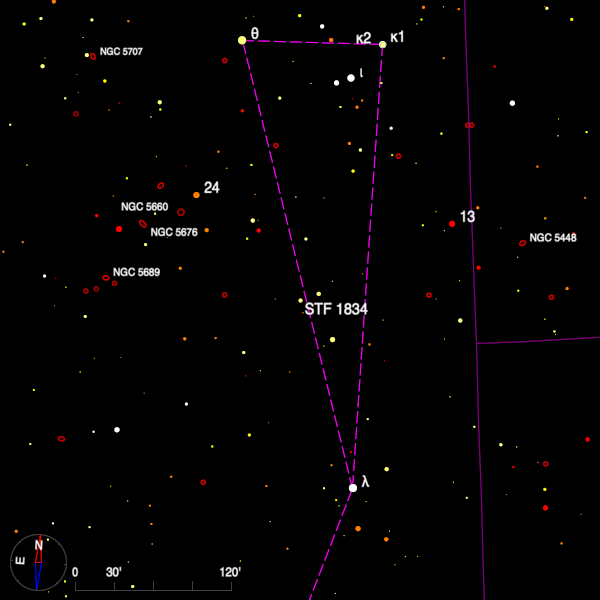
A finder chart for the double star STF 1834 in Boötes created with Cartes du Ciel. It is a well-known binary and the Washington Double Star catalog (WDS) notes than 250 direct measurements have been since discovery by Struve at Pulkova. From about 1830 to 1900 the two stars, magnitudes 8.1 and 8.3, closed steadily from 1".7 but then in just a few years the companion swung around its partner at which point it was out of range of even the large refractors of the time and began heading out towards the discovery position.
The period of the pair is 413 years and at the present time the position angle and separation are 204 degrees and 1".7. The relative faintness of the stars would suggest that an aperture of 15-cm would be better to view them.
About 1 degree south-east is STF 1843, a pair of stars of magnitude 7.7 and 9.2 currently at 186 degrees and 19".8. The stars lie at a similar distance and have common proper motion.
Near the border of Libra with Lupus, HJ 4774 (15 28 58.69 -28 52 00.5) was discovered by John Herschel from Feldhausen during his stay at the Cape of Good Hope. The brightest star is magnitude 7.0 and has a 9.6 magnitude companion almost 10 arc-seconds distance in PA 11 degrees.
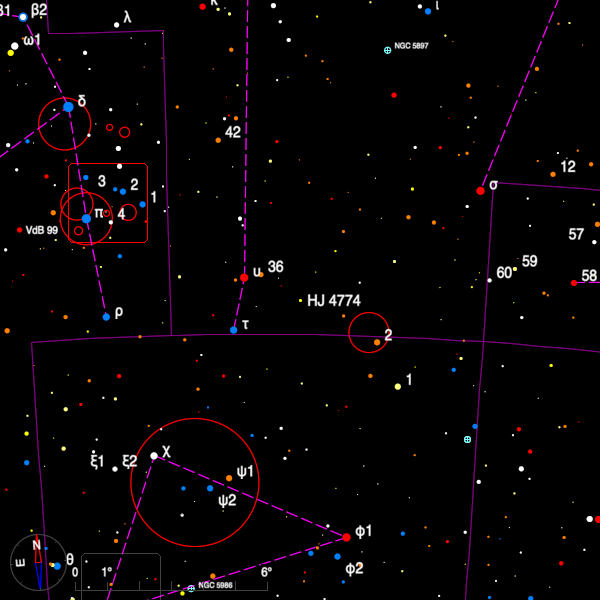
A finder chart for the double star HJ 4774 in Libra created with Cartes du Ciel. In 1889 the eagle-eyed S. W. Burnham found that the primary star was double again with a 7.7 magnitude star at a distance of 0".7. Since then the separation of the close pair has closed to 0".1. A recent orbit by Dr. Andrei Tokovinin indicates that the orbit is only 0.6 degrees from being edge-on and in 2027 when periastron occurs the two stars will be only 8 milliarcseconds apart.
Bob Argyle - Double Star Section Director
-
April 2024 - Double Star of the Month
STF 1645 (12 28 04.45 +44 47 39.5) is a fine pair in Canes Venatici found 3.5 degrees WNW of beta CVn (chara) and also 3/4 degrees north of the galaxy NGC 4449.
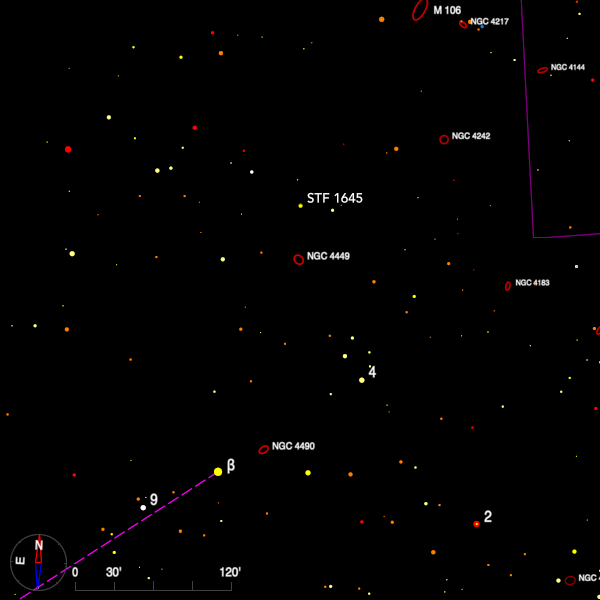
A finder chart for the double star STF 1645 in Canes Venatici created with Cartes du Ciel. T. W. Webb, in Celestial Objects for Common Telescopes reports an observation by Bird, a Victorian amateur astronomer, as
a lovely pair as I ever saw
. Webb also calls them yellow which chimes with the spectral types of F9V and KV given in the Washington Double Star catalog (WDS). In 1972 using a 10-in (25-cm) Newtonian I made the colours yellow and blue, whilst Sissy Haas using a 60-mm refractor finds both are peach-white.The stars have visual magnitudes of 7.5 and 8.1 and they are currently at 156 degrees and 9".8, but the stars were 16" apart when found by William Herschel in 1791. Nevertheless they both appear to be 147.7 light-years from the Earth and are moving almost directly south on the celestial sphere at the rate of 0".2 per year.
Two degrees north of iota Librae is a coarse triangle of stars. The most north-westerly of this trio is SHJ 195 (15 14 28.13 -18 25 42.7) which again, despite the catalogue name, was discovered by William Herschel.
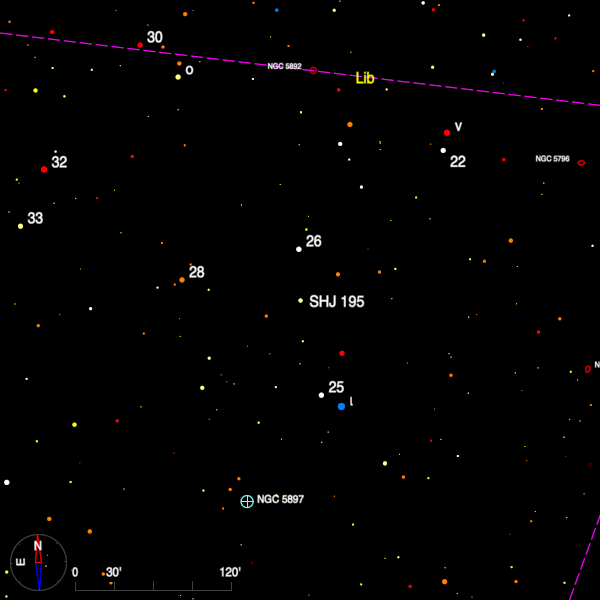
A finder chart for the double star SHJ 195 in Libra created with Cartes du Ciel. Again this is a pair of F5 stars whose visual magnitudes are given as 7.5 and 8.1 in the WDS, which Admiral Smyth described as white and bluish. Although low in the Cambridge sky, I made a pair of measures in 2009 with the result 140.3 degrees, 45".59.
Gaia EDR3 records parallaxes that are the same within the quoted errors, although the error of the bright star's parallax is some ten times larger than the typical value for that magnitude. The proper motions are also very similar - the stars are moving at 0".1 per year.
Bob Argyle - Double Star Section Director
-
June 2023 - Double Star of the Month
HU 149 (15 24 35.30 +54 12 46.1) is from the catalogue of William J. Hussey, a well-known observer and discoverer of visual double stars who worked in the USA and who was a leading instigator of the Lamont-Hussey Observatory which was set up in Bloemfontein, South Africa and equipped with a 27-inch refractor with which R. A. Rossiter spent a lifetime on his own catalogue of discoveries.
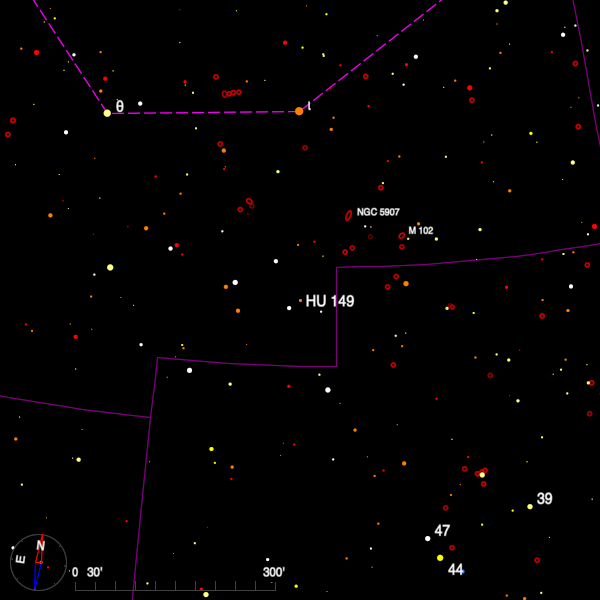
A finder chart for the double star HU 149 in Draco created with Cartes du Ciel. Many of the Hussey pairs tend to be close and difficult and HU 149 was only 0".2 apart when found in 1900, but it has since widened and according to the 770 year orbit of Zirm (2015), the stars should now be about 0".65 apart. A recent measurement by Andreas Alzner with a 32-cm Cassegrain confirms that the separation is close to 0".7. The pair has just passed one of the maximum separations in the apparent orbit and will now close to 0".1 by the 2180s. The stars are almost equally bright at V = 7.5 and 7.6 respectively.
The name Jerome de Lalande appears in the Washington Double Star catalog (WDS) although just 4 pairs appear under his discovery prefix (LAL) - numbers 53, 123, 192 and 193. All are worth looking out for and this month I have chosen LAL 123 (15 33 09.52 -24 29 15.9) which sits roughly half-way between the three bright stars in the head of the Scorpion and sigma Librae.
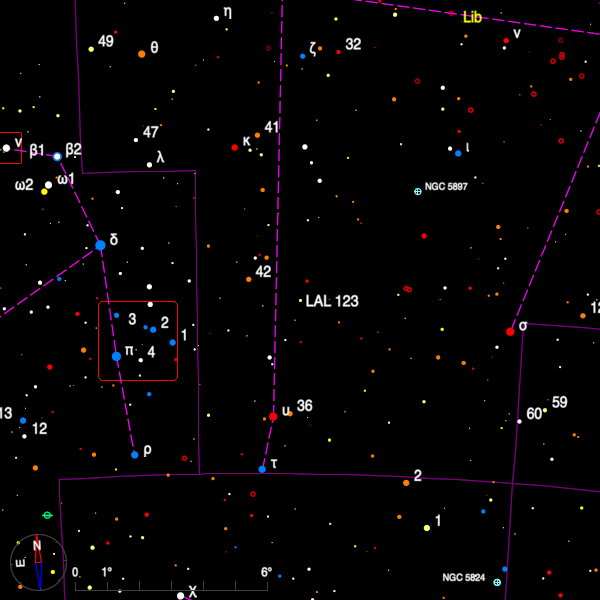
A finder chart for the double star LAL 123 in Libra created with Cartes du Ciel. The stars are magnitudes 6.9 and 7.0 and were 9".3 apart in 2016 at PA 302 degrees. This is an easy object for 10-cm but the possessors of larger telescopes may like to examine the B star more closely. This was found to be double by T.J.J. See and has turned out to be a binary of 61 year period. The pair passes widest separation the next few years and at the moment the stars are just 0".33 apart - calling for at least 40-cm to resolve - and they have visual magnitudes of 7.0 and 8.2.
The A component is an even closer pair and was found by speckle interferometry. CHR 232, at 0".1 and a period of 16.47 years, is beyond all but the largest apertures especially as there is almost a two magnitude difference in the brightness of the components.
Bob Argyle - Double Star Section Director
-
May 2022 - Double Star of the Month
In the second edition of the Cambridge Double Star Atlas, SHJ 191 (14 59 34.58 +53 51 36.7) is the most northerly labelled double star in the constellation of Boötes and lies just over a degree south of the border with Ursa Major.
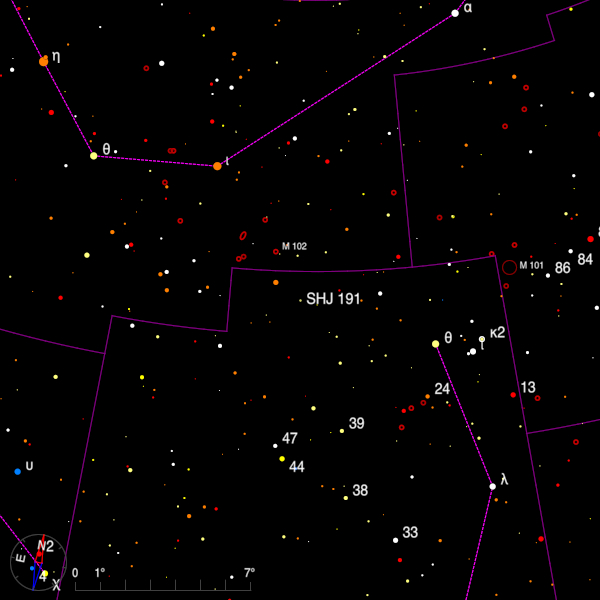
A finder chart for the double star SHJ 191 in Boötes created with Cartes du Ciel. It was measured by Sir James South on 1823, April 27 and again on May 3 of that year using his 5-foot equatorial and he found the mean separation to be 40".85 (the text in the catalogue gives 48".85) and the mean position angle 343° 10'. These values are little changed today and whilst the proper motions determined by Gaia in the EDR3 catalogue are similar, the parallaxes appear to be significantly different, with 9.590 ± 0.122 mas for the A component and 8.875 ± 0.015 mas for B. The large error for A may indicate additional structure.
The Washington Double Star Catalog (WDS) gives magnitudes of 6.9 and 7.6 for A and B and both stars are F1 dwarfs. An interesting feature in the finder chart plotted using SIMBAD is the presence of a nearby pair of faint red stars and which are described at greater length in the upcoming Double Star Section Circular (DSSC) Number 30.
One of S. W. Burnham's more attractive pairs for the small telescope is mu Lib - also known as BU 106 (14 49 19.09 -14 08 56.3). It is easy to find sitting just 2 degrees north and slightly west of Zubenelgenubi, or alpha Cap, which is, in turn, a fine very wide pair, the stars being 376" apart.
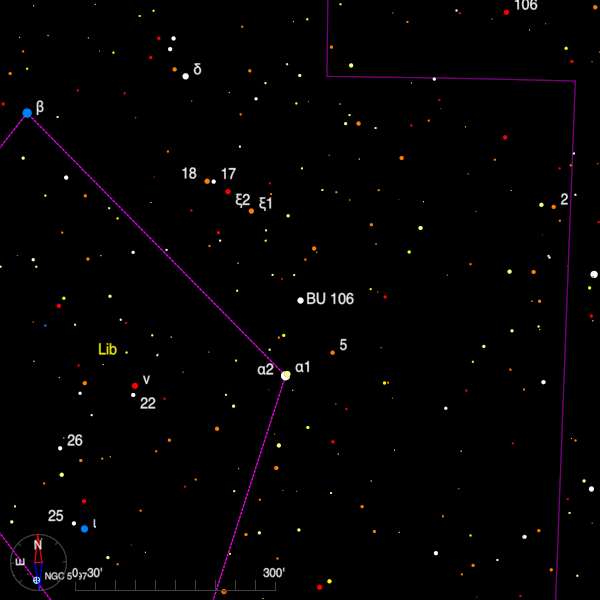
A finder chart for the double star BU 106 in Libra created with Cartes du Ciel. Mu Lib was discovered by Burnham with his 6-inch Clark in 1873 when the stars were separated by 1".3, and since then they have slowly separated (currently 1".9) with a change in position angle of just 27 degrees, even so an orbit exists for the system with a period of 614 years. A and B have V magnitudes 5.6 and 6.2 and whilst the A component does not appear in EDR3 the B star has a measured distance of 245 light-years. A magnitude 12.6 star lying at PA 232 degrees and 27" from A has the same parallax and would appear to be physically connected to the binary pair.
Bob Argyle - Double Star Section Director
-
Double Star of the Month - June 2010
In this series of short articles, a double star in both the northern and southern hemispheres will be highlighted for observation with small telescopes, with new objects being selected for each month.
To the small telescope user STF1964 (15 38 12.96 +36 14 48.3) is a pair of 7.9 and mag 8.0 white stars separated by about 14". Readers of Celestial Objects for Common Telescopes will note that the stars are given as mags 6.8 and 7.3, a considerable difference to the quoted WDS magnitudes above. STF1964 lies about half a degree south preceding zeta CrB, a much brighter and somewhat closer pair. STF1964 is, however, not without its attractions. Each of the two stars is a visual double - the fainter component actually known as C was found by Struve and the writer managed to measure this 1".4 pair last year. The brighter star A (=HU 1167) is somewhat closer but the companion (B) is fainter and this system is a challenge to those with 25 to 30-cm of aperture. In 1970, professional observer Richard Walker of USNO reported that star A had another closer companion at a distance of 0".1 but there has not yet been confirmation of this star.
HN 28 (14 57 27.99 -21 24 55.8) is also known as Hh457 in Webb. Star A is number 570 in the Gliese Catalogue of Nearby Stars. It is 19.1 light years distant and with both stars moving through space at more than 2" per year, it is a physical system. In 1806 Piazzi measured both stars and at that time the position was 251 degs and 9".4. In 2009, the writer found 306 degrees and 25".3. The stars are 5.8 and 8.2 and offer a fine colour contrast. Star A is spectral type K5V and orange in colour whilst B is type M2V and red, the colours being noted by Hartung. Sissy Haas calls it 33 Lib and notes that Smyth made it ``straw coloured and orpiment yellow". The USNO 6th orbit catalogue includes it with a period of 2130 years. In 1990 B was found to be a close binary with a period of 308 days and a separation of 0".2. To the small telescope user there are a number of fainter companions ranging from mag 9.5 to 13 or so all of which are being left behind by the principal stars.
Bob Argyle - Double Star Section Director
-
Double Star of the Month - June 2009
In this series of short articles, a double star in both the northern and southern hemispheres will be highlighted for observation with small telescopes, with new objects being selected for each month.
The two pairs in this month's column are similar in that they contain stars of spectral type A but there the similarity ends. Zeta Boötis is a close, bright binary and SHJ 179 is much fainter and considerably wider.
zeta Boötis (14 41 08.92 +13 43 42.0) is a white mag. 3.7 star south following Arcturus by about 8 degrees. Its binary nature was discovered by William Herschel on 1796, Apr 5 when he said that the pair was `very nearly in contact; I can, however, see a small division'. He had previously seen a mag. 11 optical companion in 1782 which became H VI 104. The proper motion of AB is taking it away from C and the distance has increased from 99 to 103 arc seconds over the last century or so.
The main pair is a bright, equal binary of high inclination and extreme eccentricity - in fact it appears to be the current record holder, surpassing even the value for 41 Dra (see Astronomy Now for June 2009). Having spent most of the last half century near PA 310 degrees and separation 1", it is now noticeably closing and the writer found it separated by 0".6 last Spring. If the 122.98 year orbit by Andreas Alzner is correct it will pass 0".5 in 2011 and then dip below 0".01 in the summer of 2021 when the angular motion will be 10 degrees per DAY. From there it will rapidly return to the 4th quadrant again the following year. The stars are both A0 dwarfs and the revised Hipparcos parallax is 19.00 mas.
SHJ 179 (14 25 29.91 -19 58 11.8) First measured in 1798 and placed in the catalogue of stars found by James South and John Herschel, this attractive wide pair of magnitude 6.6 and 7.2 stars makes an excellent target for the small telescope. Sissy Haas marks them as reddish white whilst Hartung from Australia notes them as pale yellow. They are low in the sky for the northern observer so this may explain the reddish tinge, as the WDS gives the spectral types as A2V and A4V. The proper motion of A seems to be shared by B and the relative position has changed little in the last 200 years, the current values being 205 degrees and 34.7. These are distant stars, the parallax of A placing it about 457 light years away.
In 1867 Burnham using his 6-inch Clark refractor found that B was double again and in the intervening period, the companion has moved about 15 degrees in a retrograde direction, remaining close to the discovery separation of 1".2. This pair is BU 225 BC in the WDS but also bears the appellation HDO 138 indicating that it was found later from Peru by the Harvard observers at Arequipa but who were unaware of Burnham's observation. The difference in magnitude is about 1.7 so this pair requires at least 100-mm of aperture to see well.
Bob Argyle - Double Star Section Director
